
Costar conjugation in Spanish: every tense you need, with examples
Costar means “to cost”, and it’s a regular o→ue stem-changing verb, the same pattern as contar or mostrar. The grammar isn’t the trap here — the usage is. Because the subject of costar is almost always a price or an idea, not a person, the yo, tú, nosotros and vosotros forms barely exist outside a grammar table. This page gives you every form, marks which ones people actually say, and covers me cuesta, the idiom that makes this verb worth learning well. 1on1Spanish teaches this in 25-minute one-on-one lessons with qualified native teachers, online across the United States.
Reviewed by María Jiménez — Licenciada en Filología Hispánica (BA in Hispanic Philology) · Updated Sep 2026
What costar means
Costar is “to cost”, in the plain financial sense: el vuelo cuesta más en diciembre. It’s also how Spanish talks about effort: costar plus an infinitive means something is hard for someone to do. Me cuesta levantarme temprano — getting up early is hard for me — is one of the most useful idioms in the language, and it has no literal English translation.
Grammatically it’s stem-changing (o→ue), in the same family as contar, mostrar and recordar. Every form of the six-person paradigm below is grammatically correct. In real Spanish, almost nobody uses yo cuesto or tú cuestas — a thing costs money, or an action costs you effort, so the subject is nearly always él/ella/usted (it) or ellos/ellas (they), singular or plural depending on what’s being priced. The tables are complete because that’s what a reference page owes you, but the note stands: cuesta and cuestan carry almost all the real-world weight of this verb.
Costar conjugation: present tense
Stem change in every form except nosotros and vosotros — but only the third-person forms are common in everyday speech.
| Form | Example | |
|---|---|---|
| yo | cuesto | (grammatically correct, but people don’t really say this) |
| tú | cuestas | (grammatically correct, but people don’t really say this) |
| él / ella / usted | cuesta | Este colchón cuesta ochocientos dólares. (This mattress costs eight hundred dollars.) |
| nosotros | costamos | (grammatically correct, but people don’t really say this) |
| vosotros | costáis | (grammatically correct, but people don’t really say this) |
| ellos / ellas / ustedes | cuestan | Los boletos cuestan menos entre semana. (Tickets cost less on weekdays.) |
Costar conjugation: preterite
No stem change in the preterite of any -ar stem-changing verb, costar included.
| Form | |
|---|---|
| yo | costé |
| tú | costaste |
| él / ella / usted | costó |
| nosotros | costamos |
| vosotros | costasteis |
| ellos / ellas / ustedes | costaron |
El seguro me costó más de lo que esperaba. — The insurance cost me more than I expected. Only costó and costaron are common in real speech, for the same reason as the present tense.
Costar conjugation: imperfect
Fully regular.
| Form | |
|---|---|
| yo | costaba |
| tú | costabas |
| él / ella / usted | costaba |
| nosotros | costábamos |
| vosotros | costabais |
| ellos / ellas / ustedes | costaban |
Antes, la gasolina costaba mucho menos. — Gas used to cost a lot less.
Costar conjugation: future
Regular endings on the infinitive.
| Form | |
|---|---|
| yo | costaré |
| tú | costarás |
| él / ella / usted | costará |
| nosotros | costaremos |
| vosotros | costaréis |
| ellos / ellas / ustedes | costarán |
La reparación costará unos doscientos dólares. — The repair will cost around two hundred dollars.
Costar conjugation: conditional
| Form | |
|---|---|
| yo | costaría |
| tú | costarías |
| él / ella / usted | costaría |
| nosotros | costaríamos |
| vosotros | costaríais |
| ellos / ellas / ustedes | costarían |
Sin descuento, costaría el doble. — Without the discount, it would cost double.
Costar conjugation: present subjunctive
Stem change in the stressed forms, just like the indicative present.
| Form | |
|---|---|
| yo | cueste |
| tú | cuestes |
| él / ella / usted | cueste |
| nosotros | costemos |
| vosotros | costéis |
| ellos / ellas / ustedes | cuesten |
Lo voy a arreglar, cueste lo que cueste. — I’m going to fix it, whatever it costs. This is the one place the subjunctive of costar shows up constantly, in a fixed phrase every learner should know.
Costar conjugation: imperfect subjunctive
Built on the regular preterite stem, no stem change.
| Form (-ra) | Form (-se) | |
|---|---|---|
| yo | costara | costase |
| tú | costaras | costases |
| él / ella / usted | costara | costase |
| nosotros | costáramos | costásemos |
| vosotros | costarais | costaseis |
| ellos / ellas / ustedes | costaran | costasen |
Si costara menos, lo compraría hoy mismo. — If it cost less, I’d buy it today.
Costar commands (imperative)
Grammatically complete, but this is the least useful table on the page: a price can’t obey an order. It’s here for reference only.
| Affirmative | Negative | |
|---|---|---|
| tú | cuesta | no cuestes |
| usted | cueste | no cueste |
| nosotros | costemos | no costemos |
| vosotros | costad | no costéis |
| ustedes | cuesten | no cuesten |
Participle, gerund and compound tenses
Participle costado, gerund costando. Both regular, and costado shows up in a genuinely common phrase: me ha costado mucho terminar el proyecto — it’s taken me a lot to finish the project. Compounds take haber:
Este trámite me ha costado semanas de espera (present perfect) · Ya nos había costado tres citas conseguir la cita (past perfect) · Para entonces, habrá costado el doble (future perfect).
When to use costar
The price of something
¿Cuánto cuesta esto? The most direct use, and the one every learner meets first, usually at a store or a restaurant.
Difficulty accepting or processing something emotional
Le costó mucho aceptar la noticia. Same structure, applied to feelings rather than tasks — common in conversations about family, health or loss.
Common mistakes English speakers make with costar
Costar is what a thing costs a buyer, not what a person charges for their work. To say what you charge, use cobrar.
Costar plus an infinitive never takes a preposition in between.
The person who’s struggling needs an indirect object pronoun — me, te, le, nos, les — in front of costar, the same way gustar needs one.
Price questions use cuánto, not cuántos, even when the plural cuestan is the right verb for several items: ¿cuánto cuestan estos zapatos?
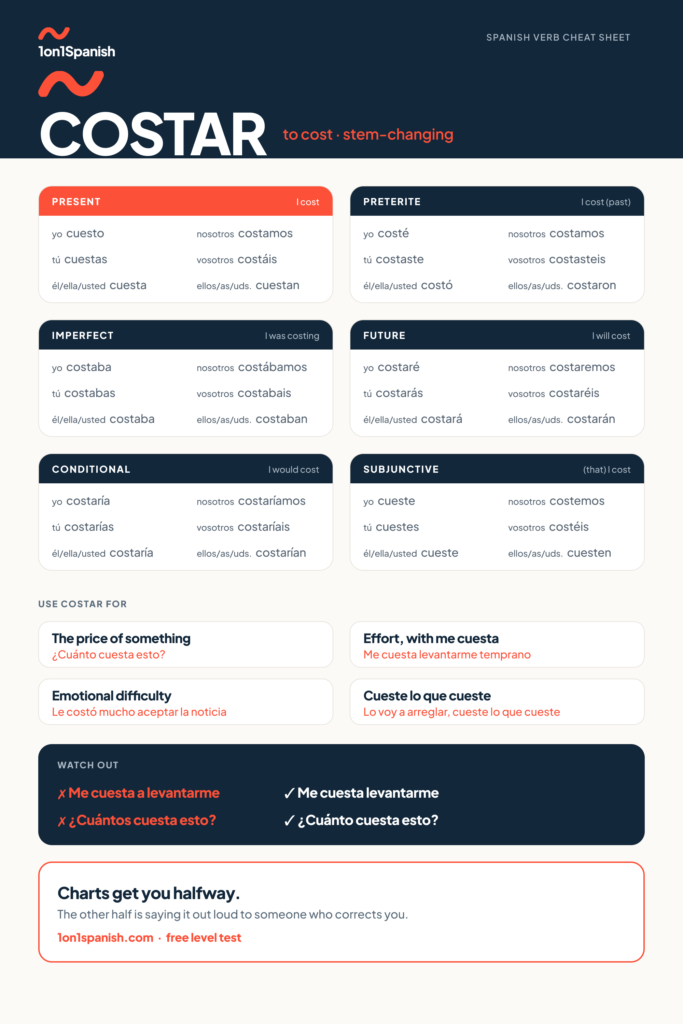
Take the chart with you
The chart is free to view and share. Drop your email and we’ll send the print-ready US Letter PDF — the version you stick on the fridge.
Practice
Practice costar with a real teacher
Charts get you halfway. The other half is saying it out loud to someone who corrects you on the spot. At 1on1Spanish you get 25-minute private lessons with a qualified native teacher, exercises built from the mistakes you make in class, and AI practice between lessons.
First month $1. No contracts, cancel anytime.
Prefer to practice with a person? Take one-on-one Spanish lessons online with a qualified native teacher.
Take your free level testBuilt on RingTeacher's method — 700,000+ classes delivered since 2017, teaching English to Spanish speakers. Now in the other direction.
Frequently asked questions
Is costar regular or irregular in Spanish?
Costar is a stem-changing verb (o→ue), the same pattern as contar or mostrar — not a fully irregular one. The o becomes ue in the stressed forms: cuesto, cuestas, cuesta, cuestan, while costamos and costáis keep the o. In real Spanish, only the third-person forms — cuesta and cuestan — get much use, because the subject is almost always a price or a task, not a person.
Why don’t people say “yo cuesto”?
Because the meaning doesn’t fit. Costar describes what something costs — money or effort — and a person is rarely the thing being priced. The grammatically correct forms cuesto and cuestas exist, but a native speaker has almost no reason to use them, so a page that lists the full table without saying this would be misleading.
What does “me cuesta” mean in Spanish?
Me cuesta plus an infinitive means “it’s hard for me to” — me cuesta dormir, me cuesta concentrarme. It follows the same pattern as me gusta: an indirect object pronoun in front of costar, with the verb agreeing with the activity, not the person struggling with it.
What is the past tense of costar in Spanish?
The preterite — costó, costaron being the common forms — describes a specific price at a specific moment: el vuelo me costó cuatrocientos dólares. The imperfect — costaba, costaban — describes what something used to cost, as a general or repeated fact: antes, la gasolina costaba mucho menos.
Do I need the subjunctive of costar in everyday conversation?
Mainly in one fixed phrase: cueste lo que cueste, “whatever it costs” or “at any cost”. Outside that expression, the subjunctive of costar is rare, again because most sentences with this verb describe a fact (a price) rather than a wish, doubt or command — the situations that call for the subjunctive.