
Creer conjugation in Spanish: every tense you need, with examples
Creer means “to believe” or “to think”, and its endings are regular, so most learners assume the whole verb is — and then hit creyó, creyeron and creyendo, where an unstressed i between two vowels turns into a y. That’s a spelling rule, not an irregularity, and it’s the same one that governs leer. The other trap is grammatical, not spelling: no creo que switches the next verb into the subjunctive, and it comes up constantly in real conversation. Every tense is below. 1on1Spanish teaches this in 25-minute one-on-one lessons with qualified native teachers, online across the United States.
Reviewed by María Jiménez — Licenciada en Filología Hispánica (BA in Hispanic Philology) · Updated Sep 2026
What creer means
Creer covers both “to believe” and “to think” in the sense of an opinion. Creo que va a llover is I think it’s going to rain; No creo en las coincidencias is I don’t believe in coincidences.
Creer que introduces a straightforward opinion in the indicative: Creo que tiene razón. But once the sentence turns negative, no creer que, the following verb switches to the subjunctive: No creo que tenga razón. This flip trips up almost every learner, because English “I don’t think she’s right” doesn’t change the verb form at all.
Creerle a alguien means to believe a person specifically: No le creo a mi vecino. And creerse algo (reflexive) means to actually buy into something, often with a hint of doubt: Se cree todo lo que lee en internet.
The stem never changes. What changes is the spelling: because the stem cre- ends in a vowel, an unstressed i in the ending becomes y (creyó, creyendo), and a stressed one takes a written accent to break the hiatus (creí, creído). Leer and caer follow the exact same pattern.
Creer conjugation: present tense
Completely regular -er endings.
| Form | Example | |
|---|---|---|
| yo | creo | Creo que sí funciona. (I think it does work.) |
| tú | crees | ¿Crees en el destino? (Do you believe in fate?) |
| él / ella / usted | cree | Mi papá cree en la medicina natural. (My dad believes in natural medicine.) |
| nosotros | creemos | Creemos que el plan es bueno. (We think the plan is good.) |
| vosotros | creéis | ¿Creéis que va a subir el precio? (Do you think the price will go up?) |
| ellos / ellas / ustedes | creen | Mis hijos ya no creen en eso. (My kids don’t believe that anymore.) |
Creer conjugation: preterite
This is the table people come for. The i of the ending becomes y in the third person, and the first person keeps a written accent.
| Form | |
|---|---|
| yo | creí |
| tú | creíste |
| él / ella / usted | creyó |
| nosotros | creímos |
| vosotros | creísteis |
| ellos / ellas / ustedes | creyeron |
No le creyó ni una palabra. — He didn’t believe a word she said.
Creer conjugation: imperfect
Regular, with the accent on the í in every form. This is the tense for a belief you held for a while, not one specific moment.
| Form | |
|---|---|
| yo | creía |
| tú | creías |
| él / ella / usted | creía |
| nosotros | creíamos |
| vosotros | creíais |
| ellos / ellas / ustedes | creían |
Yo creía que el vuelo salía a las seis. — I thought the flight left at six. The choice between creía and creyó depends on whether the belief was ongoing or a specific realization.
Creer conjugation: future
Regular endings on the infinitive.
| Form | |
|---|---|
| yo | creeré |
| tú | creerás |
| él / ella / usted | creerá |
| nosotros | creeremos |
| vosotros | creeréis |
| ellos / ellas / ustedes | creerán |
Nadie te creerá si no traes pruebas. — Nobody will believe you if you don’t bring proof.
Creer conjugation: conditional
| Form | |
|---|---|
| yo | creería |
| tú | creerías |
| él / ella / usted | creería |
| nosotros | creeríamos |
| vosotros | creeríais |
| ellos / ellas / ustedes | creerían |
Yo no creería esa oferta sin leer la letra pequeña. — I wouldn’t believe that offer without reading the fine print.
Creer conjugation: present subjunctive
Regular. Note the accent in creáis, and remember this is the form that follows no creer que — see the Spanish subjunctive for the full set of triggers, not just this one.
| Form | |
|---|---|
| yo | crea |
| tú | creas |
| él / ella / usted | crea |
| nosotros | creamos |
| vosotros | creáis |
| ellos / ellas / ustedes | crean |
No creo que sea buena idea. — I don’t think it’s a good idea.
Creer conjugation: imperfect subjunctive
Built on the third-person preterite stem creyer-, so the y runs through every form.
| Form (-ra) | Form (-se) | |
|---|---|---|
| yo | creyera | creyese |
| tú | creyeras | creyeses |
| él / ella / usted | creyera | creyese |
| nosotros | creyéramos | creyésemos |
| vosotros | creyerais | creyeseis |
| ellos / ellas / ustedes | creyeran | creyesen |
No creí que llegaras a tiempo. — I didn’t think you’d arrive on time.
Creer commands (imperative)
| Affirmative | Negative | |
|---|---|---|
| tú | cree | no creas |
| usted | crea | no crea |
| nosotros | creamos | no creamos |
| vosotros | creed | no creáis |
| ustedes | crean | no crean |
No creas todo lo que ves en línea. — Don’t believe everything you see online. No spelling change anywhere in the imperative.
Participle, gerund and compound tenses
Participle creído — with an accent on the í, because e and i would otherwise glue into one syllable. Gerund creyendo, with the same i→y switch as the preterite. Compounds use haber:
He creído en este proyecto desde el principio (present perfect) · Nunca había creído esa historia (past perfect) · Para entonces habré creído lo peor (future perfect).
When to use creer
Stating an opinion
Creo que el plan funciona. This is the everyday, positive use, and it takes the regular indicative, exactly like English “I think”.
Doubting something — with the subjunctive
No creo que llegue a tiempo. Once creer is negative, the next verb switches to the subjunctive. This is the single most useful pattern in the verb, and it comes up in every disagreement, every doctor’s appointment and every negotiation.
Believing (or not) a person
No le creo nada a esa aseguradora. Adds le for the person you do or don’t believe, separate from believing the statement itself.
Not being able to accept something
No puedo creer que hayan subido la renta otra vez. Used for surprise or frustration, almost always with the subjunctive that follows.
Creer vs pensar
Both translate as “to think”, and in casual speech they overlap. The difference shows up with opinions you hold strongly versus ones you’re still forming.
| Spanish | What it means |
|---|---|
| Creo que tiene razón. | I believe he’s right (a settled opinion). |
| Pienso que deberíamos esperar. | I think we should wait (a view, open to discussion). |
| No creo en los horóscopos. | I don’t believe in horoscopes. |
| ¿Qué piensas del contrato? | What do you think of the contract? |
| Creo que sí. | I think so. |
Creer leans toward belief and conviction, including belief in things (creer en Dios, creer en el karma). Pensar leans toward the act of thinking something over, and it’s the one to use when asking someone’s opinion directly: ¿qué piensas?, not ¿qué crees?
Common mistakes English speakers make with creer
Between two vowels the unstressed i of the ending becomes y. Same in creyeron, creyendo, creyera.
No creer que triggers the subjunctive. This is the mistake that matters most, because it’s grammatical, not just spelling — English gives no signal that the verb has to change.
Without the accent, creido would be stressed on the wrong syllable. The accent is not optional.
Creer almost never takes the gerund with estar — beliefs aren’t ongoing actions the way “watching TV” is. Just use the simple present, creo.
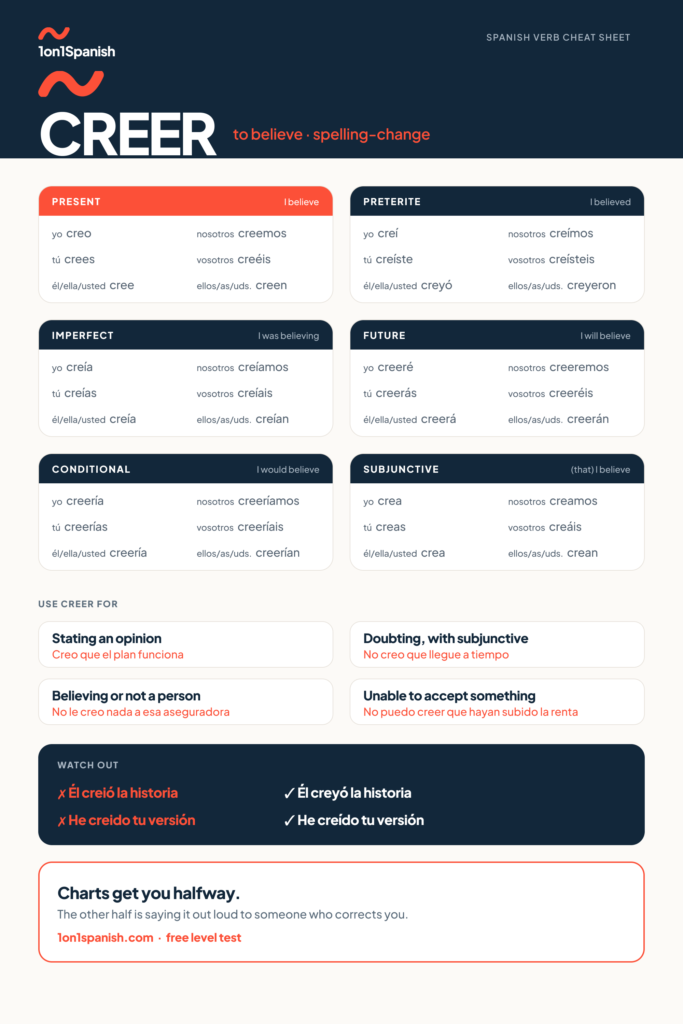
Take the chart with you
The chart is free to view and share. Drop your email and we’ll send the print-ready US Letter PDF — the version you stick on the fridge.
Practice
Practice creer with a real teacher
Charts get you halfway. The other half is saying it out loud to someone who corrects you on the spot. At 1on1Spanish you get 25-minute private lessons with a qualified native teacher, exercises built from the mistakes you make in class, and AI practice between lessons.
First month $1. No contracts, cancel anytime.
You can go further with someone listening: Learn Spanish with 1on1Spanish, 25 minutes at a time.
Take your free level testBuilt on RingTeacher's method — 700,000+ classes delivered since 2017, teaching English to Spanish speakers. Now in the other direction.
Frequently asked questions
Is creer regular or irregular in Spanish?
Creer is regular in its endings and irregular only in spelling. Where a regular -er verb would have an unstressed i between two vowels, creer writes y: creyó, creyeron, creyendo, creyera. Where the i is stressed, it takes a written accent: creí, creíste, creído, creía. The same pattern governs leer, caer and poseer.
Why does “no creo que” need the subjunctive?
Negating a verb of belief turns the statement into doubt, and doubt is one of the core triggers for the Spanish subjunctive. Creo que tiene razón states a fact as you see it, so it stays in the indicative. No creo que tenga razón expresses uncertainty about the same fact, so the verb switches to tenga. The same flip happens with pensar and parecer.
What’s the difference between creer and pensar?
Both can mean “to think”, but creer leans toward belief and conviction — including believing in things, creer en algo — while pensar leans toward the act of forming or sharing an opinion. ¿Qué piensas? asks for someone’s view; ¿Tú crees? asks whether they actually believe something is true. In casual conversation the two overlap heavily and either often works.
What is the past tense of creer in Spanish?
There are two. The preterite is creí, creíste, creyó, creímos, creísteis, creyeron, for a belief formed at one moment: no le creyó nada. The imperfect is creía, creías, creía, creíamos, creíais, creían, for a belief held over time: de niño creía en los fantasmas. Compound past tenses use haber plus creído.
How do you say “I don’t think so” in Spanish?
Creo que no is the standard answer, literally “I think not” — it keeps the indicative because the negation attaches to no, not to creer itself. No creo alone also works and is even more common in speech. If a full clause follows, remember the subjunctive: no creo que sea así.