
Dar conjugation in Spanish: every tense you need, with examples
Dar means “to give”, and it is short, common and irregular in exactly the places that trip people up: doy in the present, di and dio in the preterite with no written accent, and dé in the subjunctive with one. It also powers dozens of everyday expressions that have nothing to do with giving: dar un paseo, dar las gracias, me da igual. All the tables are below. 1on1Spanish teaches this in 25-minute one-on-one lessons with qualified native teachers, online across the United States.
Reviewed by María Jiménez — Licenciada en Filología Hispánica (BA in Hispanic Philology) · Updated Aug 2026
What dar means
The core meaning is handing something over: Le di las llaves a mi vecina. Almost every sentence with dar carries an indirect object pronoun, because giving needs a receiver: me, te, le, nos, os, les.
From there Spanish builds a long list of set expressions where dar stops meaning “give”: dar un paseo (take a walk), dar las gracias (say thank you), dar miedo (to be scary), dar igual (not to matter), darse cuenta (to realize). These are memorized as blocks, not translated word by word.
It is short enough to look easy on a list of Spanish verbs, which is exactly why its irregular forms catch people out.
Grammatically dar is an -ar verb that borrows -er endings in the preterite. Its irregular forms are doy, the preterite series di, diste, dio…, and the subjunctive dé, which carries a written accent to separate it from the preposition de. The participle dado and the gerund dando are regular.
Dar conjugation: present tense
| Form | Example | |
|---|---|---|
| yo | doy | Te doy mi número. (I’ll give you my number.) |
| tú | das | ¿Me das cinco minutos? (Can you give me five minutes?) |
| él / ella / usted | da | El seguro no da cobertura dental. (The insurance doesn’t cover dental.) |
| nosotros | damos | Damos clase los martes. (We teach class on Tuesdays.) |
| vosotros | dais | ¿Le dais propina aquí? (Do you tip here?) |
| ellos / ellas / ustedes | dan | Me dan miedo los aviones. (Planes scare me.) |
Dar conjugation: preterite
-Er endings on the bare stem, and none of these forms takes a written accent. Di and dio are one syllable each, so the accent that regular preterites carry (hablé, habló) has no place here.
| Form | |
|---|---|
| yo | di |
| tú | diste |
| él / ella / usted | dio |
| nosotros | dimos |
| vosotros | disteis |
| ellos / ellas / ustedes | dieron |
Me dio su tarjeta al final de la reunión. — He gave me his card at the end of the meeting.
Dar conjugation: imperfect
Completely regular.
| Form | |
|---|---|
| yo | daba |
| tú | dabas |
| él / ella / usted | daba |
| nosotros | dábamos |
| vosotros | dabais |
| ellos / ellas / ustedes | daban |
Mi abuelo nos daba un dólar cada domingo. — My grandfather used to give us a dollar every Sunday.
Dar conjugation: future
Regular endings on the full infinitive.
| Form | |
|---|---|
| yo | daré |
| tú | darás |
| él / ella / usted | dará |
| nosotros | daremos |
| vosotros | daréis |
| ellos / ellas / ustedes | darán |
Te daré una respuesta el viernes. — I’ll give you an answer on Friday.
Dar conjugation: conditional
| Form | |
|---|---|
| yo | daría |
| tú | darías |
| él / ella / usted | daría |
| nosotros | daríamos |
| vosotros | daríais |
| ellos / ellas / ustedes | darían |
Yo le daría un par de días más. — I’d give him a couple more days.
Dar conjugation: present subjunctive
The yo and third person singular form is dé, with a written accent that distinguishes it from the preposition de. The rest carry no accent.
| Form | |
|---|---|
| yo | dé |
| tú | des |
| él / ella / usted | dé |
| nosotros | demos |
| vosotros | deis |
| ellos / ellas / ustedes | den |
Espero que me den la respuesta hoy. — I hope they give me the answer today.
Dar conjugation: imperfect subjunctive
From the preterite stem. Both sets are correct; the -ra forms dominate in speech.
| Form (-ra) | Form (-se) | |
|---|---|---|
| yo | diera | diese |
| tú | dieras | dieses |
| él / ella / usted | diera | diese |
| nosotros | diéramos | diésemos |
| vosotros | dierais | dieseis |
| ellos / ellas / ustedes | dieran | diesen |
Si me dieran el préstamo, compraría la casa. — If they gave me the loan, I’d buy the house.
Dar commands (imperative)
Pronouns attach to affirmative commands: dame, dámelo, deme.
| Affirmative | Negative | |
|---|---|---|
| tú | da | no des |
| usted | dé | no dé |
| nosotros | demos | no demos |
| vosotros | dad | no deis |
| ustedes | den | no den |
Dame un segundo. — Give me a second. Deme dos, por favor is what you say at a counter. The pronoun rules live in indirect object pronouns.
Participle, gerund and compound tenses
Participle dado, gerund dando. Compounds take haber:
Ya le he dado el informe (present perfect) · Nunca me había dado su dirección (past perfect) · Habrán dado la noticia esta mañana (future perfect).
When to use dar
Handing something over
The literal use, nearly always with a pronoun: ¿Me das el recibo? Les dimos las llaves a los inquilinos.
Producing an effect on someone
Dar + noun, where the person is the indirect object: Me da miedo. Me da vergüenza. Me da igual. Me da pena. English turns these into adjectives; Spanish keeps the verb.
Activities built with dar
Dar un paseo (take a walk), dar una vuelta (go for a spin), dar clase (teach or take a class), dar de comer (to feed).
Social formulas
Dar las gracias (thank), dar la enhorabuena (congratulate), dar el pésame (offer condolences), dar recuerdos (send regards).
Dar vs regalar
Both can land on “give” in English, but they are not the same act, and mixing them changes the occasion.
| With dar | With regalar |
|---|---|
| Le di el informe — I handed him the report | Le regalé un libro — I gave him a book as a gift |
| Dame el dinero — Give me the money | Me lo regaló — He gave it to me for free |
| Dar las gracias — To thank someone | Regalar por su cumpleaños — To give a birthday present |
Rule of thumb: regalar implies a gift and no return. Dar is neutral, so a wallet handed back to its owner is dar, never regalar.
Common mistakes English speakers make with dar
Dio has been written without an accent since the 2010 spelling reform, along with fue, vio and di. Older textbooks still show the accent.
Here the accent is required: dé is the verb, de is the preposition. This is one of the few accents in Spanish that changes the part of speech, not the stress.
Spanish repeats the indirect object with a pronoun even when the person is named. Dropping le sounds incomplete to a native ear.
Fear, embarrassment and disgust are produced by something, so the thing is the subject: me da miedo, me da vergüenza, me da asco.
Darse cuenta keeps its de. Dropping it is common in casual speech but wrong in writing.
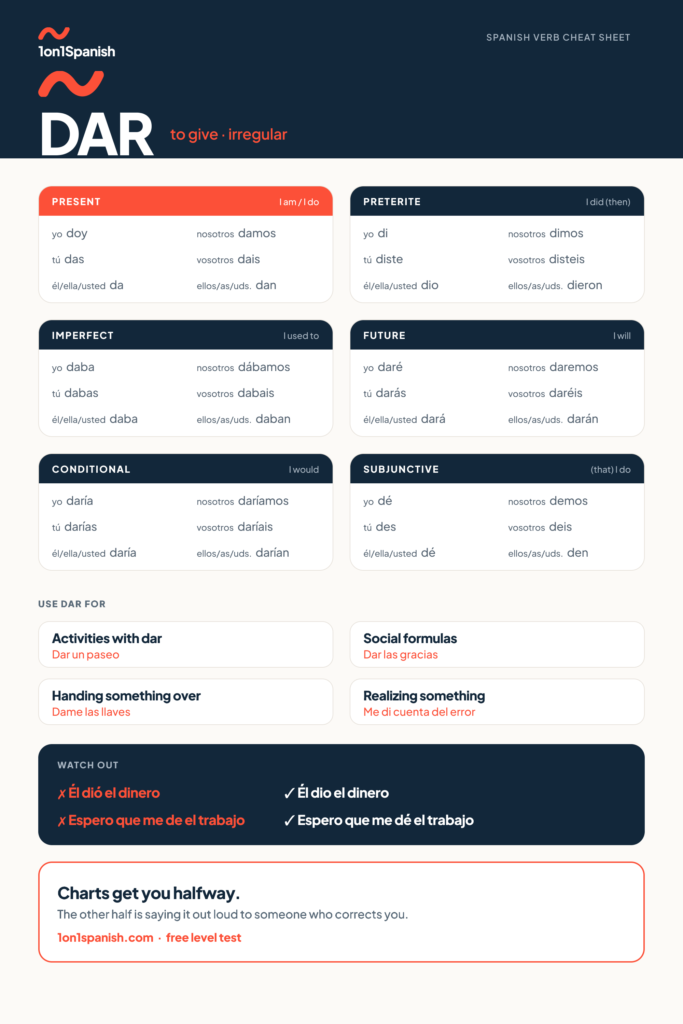
Take the chart with you
The chart is free to view and share. Drop your email and we’ll send the print-ready US Letter PDF — the version you stick on the fridge.
Practice
Practice dar with a real teacher
Charts get you halfway. The other half is saying it out loud to someone who corrects you on the spot. At 1on1Spanish you get 25-minute private lessons with a qualified native teacher, exercises built from the mistakes you make in class, and AI practice between lessons.
First month $1. No contracts, cancel anytime.
The expressions with dar only stick once you use them in a real conversation with a Spanish tutor.
These guides are free. When you want someone correcting you out loud, learn Spanish online with a qualified native teacher.
Take your free level testBuilt on RingTeacher's method — 700,000+ classes delivered since 2017, teaching English to Spanish speakers. Now in the other direction.
Frequently asked questions
Is dar regular or irregular in Spanish?
Dar is irregular in three spots. The present takes doy instead of the expected do. The preterite borrows -er endings (di, diste, dio, dimos, disteis, dieron) instead of the -ar set. And the subjunctive dé carries a written accent. The imperfect, future and conditional are completely regular.
Does dio have an accent in Spanish?
No. Dio is written without an accent, and so are di, fue and vio. They are single-syllable words, and Spanish spelling rules removed the accent from them in the 2010 reform by the Real Academia Española. Textbooks printed before then still show dió, which is why the doubt keeps coming back.
Why does the subjunctive dé have an accent?
Because de without an accent is the preposition “of” or “from”, and the two would be indistinguishable in writing. This is called a diacritical accent, the same device that separates sé from se and él from el. It appears only on the yo and usted forms: dé. The others (des, demos, deis, den) take no accent.
What are the most common expressions with dar in Spanish?
Dar un paseo (take a walk), dar las gracias (to thank), dar miedo (to be scary), dar igual (not to matter), darse cuenta de (to realize), dar clase (to teach or attend a class), dar la enhorabuena (to congratulate). None of them translates literally, so they’re learned as whole phrases rather than built from “give”.
How do you say “give me” in Spanish?
Dame informally, deme when addressing someone as usted. The pronoun attaches to the end of the affirmative command, and it stacks: dámelo is “give it to me”. In the negative it moves in front and separates: no me lo des. At a counter or a restaurant, ¿me da…? is softer and more common than a bare command.