
Deber conjugation in Spanish: every tense you need, with examples
Deber is a fully regular -er verb — none of the nine tables below have an irregular form. What makes this verb worth its own page isn’t morphology, it’s meaning: deber covers both owing money and moral obligation, and the small preposition de changes obligation into a guess. Its conditional, debería, is one of the most-used verb forms in the whole language. 1on1Spanish teaches this in 25-minute one-on-one lessons with qualified native teachers, online across the United States.
Reviewed by María Jiménez — Licenciada en Filología Hispánica (BA in Hispanic Philology) · Updated Sep 2026
What deber means
Deber has two separate jobs. As a regular transitive verb, it means “to owe”: le debo cien dólares a mi hermano. As a modal verb followed by an infinitive, it means “must” or “should”: debes llamar al médico.
The two uses never overlap in a sentence, but they share every conjugated form, so context always tells you which one you’re reading. Add the preposition de before the infinitive — deber de — and the meaning shifts from obligation to probability: debe de estar en una junta is “she’s probably in a meeting”, a guess, not an order.
Grammatically it’s fully regular: standard -er endings throughout, no stem change, no spelling change. Participle debido, gerund debiendo.
Deber conjugation: present tense
Fully regular. No irregular forms in this table.
| Form | Example | |
|---|---|---|
| yo | debo | Debo terminar el reporte hoy. (I have to finish the report today.) |
| tú | debes | ¿Cuánto me debes todavía? (How much do you still owe me?) |
| él / ella / usted | debe | Ella debe llegar temprano al trabajo. (She has to arrive early to work.) |
| nosotros | debemos | Debemos hablar con el contador. (We need to talk to the accountant.) |
| vosotros | debéis | ¿Debéis dinero del alquiler? (Do you owe money on the rent?) |
| ellos / ellas / ustedes | deben | Mis vecinos deben avisar antes de la fiesta. (My neighbors should give notice before the party.) |
Deber conjugation: preterite
Regular -er endings, no spelling change.
| Form | |
|---|---|
| yo | debí |
| tú | debiste |
| él / ella / usted | debió |
| nosotros | debimos |
| vosotros | debisteis |
| ellos / ellas / ustedes | debieron |
Le debí cien dólares durante casi un año. — I owed him a hundred dollars for almost a year.
Deber conjugation: imperfect
Fully regular.
| Form | |
|---|---|
| yo | debía |
| tú | debías |
| él / ella / usted | debía |
| nosotros | debíamos |
| vosotros | debíais |
| ellos / ellas / ustedes | debían |
De estudiante, debía dinero en préstamos todos los años. — As a student, I owed money on loans every year.
Deber conjugation: future
Regular endings on the infinitive.
| Form | |
|---|---|
| yo | deberé |
| tú | deberás |
| él / ella / usted | deberá |
| nosotros | deberemos |
| vosotros | deberéis |
| ellos / ellas / ustedes | deberán |
Deberás presentar tu identificación en la entrada. — You’ll need to show your ID at the entrance.
Deber conjugation: conditional
The most common form of this entire verb, and the softest way to give advice in Spanish.
| Form | |
|---|---|
| yo | debería |
| tú | deberías |
| él / ella / usted | debería |
| nosotros | deberíamos |
| vosotros | deberíais |
| ellos / ellas / ustedes | deberían |
Deberías tomar más agua durante el día. — You should drink more water during the day.
Deber conjugation: present subjunctive
Built on the debo stem, fully regular.
| Form | |
|---|---|
| yo | deba |
| tú | debas |
| él / ella / usted | deba |
| nosotros | debamos |
| vosotros | debáis |
| ellos / ellas / ustedes | deban |
No creo que él deba tanto dinero. — I don’t think he owes that much money.
Deber conjugation: imperfect subjunctive
Built on the preterite stem debieron-, both forms interchangeable.
| Form (-ra) | Form (-se) | |
|---|---|---|
| yo | debiera | debiese |
| tú | debieras | debieses |
| él / ella / usted | debiera | debiese |
| nosotros | debiéramos | debiésemos |
| vosotros | debierais | debieseis |
| ellos / ellas / ustedes | debieran | debiesen |
Si debiera tanto, ya me habrían llamado. — If I owed that much, they would have already called me.
Deber commands (imperative)
The imperative of deber exists grammatically, but native speakers almost never use it — deber describes an obligation, not an action you can order someone to start doing on the spot, so debería or a plain statement of obligation does the real work instead.
| Affirmative | Negative | |
|---|---|---|
| tú | debe | no debas |
| usted | deba | no deba |
| nosotros | debamos | no debamos |
| vosotros | debed | no debáis |
| ustedes | deban | no deban |
Participle, gerund and compound tenses
Participle debido, gerund debiendo. Both regular. Compounds take haber:
He debido esa cantidad desde marzo (present perfect) · Ya había debido más dinero antes de consolidar el préstamo (past perfect) · Para entonces habré debido menos de mil dólares (future perfect).
When to use deber
Obligation
Debes llamar al médico antes del viernes. Deber plus an infinitive states what someone has to do — direct and a little more forceful than debería.
Owing money or a favor
Le debo cien dólares a mi hermano. Deber by itself, with no infinitive, always means “to owe”.
Softened advice, with the conditional
Deberías descansar más. Debería is how most everyday advice actually gets phrased in Spanish — gentler than the plain present, and far more common in conversation.
Deber vs deber de
The difference is one small preposition, and mixing the two up is one of the most common confusions in the language, even among some native speakers in casual speech.
| Deber + infinitive (obligation) | Deber de + infinitive (supposition) |
|---|---|
| Debes llegar a tiempo — You must arrive on time | Debe de ser tarde — It must be late (a guess) |
| States what should happen | States what’s probably true |
| Debiste estudiar más — You should have studied more (you didn’t) | Debiste de estudiar mucho — You must have studied a lot (a guess about the past) |
In formal writing, the distinction matters. In everyday speech, plenty of native speakers use deber alone for both meanings and let context carry the difference — but knowing the rule helps you catch which one a speaker means.
Common mistakes English speakers make with deber
Plain obligation never takes de. Adding it turns a clear instruction into a guess, which changes the meaning entirely.
The conditional form of advice doesn’t take de either — this is a common hypercorrection from learners who’ve just learned about deber de.
Here the missing de actually hides the meaning: this sentence is a guess about the time, so the formal, precise version needs deber de.
When you mean “you should have” — an obligation that wasn’t met — no de is needed. Debiste de estudiar would mean “you probably studied”, the opposite point.
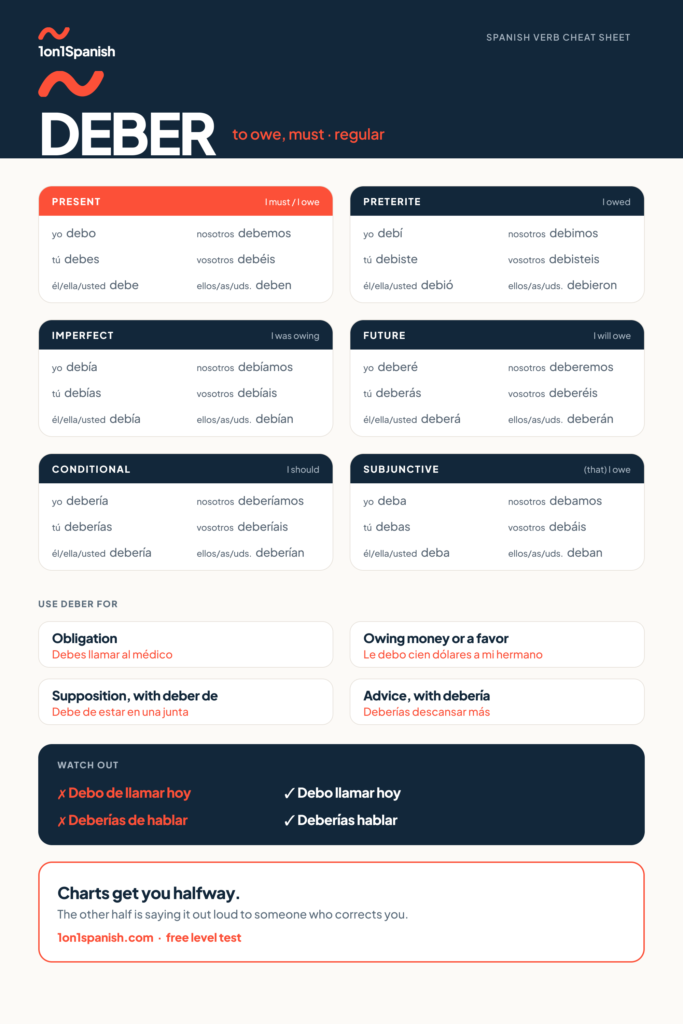
Take the chart with you
The chart is free to view and share. Drop your email and we’ll send the print-ready US Letter PDF — the version you stick on the fridge.
Practice
Practice deber with a real teacher
Charts get you halfway. The other half is saying it out loud to someone who corrects you on the spot. At 1on1Spanish you get 25-minute private lessons with a qualified native teacher, exercises built from the mistakes you make in class, and AI practice between lessons.
First month $1. No contracts, cancel anytime.
The fastest way to make this stick is to say it to someone. Learn Spanish online with a real teacher.
Take your free level testBuilt on RingTeacher's method — 700,000+ classes delivered since 2017, teaching English to Spanish speakers. Now in the other direction.
Frequently asked questions
Is deber regular or irregular in Spanish?
Fully regular. Deber follows the standard -er pattern in every tense — present, preterite, imperfect, future, conditional and both subjunctives — with no stem change and no spelling change. What makes this verb tricky isn’t the forms, it’s the meaning: obligation, owing money, and supposition all live in the same word.
What’s the difference between deber and deber de?
Deber plus an infinitive states an obligation: debes llegar a tiempo, you must arrive on time. Deber de plus an infinitive states a guess based on evidence: debe de estar en casa, she’s probably home. The two meanings are genuinely different, and in careful writing the de signals which one you mean — though in casual speech, plenty of speakers drop it for both.
How do you say “you should” in Spanish?
Deberías, the conditional tú form, is how most everyday advice gets phrased: deberías tomar más agua, deberías descansar. It’s softer than the plain present debes, which sounds more like a direct instruction. Debería (usted, él, ella) is just as common in formal or polite contexts.
What is the past tense of deber in Spanish?
Two forms depending on what you’re describing. The preterite — debí, debiste, debió, debimos, debisteis, debieron — is for a completed debt or a missed obligation: debiste estudiar más, you should have studied more. The imperfect — debía, debías, debía, debíamos, debíais, debían — is for an ongoing debt or a repeated obligation: debía dinero en préstamos todos los años.
Do I need the subjunctive of deber in everyday conversation?
It comes up, but less than with most other verbs, mainly after doubt. Deba appears after no creo que (no creo que deba tanto dinero) and after dudo que (dudo que deba explicaciones). It’s far less frequent than debería, which handles most of the everyday advice and suggestion that learners actually need.