
Decir conjugation in Spanish: every tense you need, with examples
Decir means “to say” and “to tell”, and it is one of the verbs you cannot avoid: every time you report what someone else said, you need it. It is irregular in nearly every tense you need — digo in the present, dije and dijeron in the preterite, diré in the future, dicho as a participle, and a one-letter command, di. All the tables are below. 1on1Spanish teaches this in 25-minute one-on-one lessons with qualified native teachers, online across the United States.
Reviewed by María Jiménez — Licenciada en Filología Hispánica (BA in Hispanic Philology) · Updated Sep 2026
What decir means
English separates “say” from “tell”; Spanish uses decir for both and lets the pronoun do the work. Dice que no viene is “he says he isn’t coming”. Add an indirect object pronoun and it becomes “tell”: Me dice que no viene is “he tells me he isn’t coming”.
That pronoun is where most of the difficulty sits. Decir almost always travels with me, te, le, nos, os, les, and in the preterite it usually contracts in speech: se lo dije, not lo dije a él.
Of the irregular Spanish verbs, this is the one that shows up the moment you start relaying information rather than describing yourself.
Structurally it is an e→i stem-changing verb with an irregular yo form (digo), the strong preterite stem dij-, the short future and conditional stem dir-, and the irregular participle dicho. The gerund is diciendo.
Decir conjugation: present tense
| Form | Example | |
|---|---|---|
| yo | digo | Siempre digo la verdad. (I always tell the truth.) |
| tú | dices | ¿Qué dices? (What are you saying?) |
| él / ella / usted | dice | El médico dice que estoy bien. (The doctor says I’m fine.) |
| nosotros | decimos | Nosotros no decimos nada. (We’re not saying anything.) |
| vosotros | decís | ¿Qué decís vosotros? (What do you say?) |
| ellos / ellas / ustedes | dicen | Dicen que va a subir el alquiler. (They say the rent is going up.) |
Decir conjugation: preterite
Stem dij-. Note the third person plural: dijeron, not dijieron — the i drops after the j.
| Form | |
|---|---|
| yo | dije |
| tú | dijiste |
| él / ella / usted | dijo |
| nosotros | dijimos |
| vosotros | dijisteis |
| ellos / ellas / ustedes | dijeron |
Me dijo que llegaba tarde. — He told me he’d be late.
Decir conjugation: imperfect
Regular -ir endings on the infinitive stem.
| Form | |
|---|---|
| yo | decía |
| tú | decías |
| él / ella / usted | decía |
| nosotros | decíamos |
| vosotros | decíais |
| ellos / ellas / ustedes | decían |
Mi padre siempre decía lo mismo. — My father always used to say the same thing.
Decir conjugation: future
Short stem dir-, regular endings.
| Form | |
|---|---|
| yo | diré |
| tú | dirás |
| él / ella / usted | dirá |
| nosotros | diremos |
| vosotros | diréis |
| ellos / ellas / ustedes | dirán |
Te diré algo cuando sepa la fecha. — I’ll tell you something when I know the date.
Decir conjugation: conditional
Same short stem dir-.
| Form | |
|---|---|
| yo | diría |
| tú | dirías |
| él / ella / usted | diría |
| nosotros | diríamos |
| vosotros | diríais |
| ellos / ellas / ustedes | dirían |
Yo no le diría nada todavía. — I wouldn’t tell him anything yet.
Decir conjugation: present subjunctive
Built on digo, so the -g- runs through every person.
| Form | |
|---|---|
| yo | diga |
| tú | digas |
| él / ella / usted | diga |
| nosotros | digamos |
| vosotros | digáis |
| ellos / ellas / ustedes | digan |
No le digas nada a tu hermana. — Don’t tell your sister anything.
Decir conjugation: imperfect subjunctive
From the preterite stem dij-, and again with no i after the j. Both sets are correct; the -ra forms dominate in speech.
| Form (-ra) | Form (-se) | |
|---|---|---|
| yo | dijera | dijese |
| tú | dijeras | dijeses |
| él / ella / usted | dijera | dijese |
| nosotros | dijéramos | dijésemos |
| vosotros | dijerais | dijeseis |
| ellos / ellas / ustedes | dijeran | dijesen |
Si me lo dijeras antes, cambiaría el vuelo. — If you told me sooner, I’d change the flight.
Decir commands (imperative)
The tú command is a single letter, di, and it takes no accent. Pronouns attach to the end of affirmative commands and force a written accent: dime, dímelo, díganos.
| Affirmative | Negative | |
|---|---|---|
| tú | di | no digas |
| usted | diga | no diga |
| nosotros | digamos | no digamos |
| vosotros | decid | no digáis |
| ustedes | digan | no digan |
Dime la verdad. — Tell me the truth. On the phone, ¿Diga? and Dígame are how Spaniards answer a call. The rules for attaching pronouns are in Spanish commands.
Participle, gerund and compound tenses
Participle dicho, gerund diciendo. The participle doubles as a noun: un dicho is a saying, and lo dicho means “as agreed”. Compounds take haber:
Ya te he dicho que sí (present perfect) · Nunca me había dicho eso (past perfect) · Habrán dicho lo mismo a todos (future perfect).
When to use decir
Reporting what someone said
The main use, almost always followed by que: Dice que llega a las ocho. Dijeron que el pedido sale hoy. The que is not optional in Spanish, unlike English.
Telling someone something
With an indirect object pronoun: Te lo digo en serio. Le dije a mi jefe que necesito el viernes libre.
Asking for a repeat or clarification
¿Cómo dice? ¿Qué has dicho? ¿Me lo puede repetir?
Fixed phrases you’ll hear daily
Es decir (that is), ni que decir tiene (it goes without saying), digamos que (let’s say), como dicen (as they say).
Impersonal rumor
Dicen que is how Spanish says “they say” or “apparently”: Dicen que va a cerrar la tienda.
Decir vs hablar vs contar
Three verbs that English collapses into “say”, “speak” and “tell”. They are not interchangeable.
| Verb | What it takes | Example |
|---|---|---|
| decir | the words themselves, or que + a clause | Dijo que sí. — He said yes. |
| hablar | a language, or the act of speaking | Hablo español. — I speak Spanish. |
| contar | a story, a piece of news, a whole account | Me contó el problema. — He told me about the problem. |
| preguntar | a question | Me preguntó la dirección. — He asked me for the address. |
Rule of thumb: decir transmits words, hablar describes the activity, contar narrates.
Common mistakes English speakers make with decir
English drops “that” freely; Spanish never drops que in reported speech.
After the j of the stem, the i of the ending disappears. The same happens with trajeron and condujeron.
Hablar doesn’t take reported speech. To transmit content, use decir with an indirect object pronoun.
The pronoun is already inside the command. Adding a mí on top sounds like you’re insisting on something, not asking.
The participle after haber never agrees with the subject. It stays dicho, whoever is speaking.
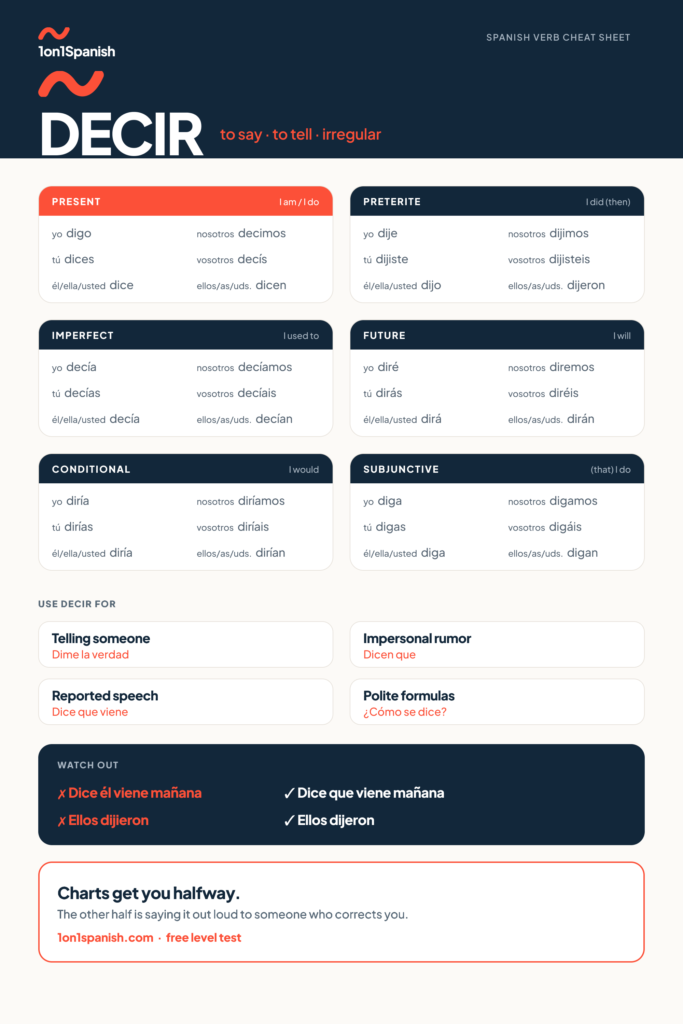
Take the chart with you
The chart is free to view and share. Drop your email and we’ll send the print-ready US Letter PDF — the version you stick on the fridge.
Practice
Practice decir with a real teacher
Charts get you halfway. The other half is saying it out loud to someone who corrects you on the spot. At 1on1Spanish you get 25-minute private lessons with a qualified native teacher, exercises built from the mistakes you make in class, and AI practice between lessons.
First month $1. No contracts, cancel anytime.
Reporting what someone said is a skill you build by doing it, out loud, with a Spanish tutor.
Guides help. A teacher hears what a guide cannot — Learn Spanish online with a real teacher.
Take your free level testBuilt on RingTeacher's method — 700,000+ classes delivered since 2017, teaching English to Spanish speakers. Now in the other direction.
Frequently asked questions
Is decir regular or irregular in Spanish?
Decir is irregular in every main tense except the imperfect. The present changes its stem from e to i (dices, dice) and takes digo in the yo form. The preterite uses dij-, the future and conditional shorten to dir-, the participle is dicho, and the tú command is the single syllable di.
What’s the difference between decir and hablar?
Decir transmits words or content: Dijo que no podía venir. Hablar refers to the act of speaking or to a language: Hablo español. Hablamos una hora. You can hablar con someone about a topic, but you cannot hablar a piece of information to them — that requires decir with an indirect object pronoun.
What is the preterite of decir in Spanish?
Dije, dijiste, dijo, dijimos, dijisteis, dijeron. The form to watch is the third person plural: it’s dijeron, without the i that regular -ir verbs keep. Every Spanish verb whose preterite stem ends in j behaves the same way, including traer (trajeron) and traducir (tradujeron).
How do you say “tell me” in Spanish?
Dime, with the pronoun attached to the command. Formally it’s dígame, which is also how many Spaniards answer the phone. For “tell me about it” use cuéntame, since a full account belongs to contar. To say “tell me the truth”, the standard phrase is dime la verdad.
Do I need the subjunctive of decir in everyday conversation?
Yes, in two situations. First, negative commands: no digas, no le diga nada. Second, when decir means to order rather than to report: Me dijo que viniera is “he told me to come”, while Me dijo que venía is “he told me he was coming”. That single change of mood decides whether it was an instruction or a piece of news.