
Dormir conjugation in Spanish: every tense you need, with examples
Dormir means “to sleep”, and it changes in two different ways depending on the tense. The stem vowel o becomes ue wherever it’s stressed, in the present (duermo). But it also weakens to a plain u in a second set of forms — the third person of the preterite, the whole imperfect subjunctive, and the gerund — giving durmió, durmiera, durmiendo. Both changes are below, tense by tense, along with the difference between dormir and its reflexive twin, dormirse. 1on1Spanish teaches this in 25-minute one-on-one lessons with qualified native teachers, online across the United States.
Reviewed by María Jiménez — Licenciada en Filología Hispánica (BA in Hispanic Philology) · Updated Sep 2026
What dormir means
Dormir is the state of sleeping: duermo ocho horas cada noche. It also covers naps — dormir la siesta is a normal part of the day in much of Latin America — and quality of sleep as a health topic: no duermo bien desde que empezó el nuevo trabajo is exactly the kind of sentence that comes up with a doctor.
The reflexive form, dormirse, means to fall asleep — the moment of transition, not the state: me dormí viendo la tele is I fell asleep watching TV. Mixing up the two is one of the most common mistakes learners make with this verb.
Grammatically it’s a stem-changing verb with two patterns: o→ue in the stressed forms of the present, present subjunctive and commands, and a secondary o→u change in the unstressed forms tied to the preterite stem — third-person preterite, all of the imperfect subjunctive, the nosotros and vosotros of the present subjunctive, and the gerund. The participle, dormido, is regular.
Dormir conjugation: present tense
Stem change in every form except nosotros and vosotros.
| Form | Example | |
|---|---|---|
| yo | duermo | Duermo ocho horas entre semana. (I sleep eight hours on weekdays.) |
| tú | duermes | ¿Duermes bien en el nuevo colchón? (Are you sleeping well on the new mattress?) |
| él / ella / usted | duerme | El bebé duerme toda la noche por fin. (The baby finally sleeps through the night.) |
| nosotros | dormimos | Dormimos poco durante los exámenes. (We got little sleep during exams.) |
| vosotros | dormís | ¿Dormís con la ventana abierta? (Do you sleep with the window open?) |
| ellos / ellas / ustedes | duermen | Mis abuelos duermen la siesta después de comer. (My grandparents take a nap after lunch.) |
Dormir conjugation: preterite
The stem weakens to u only in the third person — the exact place most learners forget.
| Form | |
|---|---|
| yo | dormí |
| tú | dormiste |
| él / ella / usted | durmió |
| nosotros | dormimos |
| vosotros | dormisteis |
| ellos / ellas / ustedes | durmieron |
Anoche no durmió nada por el dolor de cabeza. — Last night she didn’t sleep at all because of a headache.
Dormir conjugation: imperfect
Fully regular — the imperfect never carries a stem change.
| Form | |
|---|---|
| yo | dormía |
| tú | dormías |
| él / ella / usted | dormía |
| nosotros | dormíamos |
| vosotros | dormíais |
| ellos / ellas / ustedes | dormían |
De niños, dormíamos los cuatro en el mismo cuarto. — As kids, the four of us slept in the same room.
Dormir conjugation: future
Regular endings on the infinitive.
| Form | |
|---|---|
| yo | dormiré |
| tú | dormirás |
| él / ella / usted | dormirá |
| nosotros | dormiremos |
| vosotros | dormiréis |
| ellos / ellas / ustedes | dormirán |
Esta noche dormiré temprano, mañana empiezo el nuevo trabajo. — I’ll sleep early tonight, I start the new job tomorrow.
Dormir conjugation: conditional
| Form | |
|---|---|
| yo | dormiría |
| tú | dormirías |
| él / ella / usted | dormiría |
| nosotros | dormiríamos |
| vosotros | dormiríais |
| ellos / ellas / ustedes | dormirían |
Yo dormiría mejor sin tanto ruido en la calle. — I’d sleep better without so much noise on the street.
Dormir conjugation: present subjunctive
Both changes appear here: the stressed forms take ue, and nosotros/vosotros — unstressed, but still built on the special stem — take u, not the expected plain o.
| Form | |
|---|---|
| yo | duerma |
| tú | duermas |
| él / ella / usted | duerma |
| nosotros | durmamos |
| vosotros | durmáis |
| ellos / ellas / ustedes | duerman |
Ojalá que duermas mejor esta noche. — I hope you sleep better tonight.
Dormir conjugation: imperfect subjunctive
Built entirely on the durmieron preterite stem, so every form carries the u.
| Form (-ra) | Form (-se) | |
|---|---|---|
| yo | durmiera | durmiese |
| tú | durmieras | durmieses |
| él / ella / usted | durmiera | durmiese |
| nosotros | durmiéramos | durmiésemos |
| vosotros | durmierais | durmieseis |
| ellos / ellas / ustedes | durmieran | durmiesen |
Si durmiera más, tendría más energía. — If she slept more, she’d have more energy.
Dormir commands (imperative)
| Affirmative | Negative | |
|---|---|---|
| tú | duerme | no duermas |
| usted | duerma | no duerma |
| nosotros | durmamos | no durmamos |
| vosotros | dormid | no durmáis |
| ustedes | duerman | no duerman |
Duerme un poco, mañana tienes un día largo. — Get some sleep, tomorrow you’ve got a long day.
Participle, gerund and compound tenses
Participle dormido, completely regular. Gerund durmiendo, with the same u change as the preterite. Compounds take haber:
No he dormido bien esta semana (present perfect) · Ya había dormido cuando llamaste (past perfect) · Para el viernes habré dormido en cuatro hoteles distintos (future perfect).
When to use dormir
Sleeping through the night
Duermo ocho horas cuando puedo. The core, literal use, and the one that shows up in any conversation about health or routine.
Naps
Dormir la siesta is common enough in daily Spanish that it’s practically its own expression: los domingos duermo la siesta después de comer.
Sleep quality, especially with a doctor
No duermo bien desde hace meses. This exact phrase comes up constantly in medical Spanish — it’s one of the first things a doctor asks about.
Places, in a figurative sense
El pueblo duerme temprano — the town goes to sleep early — describing a quiet place rather than a person.
Dormir vs dormirse
Dormir is the state of being asleep; dormirse is the moment of falling asleep. English uses two different verbs for this (“sleep” vs. “fall asleep”), so the reflexive form here is actually doing the same job English does with a separate word.
| Spanish | What it means |
|---|---|
| Duermo ocho horas. | I sleep eight hours. (the state) |
| Me dormí a las once. | I fell asleep at eleven. (the transition) |
| No duermo bien en aviones. | I don’t sleep well on planes. |
| Se durmió en el sofá viendo la peli. | He fell asleep on the couch watching the movie. |
Rule of thumb: if you’re describing the state of being asleep, use dormir. If you’re describing the moment you drifted off, use dormirse.
Common mistakes English speakers make with dormir
The yo form needs the stem change: duermo, never dormo.
This is the mistake this verb is known for. The third-person preterite weakens o to u: durmió, not dormió.
The gerund carries the same u change as the preterite. Dormiendo doesn’t exist in standard Spanish.
Dormirse names the moment of falling asleep, not the hours spent asleep. To describe a stretch of sleep, use plain dormir.
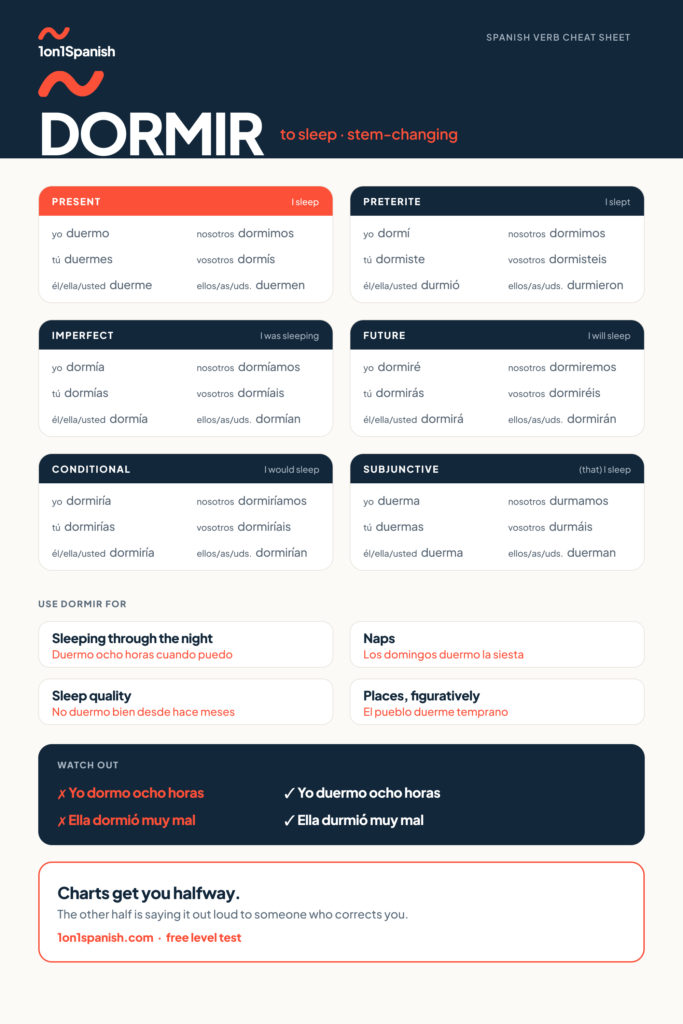
Take the chart with you
The chart is free to view and share. Drop your email and we’ll send the print-ready US Letter PDF — the version you stick on the fridge.
Practice
Practice dormir with a real teacher
Charts get you halfway. The other half is saying it out loud to someone who corrects you on the spot. At 1on1Spanish you get 25-minute private lessons with a qualified native teacher, exercises built from the mistakes you make in class, and AI practice between lessons.
First month $1. No contracts, cancel anytime.
Want a teacher listening while you practice? Learn Spanish online with us, one lesson at a time.
Take your free level testBuilt on RingTeacher's method — 700,000+ classes delivered since 2017, teaching English to Spanish speakers. Now in the other direction.
Frequently asked questions
Is dormir regular or irregular in Spanish?
Irregular, with two separate stem changes. The o becomes ue wherever it’s stressed — present duermo, subjunctive duerma, commands duerme. Separately, it weakens to a plain u in the third-person preterite (durmió, durmieron), the whole imperfect subjunctive (durmiera), the nosotros/vosotros of the present subjunctive (durmamos, durmáis), and the gerund (durmiendo). The imperfect, future, conditional and participle are all regular.
What’s the difference between dormir and dormirse?
Dormir is the state of sleeping: duermo ocho horas. Dormirse is the moment of falling asleep: me dormí viendo la tele. English marks this with two different verbs — “sleep” and “fall asleep” — so the reflexive pronoun in dormirse is doing the same job as that second English verb.
Why is it “durmió” and not “dormió”?
Because dormir has a second, weaker stem change that only shows up in specific unstressed positions: the third person of the preterite, the whole imperfect subjunctive, and the gerund. There, the o becomes u instead of staying as o. Dormió looks like it should be right because the ending is regular, but the stem itself changes.
What is the past tense of dormir in Spanish?
Two forms, and the preterite is the one with the stem change. Preterite: dormí, dormiste, durmió, dormimos, dormisteis, durmieron — only the third person changes to u. Imperfect: dormía, dormías, dormía, dormíamos, dormíais, dormían — completely regular, for habits or ongoing states: dormía mal todos los inviernos.
Do I need the subjunctive of dormir in everyday conversation?
Yes, mostly with wishes. Duerma and durmamos appear after ojalá que (ojalá que duermas mejor) and after espero que (espero que durmamos algo en el vuelo). It’s a common, natural expression — the kind of thing you say to someone before a trip or after a hard week.