
Encontrar conjugation in Spanish: every tense you need, with examples
Encontrar means “to find”, and its only irregularity is a stem change: the o turns into ue whenever the stress falls on it, giving encuentro, encuentras, encuentra, encuentran. Everything else is completely regular: preterite, imperfect, future, conditional. There is also a reflexive form, encontrarse, which covers running into someone and being located somewhere. All the tables are below. 1on1Spanish teaches this in 25-minute one-on-one lessons with qualified native teachers, online across the United States.
Reviewed by María Jiménez — Licenciada en Filología Hispánica (BA in Hispanic Philology) · Updated Aug 2026
What encontrar means
Encontrar is the result, not the search. You buscas your keys for ten minutes and then you encuentras them. English collapses both into “look for” and “find”; Spanish keeps them in separate verbs and never mixes them up.
Beyond locating an object, encontrar also means to find something to be a certain way. It states an opinion: Lo encuentro caro. La encuentro muy cambiada. That use is far more common in conversation than most learners realize.
Encontrarse adds two more meanings: bumping into someone (me encontré con Ana en el súper) and being located or being in a state (el hotel se encuentra en el centro, no se encuentra bien).
The stem change is the boot pattern: it hits every form except nosotros and vosotros, which keep the o. The participle is encontrado and the gerund encontrando, both regular. Volver, poder and contar change the same way; they are indexed under Spanish verbs.
Encontrar conjugation: present tense
| Form | Example | |
|---|---|---|
| yo | encuentro | No encuentro las llaves. (I can’t find my keys.) |
| tú | encuentras | ¿Encuentras el edificio? (Can you find the building?) |
| él / ella / usted | encuentra | Mi mujer siempre encuentra estacionamiento. (My wife always finds parking.) |
| nosotros | encontramos | No encontramos sitio en el restaurante. (We can’t find a table at the restaurant.) |
| vosotros | encontráis | ¿Cómo encontráis el apartamento? (What do you think of the apartment?) |
| ellos / ellas / ustedes | encuentran | Los niños lo encuentran todo. (The kids find everything.) |
Spanish does not add “can” here: no encuentro las llaves already means “I can’t find my keys”.
Encontrar conjugation: preterite
Fully regular. The stem change disappears because the stress moves to the ending.
| Form | |
|---|---|
| yo | encontré |
| tú | encontraste |
| él / ella / usted | encontró |
| nosotros | encontramos |
| vosotros | encontrasteis |
| ellos / ellas / ustedes | encontraron |
Encontré trabajo en dos semanas. — I found a job in two weeks.
Encontramos is both present and preterite; only the sentence tells them apart.
Encontrar conjugation: imperfect
| Form | |
|---|---|
| yo | encontraba |
| tú | encontrabas |
| él / ella / usted | encontraba |
| nosotros | encontrábamos |
| vosotros | encontrabais |
| ellos / ellas / ustedes | encontraban |
No encontraba nunca los lentes. — He could never find his glasses.
Encontrar conjugation: future
Regular endings on the full infinitive, with the o intact.
| Form | |
|---|---|
| yo | encontraré |
| tú | encontrarás |
| él / ella / usted | encontrará |
| nosotros | encontraremos |
| vosotros | encontraréis |
| ellos / ellas / ustedes | encontrarán |
Ya encontrarás la manera. — You’ll find a way.
Encontrar conjugation: conditional
| Form | |
|---|---|
| yo | encontraría |
| tú | encontrarías |
| él / ella / usted | encontraría |
| nosotros | encontraríamos |
| vosotros | encontraríais |
| ellos / ellas / ustedes | encontrarían |
Encontrar conjugation: present subjunctive
The stem change comes back, in the same boot shape as the present.
| Form | |
|---|---|
| yo | encuentre |
| tú | encuentres |
| él / ella / usted | encuentre |
| nosotros | encontremos |
| vosotros | encontréis |
| ellos / ellas / ustedes | encuentren |
Espero que encuentres lo que buscas. — I hope you find what you’re looking for. This tense turns up constantly with encontrar, because so much of what we say about finding is a wish or a doubt. The wider rule is in the Spanish subjunctive.
Encontrar conjugation: imperfect subjunctive
No stem change: it is built on the third-person preterite, which keeps the o.
| Form (-ra) | Form (-se) | |
|---|---|---|
| yo | encontrara | encontrase |
| tú | encontraras | encontrases |
| él / ella / usted | encontrara | encontrase |
| nosotros | encontráramos | encontrásemos |
| vosotros | encontrarais | encontraseis |
| ellos / ellas / ustedes | encontraran | encontrasen |
Si encontrara un buen precio, lo compraría. — If I found a good price, I’d buy it.
Encontrar commands (imperative)
| Affirmative | Negative | |
|---|---|---|
| tú | encuentra | no encuentres |
| usted | encuentre | no encuentre |
| nosotros | encontremos | no encontremos |
| vosotros | encontrad | no encontréis |
| ustedes | encuentren | no encuentren |
Direct commands with this verb are rare in real speech. You can’t order someone to succeed at finding something. What you hear instead is busca, from buscar.
Participle, gerund and compound tenses
Participle encontrado, gerund encontrando. Compounds use haber:
He encontrado un apartamento (present perfect) · Ya había encontrado otro trabajo (past perfect) · Para entonces ya habré encontrado casa (future perfect).
When to use encontrar
Finding an object or a place
No encuentro mi cartera. ¿Dónde puedo encontrar una farmacia?
Finding something abstract
Time, work, a solution: No encuentro tiempo para nada. Encontró trabajo en Denver.
Giving an opinion
Encontrar plus an adjective is how Spanish says “I find it…”: Lo encuentro caro. Encuentro raro que no llame. Note that the second one triggers the subjunctive.
Saying where something is, formally
El hospital se encuentra a diez minutos. This is the register of signs, websites and receptionists; in casual speech people say está.
Saying how you are, formally
¿Cómo se encuentra hoy? is what a doctor asks. The everyday version is ¿cómo estás?
Encontrar vs buscar vs encontrarse
Three verbs, one English sentence: “I’m looking for my phone and I can’t find it.”
| Verb | What it means | Example |
|---|---|---|
| buscar | the searching, in progress | Busco mi celular desde hace una hora. |
| encontrar | the result, the moment you have it | Al final lo encontré en el carro. |
| encontrarse con | running into a person by chance | Me encontré con Luis en el metro. |
Buscar needs no preposition: “look for” is one word in Spanish, so busco para mi celular is wrong. And encontrarse without con usually means an arranged meeting, not a coincidence.
Common mistakes English speakers make with encontrar
The personal a only goes before a person, never before an object. Las llaves don’t take it, even though encontrar usually introduces people with a.
The yo form takes the stem change. Learners who memorize encontrar as a regular -ar verb produce encontro, which does not exist.
The opposite error: the stem change does not reach nosotros or vosotros, because the stress moves off the stem.
Buscar already includes “for”. Adding por or para is a direct translation from English and marks you immediately.
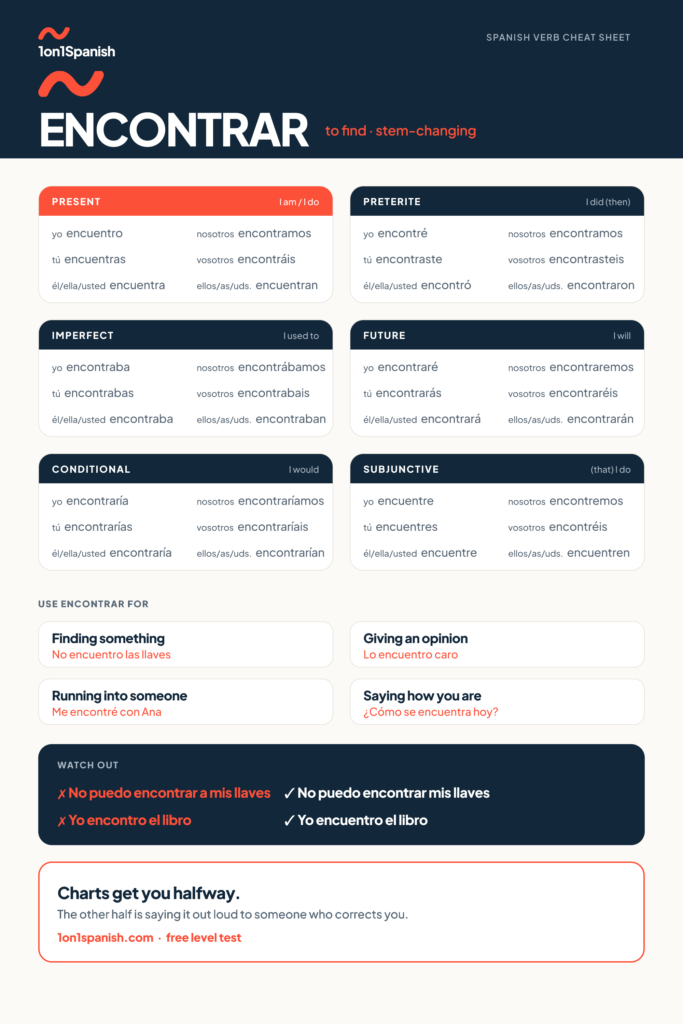
Take the chart with you
The chart is free to view and share. Drop your email and we’ll send the print-ready US Letter PDF — the version you stick on the fridge.
Practice
Practice encontrar and buscar with a real teacher
Charts get you halfway. The other half is saying it out loud to someone who corrects you on the spot. At 1on1Spanish you get 25-minute private lessons with a qualified native teacher, exercises built from the mistakes you make in class, and AI practice between lessons.
First month $1. No contracts, cancel anytime.
Guides help. A teacher hears what a guide cannot — Learn Spanish online with a real teacher.
Take your free level testBuilt on RingTeacher's method — 700,000+ classes delivered since 2017, teaching English to Spanish speakers. Now in the other direction.
Frequently asked questions
Is encontrar an irregular verb in Spanish?
Encontrar is a stem-changing verb, not a fully irregular one. The o becomes ue whenever the stress falls on the stem: encuentro, encuentras, encuentra, encuentran in the present, and encuentre, encuentres, encuentre, encuentren in the subjunctive. The preterite, imperfect, future and conditional are entirely regular, as are the participle encontrado and the gerund encontrando.
Why is it encuentro but encontramos?
Because the stem change only happens when the stress lands on the stem. In encuentro the stress falls on cuen, so the o breaks into ue. In encontramos the stress moves to the ending, and the stem keeps its original o. That is why these are called boot verbs: on a conjugation chart the changed forms outline a boot around nosotros and vosotros.
What is the difference between buscar and encontrar?
Buscar is the search and encontrar is the result. Busco trabajo means you are job hunting; encontré trabajo means you got one. Buscar also swallows the English “for”, so “I’m looking for my keys” is busco mis llaves, with no preposition. Adding por or para after buscar is a common English-speaker error.
How do you say “I can’t find it” in Spanish?
No lo encuentro, or no la encuentro if the thing is feminine. Spanish does not translate the “can” here — the plain present already carries it, and no puedo encontrarlo sounds stilted in everyday speech. For a place, use no encuentro la calle rather than a literal version of “I can’t locate it”.
What does encontrarse mean?
Encontrarse has three uses. With con, it means running into someone by chance: me encontré con mi jefe en el aeropuerto. Without it, it states where something is, in a formal register: la oficina se encuentra en el segundo piso. And with an adjective or adverb it describes health: no se encuentra bien means he isn’t feeling well.