
Entender conjugation in Spanish: every tense you need, with examples
Entender means “to understand”, and no entiendo is probably the first full sentence you’ll ever need in Spanish. It’s an e→ie stem-changing verb with regular -er endings, so the conjugations for entender split cleanly in two: the stressed forms take ie (entiendo, entiendes, entiende, entienden) and everything else stays plain. Full tables below. 1on1Spanish teaches this in 25-minute one-on-one lessons with qualified native teachers, online across the United States.
Reviewed by María Jiménez — Licenciada en Filología Hispánica (BA in Hispanic Philology) · Updated Sep 2026
What entender means
Entender is understanding in the sense of following what’s being said or grasping how something works: No entiendo el acento de Buenos Aires. ¿Entiendes cómo funciona el seguro médico?
It’s not limited to language. You use it for instructions, contracts, people’s reasons and situations: No entiendo por qué me han cobrado dos veces.
With the preposition de, it means knowing a subject well: Mi cuñado entiende de carros is “my brother-in-law knows cars”. That construction surprises learners, but it’s extremely common.
The reflexive entenderse means two people getting along or reaching an agreement: Nos entendemos bien. Entiéndete con él directamente.
Type: stem-changing e→ie, same family as perder, querer and pensar. The change appears in the present indicative, the present subjunctive and the tú, usted and ustedes commands. There is no change in the preterite, the imperfect, the future or the conditional. Participle entendido, gerund entendiendo, both regular. If you’ve already learned the perder conjugation, you’ve learned this one: swap the stem and the pattern is identical.
Entender conjugation: present tense
| Form | Example | |
|---|---|---|
| yo | entiendo | No entiendo la factura. (I don’t understand the bill.) |
| tú | entiendes | ¿Entiendes lo que dice el médico? (Do you understand what the doctor is saying?) |
| él / ella / usted | entiende | Mi mujer entiende el catalán. (My wife understands Catalan.) |
| nosotros | entendemos | No entendemos las condiciones del contrato. (We don’t understand the terms of the contract.) |
| vosotros | entendéis | ¿Entendéis el formulario? (Do you understand the form?) |
| ellos / ellas / ustedes | entienden | Mis hijos entienden más de lo que hablan. (My kids understand more than they speak.) |
Entender conjugation: preterite
No stem change here. This tense is fully regular.
| Form | |
|---|---|
| yo | entendí |
| tú | entendiste |
| él / ella / usted | entendió |
| nosotros | entendimos |
| vosotros | entendisteis |
| ellos / ellas / ustedes | entendieron |
No entendí nada de la reunión. — I didn’t understand a thing in the meeting.
Entender conjugation: imperfect
| Form | |
|---|---|
| yo | entendía |
| tú | entendías |
| él / ella / usted | entendía |
| nosotros | entendíamos |
| vosotros | entendíais |
| ellos / ellas / ustedes | entendían |
Al principio no entendía casi nada por teléfono. — At first I understood almost nothing on the phone.
For “I didn’t understand”, both past tenses work and they say different things: no entendí points at one moment, no entendía describes a stretch of time.
Entender conjugation: future
| Form | |
|---|---|
| yo | entenderé |
| tú | entenderás |
| él / ella / usted | entenderá |
| nosotros | entenderemos |
| vosotros | entenderéis |
| ellos / ellas / ustedes | entenderán |
Entender conjugation: conditional
| Form | |
|---|---|
| yo | entendería |
| tú | entenderías |
| él / ella / usted | entendería |
| nosotros | entenderíamos |
| vosotros | entenderíais |
| ellos / ellas / ustedes | entenderían |
Si lo explicaran despacio, lo entendería. — If they explained it slowly, I’d understand it.
Entender conjugation: present subjunctive
The ie returns in the same four persons. Nosotros and vosotros stay plain, as in every -er stem-changer.
| Form | |
|---|---|
| yo | entienda |
| tú | entiendas |
| él / ella / usted | entienda |
| nosotros | entendamos |
| vosotros | entendáis |
| ellos / ellas / ustedes | entiendan |
Quiero que entiendas por qué lo hice. — I want you to understand why I did it.
Entender conjugation: imperfect subjunctive
| Form (-ra) | Form (-se) | |
|---|---|---|
| yo | entendiera | entendiese |
| tú | entendieras | entendieses |
| él / ella / usted | entendiera | entendiese |
| nosotros | entendiéramos | entendiésemos |
| vosotros | entendierais | entendieseis |
| ellos / ellas / ustedes | entendieran | entendiesen |
Hablaba despacio para que lo entendiéramos. — He spoke slowly so we’d understand him.
Entender commands (imperative)
| Affirmative | Negative | |
|---|---|---|
| tú | entiende | no entiendas |
| usted | entienda | no entienda |
| nosotros | entendamos | no entendamos |
| vosotros | entended | no entendáis |
| ustedes | entiendan | no entiendan |
The command form mostly appears in set phrases: entiéndeme, entiéndalo usted, no me entiendas mal. Note the accent when a pronoun is attached.
Participle, gerund and compound tenses
Participle entendido, gerund entendiendo. Compounds with haber:
He entendido, gracias (present perfect) · No había entendido la pregunta (past perfect) · Para entonces ya habrás entendido el sistema (future perfect).
Entendido on its own is a complete reply meaning “got it”, the same way English uses “understood”.
When to use entender
Following what someone says
The core use, and the one you need on day one: Perdón, no entiendo. Softer than no sé and more precise than staying quiet.
Understanding a document or a rule
Bills, contracts, insurance, forms: No entiendo qué cubre la póliza.
Understanding someone’s reasons
Entiendo que estés cansado — I understand you’re tired. This one takes the subjunctive when it expresses acceptance rather than information.
Entender vs comprender vs saber
Three verbs sit near “understand” in English, and swapping them changes the register or the meaning.
| Spanish | What it conveys |
|---|---|
| No entiendo el acento. | I can’t follow it — everyday, spoken |
| No comprendo su decisión. | Formal or emotional weight; also “I can’t grasp why” |
| No sé la respuesta. | I lack the information — knowledge, not comprehension |
| Entiendo de motores. | I know the subject well |
Entender and comprender are interchangeable in many sentences, with entender far more frequent in speech. Saber is a different idea entirely and cannot replace either.
Common mistakes English speakers make with entender
The stem splits into ie in the stressed forms. Only entendemos and entendéis keep the plain e in the present.
The preterite has no stem change at all. This is the mirror image of the previous mistake and just as common.
Bueno is an adjective; modifying a verb needs bien. And español takes the article here.
Querer que triggers the subjunctive, and the subjunctive keeps the ie in tú: entiendas.
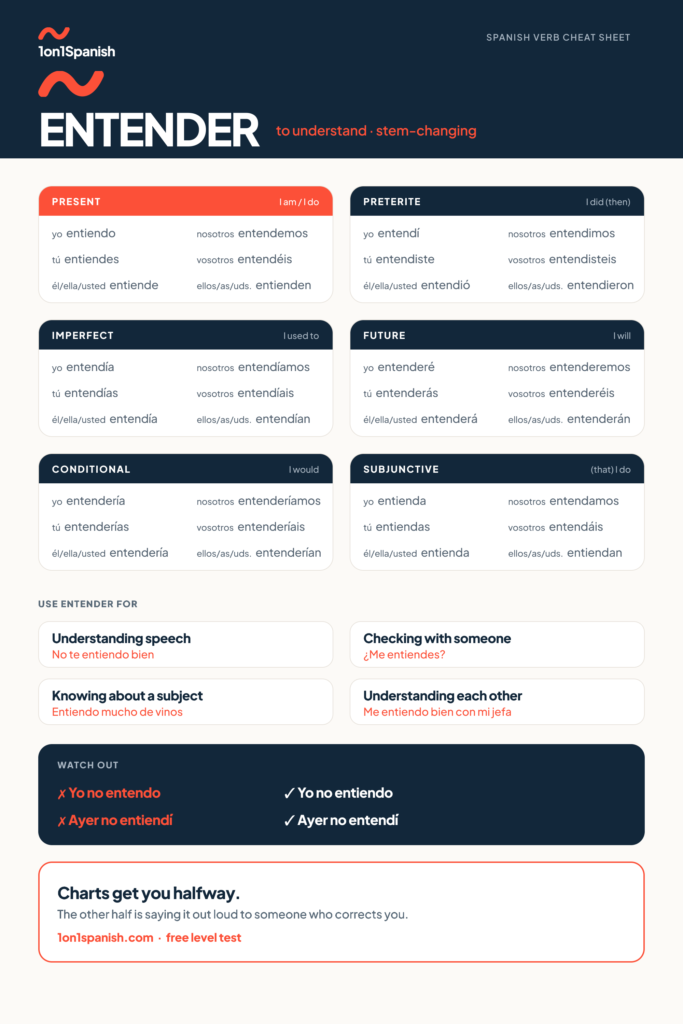
Take the chart with you
The chart is free to view and share. Drop your email and we’ll send the print-ready US Letter PDF — the version you stick on the fridge.
Practice
Practice entender with a real teacher
Charts get you halfway. The other half is saying it out loud to someone who corrects you on the spot. At 1on1Spanish you get 25-minute private lessons with a qualified native teacher, exercises built from the mistakes you make in class, and AI practice between lessons.
First month $1. No contracts, cancel anytime.
All our conjugation tables are in the guide to Spanish verbs.
Grammar you can read. Speaking you cannot. Learn Spanish online and practice it live.
Take your free level testBuilt on RingTeacher's method — 700,000+ classes delivered since 2017, teaching English to Spanish speakers. Now in the other direction.
Frequently asked questions
Is entender regular or irregular in Spanish?
Entender is a stem-changing verb with regular -er endings. The e of the stem becomes ie whenever it’s stressed: entiendo, entiendes, entiende, entienden in the present, the same four persons in the present subjunctive, and the tú, usted and ustedes commands. The preterite, imperfect, future, conditional and participle entendido are entirely regular.
What’s the difference between entender and comprender?
In most sentences they’re interchangeable, and entender is the one people actually say. Comprender sounds more formal in writing and carries more weight when the subject is a decision or a feeling: No comprendo su reacción. For following speech, an accent or an explanation, entender is the natural choice: No entiendo el acento chileno.
How do you say “I don’t understand” in Spanish?
No entiendo. That’s the complete sentence, and it’s polite as it stands. To be more specific, add what’s missing: No entiendo la palabra, No entiendo el acento, No entiendo lo que dice. If you want it repeated, follow up with ¿puede repetir, por favor?. In the past, use no entendí for one moment and no entendía for a stretch of time.
What does “entender de algo” mean?
Entender de plus a noun means knowing a subject well, not merely understanding it: Entiende de vinos, No entiendo nada de impuestos. Spanish speakers use it constantly to say who the expert in the room is. Drop the de and the meaning changes: entiende vinos would be comprehension, which isn’t what anyone means here.
Do I need the subjunctive of entender in everyday conversation?
Yes. Entiendas and entienda show up whenever you’re asking for understanding rather than stating it: Quiero que lo entiendas, Espero que me entienda, No creo que entiendan el problema. The negative command no me entiendas mal (“don’t get me wrong”) is subjunctive too, and it’s a phrase you’ll want early.