
Perder conjugation in Spanish: every tense you need, with examples
Perder means “to lose” and also “to miss”: a flight, a meeting, a chance. It’s an e→ie stem-changing verb, so the stressed forms come out as pierdo, pierdes, pierde, pierden while the endings stay those of a regular -er verb. Nothing else in the verb is irregular: the preterite, the imperfect and the participle behave normally. Every table is below. 1on1Spanish teaches these verbs in 25-minute one-on-one lessons with qualified native teachers, online across the United States.
Reviewed by María Jiménez — Licenciada en Filología Hispánica (BA in Hispanic Philology) · Updated Sep 2026
What perder means
The core sense is losing something you had: keys, a wallet, a client, a game. Perdí la cartera en el aeropuerto. Nuestro equipo perdió otra vez.
The second sense is missing something scheduled, and it catches English speakers off guard, because English uses a different verb: Perdí el vuelo is “I missed my flight”, not “I lost it”. Same with a train, a bus, an appointment or a deadline.
It also works with abstractions: perder tiempo, perder la paciencia, perder peso, perder el trabajo. Then there’s the reflexive perderse, a separate verb in practice: me perdí is “I got lost”.
Classification: stem-changing e→ie, in the same family as entender, querer and pensar. The change appears in the present indicative, the present subjunctive and the tú/usted/ustedes commands, and nowhere else. Participle perdido, gerund perdiendo, both regular. The entender conjugation follows the exact same pattern, so the two verbs are worth learning together.
Perder conjugation: present tense
| Form | Example | |
|---|---|---|
| yo | pierdo | Siempre pierdo las llaves. (I always lose my keys.) |
| tú | pierdes | Pierdes mucho tiempo en el tráfico. (You lose a lot of time in traffic.) |
| él / ella / usted | pierde | Mi padre pierde los lentes cada día. (My father loses his glasses every day.) |
| nosotros | perdemos | Si salimos ahora, no perdemos el tren. (If we leave now, we won’t miss the train.) |
| vosotros | perdéis | ¿Perdéis mucho dinero con eso? (Are you losing a lot of money on that?) |
| ellos / ellas / ustedes | pierden | Pierden clientes cada mes. (They lose clients every month.) |
Perder conjugation: preterite
Completely regular. No stem change: the stress moves onto the ending.
| Form | |
|---|---|
| yo | perdí |
| tú | perdiste |
| él / ella / usted | perdió |
| nosotros | perdimos |
| vosotros | perdisteis |
| ellos / ellas / ustedes | perdieron |
Perdimos el vuelo de conexión en Dallas. — We missed our connecting flight in Dallas.
Perder conjugation: imperfect
| Form | |
|---|---|
| yo | perdía |
| tú | perdías |
| él / ella / usted | perdía |
| nosotros | perdíamos |
| vosotros | perdíais |
| ellos / ellas / ustedes | perdían |
Antes perdía la paciencia con mucha facilidad. — I used to lose my patience very easily.
Perder conjugation: future
| Form | |
|---|---|
| yo | perderé |
| tú | perderás |
| él / ella / usted | perderá |
| nosotros | perderemos |
| vosotros | perderéis |
| ellos / ellas / ustedes | perderán |
Perder conjugation: conditional
| Form | |
|---|---|
| yo | perdería |
| tú | perderías |
| él / ella / usted | perdería |
| nosotros | perderíamos |
| vosotros | perderíais |
| ellos / ellas / ustedes | perderían |
Sin ese contrato perderíamos la mitad del año. — Without that contract we’d lose half the year.
Perder conjugation: present subjunctive
The stem change comes back, but nosotros and vosotros stay regular. That’s the rule for -er stem-changers, and it’s what separates perder from an -ir verb like repetir. Compare the repetir conjugation, where the stem shifts in every single person of this tense.
| Form | |
|---|---|
| yo | pierda |
| tú | pierdas |
| él / ella / usted | pierda |
| nosotros | perdamos |
| vosotros | perdáis |
| ellos / ellas / ustedes | pierdan |
Espero que no pierdas el vuelo. — I hope you don’t miss your flight.
Perder conjugation: imperfect subjunctive
Built on the preterite stem, so no ie anywhere. Both endings are correct; the -ra set is the one you’ll hear.
| Form (-ra) | Form (-se) | |
|---|---|---|
| yo | perdiera | perdiese |
| tú | perdieras | perdieses |
| él / ella / usted | perdiera | perdiese |
| nosotros | perdiéramos | perdiésemos |
| vosotros | perdierais | perdieseis |
| ellos / ellas / ustedes | perdieran | perdiesen |
Si perdiera el trabajo, me mudaría. — If I lost my job, I’d move.
Perder commands (imperative)
| Affirmative | Negative | |
|---|---|---|
| tú | pierde | no pierdas |
| usted | pierda | no pierda |
| nosotros | perdamos | no perdamos |
| vosotros | perded | no perdáis |
| ustedes | pierdan | no pierdan |
In real life the negative is what you hear: No pierdas la calma. No se pierda la cita. The affirmative shows up mostly in fixed advice: pierde el miedo.
Participle, gerund and compound tenses
Participle perdido, gerund perdiendo. Compounds with haber:
He perdido el recibo (present perfect) · Había perdido el interés hacía meses (past perfect) · Habré perdido media hora buscándolo (future perfect).
Perdido also works as an adjective: un caso perdido, estoy perdido.
When to use perder
Losing an object
Wallet, phone, passport, insurance card: He perdido la tarjeta del seguro. The thing existed, and now you can’t find it.
Missing something with a schedule
Flights, trains, connections, appointments, deadlines: Perdí la cita con el dentista. English says “miss”; Spanish says perder.
Losing a competition or a case
Perdimos el partido. El abogado perdió el juicio.
Losing something abstract
Perder el trabajo, perder peso, perder la paciencia, perder la esperanza, perder el tiempo. These are set phrases; learn them whole.
Perder vs faltar vs echar de menos
English “miss” splits into three Spanish verbs, and picking the wrong one changes what you said.
| Spanish | What it means |
|---|---|
| Perdí el avión. | I missed the plane — it left without me |
| Falté a la reunión. | I missed the meeting — I didn’t show up |
| Echo de menos a mi hermana. | I miss my sister — I feel her absence |
| Me faltan dos dólares. | I’m two dollars short — something is lacking |
Rule of thumb: perder is for things that leave without you, faltar a for events you skipped, and echar de menos (or extrañar in most of Latin America) for people and places.
Common mistakes English speakers make with perder
The stem vowel splits into ie in every stressed form. Perdemos and perdéis are the only two present forms that keep the plain e.
The preterite has no stem change at all. Writing pierdí is the single most common error on this verb.
Perder never means missing a person emotionally. Said to someone you care about, te pierdo sounds like you’re losing them.
Esperar que triggers the subjunctive, and the subjunctive keeps the ie: pierdas, not pierdes.
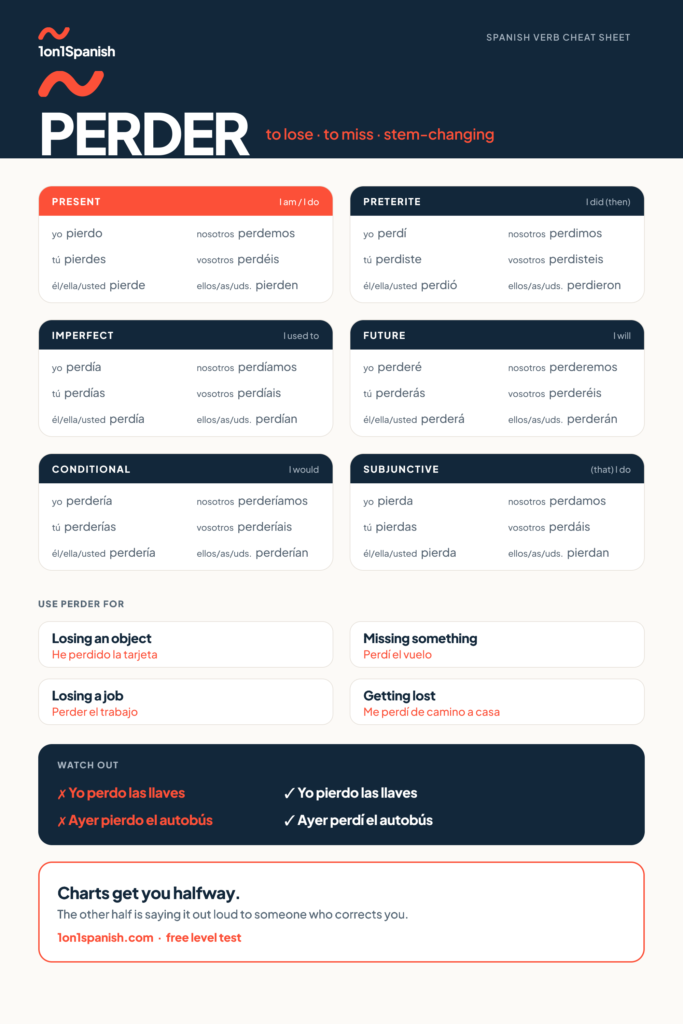
Take the chart with you
The chart is free to view and share. Drop your email and we’ll send the print-ready US Letter PDF — the version you stick on the fridge.
Practice
Practice perder with a real teacher
Charts get you halfway. The other half is saying it out loud to someone who corrects you on the spot. At 1on1Spanish you get 25-minute private lessons with a qualified native teacher, exercises built from the mistakes you make in class, and AI practice between lessons.
First month $1. No contracts, cancel anytime.
More conjugation tables in our guide to Spanish verbs.
Guides help. A teacher hears what a guide cannot — Learn Spanish online with a real teacher.
Take your free level testBuilt on RingTeacher's method — 700,000+ classes delivered since 2017, teaching English to Spanish speakers. Now in the other direction.
Frequently asked questions
Is perder regular or irregular in Spanish?
Perder is a stem-changing verb with regular endings. The e becomes ie whenever it’s stressed: pierdo, pierdes, pierde, pierden in the present, the same four persons in the present subjunctive, and the tú, usted and ustedes commands. Everything else follows the standard -er pattern: preterite, imperfect, future, conditional, participle perdido.
What’s the difference between perder and echar de menos?
Perder is losing or missing something physical or scheduled: an object, a flight, a game, a job. Echar de menos is missing someone or something emotionally: Echo de menos a mis padres. In most of Latin America people say extrañar instead. Using perder for a person suggests you’re losing them, which is not what you mean.
How do you say “I missed my flight” in Spanish?
Perdí el vuelo. Add the detail the way you would in English: Perdí el vuelo por el tráfico, Perdí la conexión en Miami, Perdimos el vuelo de vuelta. Note the preterite has no stem change, so it’s perdí, never pierdí. For an appointment you didn’t attend, use faltar a: Falté a la cita.
How do you use perderse to say “I got lost”?
Perderse is the reflexive form, and it needs a pronoun that matches the subject: me perdí, te perdiste, se perdió, nos perdimos, se perdieron. Me perdí buscando el hospital is “I got lost looking for the hospital”. It also means missing out on something: Te perdiste una cena buenísima.
Do I need the subjunctive of perder in everyday conversation?
Yes, mainly through negative commands and polite worry. No pierdas el recibo and No pierda usted el tiempo are subjunctive forms, and so is anything after espero que, ojalá or antes de que: Ojalá no pierdan la maleta. You’ll produce pierda and pierdas in your first weeks of real conversation, before you ever study the tense by name.