
Escribir conjugation in Spanish: every tense you need, with examples
Escribir means “to write”, and it is the model regular -ir verb: learn these tables and you have vivir, recibir, subir, decidir and permitir for free, because they take exactly the same endings. One thing breaks the pattern, and only one: the past participle is escrito, not escribido. Everything else is by the book. Full tables below. 1on1Spanish teaches regular verb patterns in 25-minute one-on-one lessons with qualified native teachers, online across the United States.
Reviewed by María Jiménez — Licenciada en Filología Hispánica (BA in Hispanic Philology) · Updated Aug 2026
What escribir means
Escribir is “to write” in every English sense: writing a message, writing a book, writing a check, writing to somebody. Escribo a mi hermana todos los domingos. Escribió tres novelas.
It also covers spelling. When someone asks ¿cómo se escribe?, they want the letters, not your handwriting: ¿Cómo se escribe tu apellido? Memorize that question whole. You’ll use it at every counter, clinic and hotel desk in a Spanish-speaking country.
With the preposition a, it means writing to a person: Le escribí al banco. With sobre or de, it means writing about a subject: Escribe sobre política.
Grammatically: regular -ir verb. The stem escrib- never changes vowel, never changes spelling, and never adds a letter. The gerund is escribiendo, formed the normal way. The only irregular form in the entire verb is the participle escrito, which it shares with its relatives describir → descrito and inscribir → inscrito.
How the regular -ir pattern works
Take the infinitive, drop -ir, and you get the stem escrib-. Every simple tense is that stem plus a fixed set of endings, identical for all regular -ir verbs:
- Present: -o, -es, -e, -imos, -ís, -en
- Preterite: -í, -iste, -ió, -imos, -isteis, -ieron
- Imperfect: -ía, -ías, -ía, -íamos, -íais, -ían
- Subjunctive: -a, -as, -a, -amos, -áis, -an
Future and conditional don’t even drop the ending: they attach to the whole infinitive, escribir- + -é, -ás, -á…. Compare with vivir (vivo, viví, vivía, viviré) and the parallel is exact.
Escribir conjugation: present tense
| Form | Example | |
|---|---|---|
| yo | escribo | Escribo el informe esta tarde. (I’m writing the report this afternoon.) |
| tú | escribes | ¿Cómo se escribe tu nombre? (How do you spell your name?) |
| él / ella / usted | escribe | Mi madre escribe cartas a mano. (My mother writes letters by hand.) |
| nosotros | escribimos | Escribimos a la aseguradora cada mes. (We write to the insurance company every month.) |
| vosotros | escribís | ¿Escribís vosotros el acta? (Are you writing the minutes?) |
| ellos / ellas / ustedes | escriben | Escriben el contrato en dos idiomas. (They write the contract in two languages.) |
Escribir conjugation: preterite
| Form | |
|---|---|
| yo | escribí |
| tú | escribiste |
| él / ella / usted | escribió |
| nosotros | escribimos |
| vosotros | escribisteis |
| ellos / ellas / ustedes | escribieron |
Escribí al médico para pedir el informe. — I wrote to the doctor to ask for the report.
Note that escribimos is both present and preterite. Regular -ir verbs share that form, and context does the rest: ayer escribimos vs hoy escribimos.
Escribir conjugation: imperfect
| Form | |
|---|---|
| yo | escribía |
| tú | escribías |
| él / ella / usted | escribía |
| nosotros | escribíamos |
| vosotros | escribíais |
| ellos / ellas / ustedes | escribían |
Mi abuelo escribía a máquina. — My grandfather used to write on a typewriter.
Escribir conjugation: future
| Form | |
|---|---|
| yo | escribiré |
| tú | escribirás |
| él / ella / usted | escribirá |
| nosotros | escribiremos |
| vosotros | escribiréis |
| ellos / ellas / ustedes | escribirán |
Escribir conjugation: conditional
| Form | |
|---|---|
| yo | escribiría |
| tú | escribirías |
| él / ella / usted | escribiría |
| nosotros | escribiríamos |
| vosotros | escribiríais |
| ellos / ellas / ustedes | escribirían |
Yo lo escribiría por correo, no por teléfono. — I’d put it in writing, not over the phone.
Escribir conjugation: present subjunctive
| Form | |
|---|---|
| yo | escriba |
| tú | escribas |
| él / ella / usted | escriba |
| nosotros | escribamos |
| vosotros | escribáis |
| ellos / ellas / ustedes | escriban |
Quiero que me lo escriba, por favor. — I’d like you to write it down for me, please.
Escribir conjugation: imperfect subjunctive
| Form (-ra) | Form (-se) | |
|---|---|---|
| yo | escribiera | escribiese |
| tú | escribieras | escribieses |
| él / ella / usted | escribiera | escribiese |
| nosotros | escribiéramos | escribiésemos |
| vosotros | escribierais | escribieseis |
| ellos / ellas / ustedes | escribieran | escribiesen |
Me pidió que le escribiera una carta de recomendación. — She asked me to write her a recommendation letter.
Escribir commands (imperative)
| Affirmative | Negative | |
|---|---|---|
| tú | escribe | no escribas |
| usted | escriba | no escriba |
| nosotros | escribamos | no escribamos |
| vosotros | escribid | no escribáis |
| ustedes | escriban | no escriban |
Escríbalo aquí, por favor. — Write it here, please. As with any command, attaching a pronoun adds a written accent: escríbelo, escríbemelo.
Participle, gerund and compound tenses
Gerund escribiendo, regular. Participle escrito, irregular — this is the one form you have to memorize separately.
He escrito tres correos y nadie contesta (present perfect) · Había escrito mi nombre mal en el formulario (past perfect) · Habré escrito unas cien páginas este año (future perfect).
Escrito also works as an adjective and as a noun: un examen escrito, ponlo por escrito. The rule that produces these forms is in past participle.
When to use escribir
Writing a text, a message or a document
Email, report, invoice, note for the doctor: Te escribo un correo con los detalles.
Writing to a person or an institution
With a: Escribí a la compañía de seguros y no me han contestado.
Spelling
¿Cómo se escribe? asks for the letters. ¿Puede escribirlo? asks for it in writing. Both are useful in the same situations: hotel check-in, pharmacy, bank.
Signing up and filling out forms
Escriba su nombre completo en mayúsculas is what the clerk will tell you.
Being an author
Escribe en un periódico local. No article before the profession, the way Spanish does with ser.
Common mistakes English speakers make with escribir
The participle is escrito. The same goes for its family: descrito, inscrito. Every other tense of this verb is regular, which is exactly why the participle catches people out.
A time marker in the past forces the preterite. The present escribo only works for now or for a scheduled future.
Writing to a person needs the preposition a. Without it, the sentence reads as if you were writing your mother down.
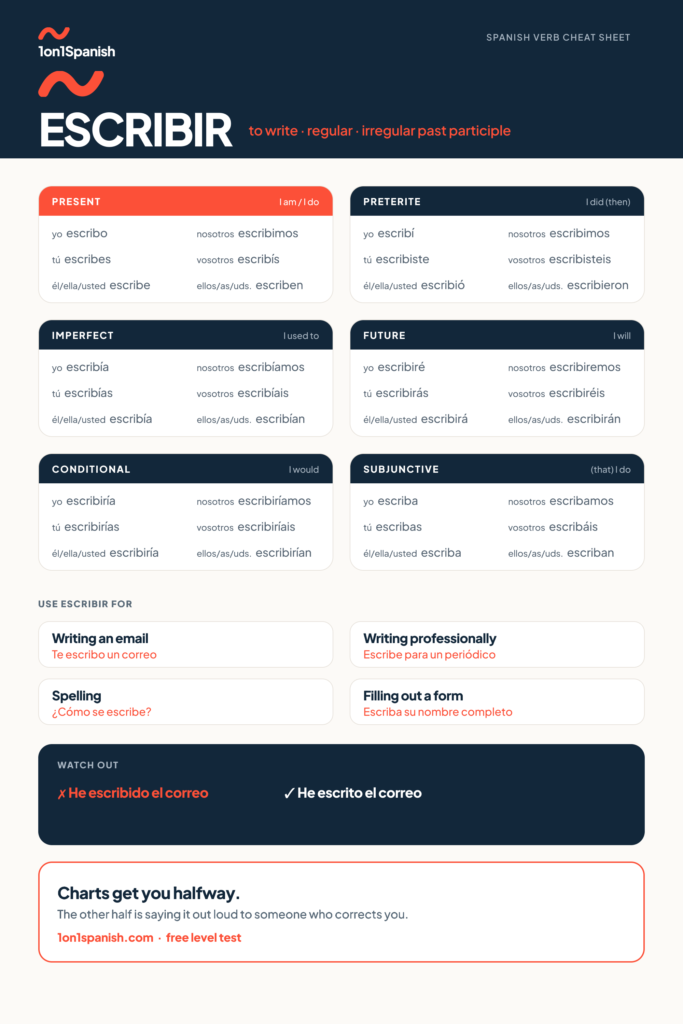
Take the chart with you
The chart is free to view and share. Drop your email and we’ll send the print-ready US Letter PDF — the version you stick on the fridge.
Practice
Practice regular -ir verbs with a real teacher
Charts get you halfway. The other half is saying it out loud to someone who corrects you on the spot. At 1on1Spanish you get 25-minute private lessons with a qualified native teacher, exercises built from the mistakes you make in class, and AI practice between lessons.
First month $1. No contracts, cancel anytime.
Every table we have lives in our guide to Spanish verbs.
When you are ready to speak it out loud, try online Spanish lessons with a native teacher.
Take your free level testBuilt on RingTeacher's method — 700,000+ classes delivered since 2017, teaching English to Spanish speakers. Now in the other direction.
Frequently asked questions
Is escribir regular or irregular in Spanish?
Escribir is regular in every main tense. Present, preterite, imperfect, future, conditional, both subjunctives and the commands all follow the standard -ir pattern on the stem escrib-. The single exception is the past participle, escrito, which replaces the expected escribido and carries over to describir → descrito and inscribir → inscrito.
Why is the past participle of escribir “escrito”?
Escrito comes straight from Latin scriptus, and it survived while the regular ending took over elsewhere in the verb. A small group of common verbs kept their inherited participles the same way: abierto from abrir, dicho from decir, hecho from hacer, visto from ver, puesto from poner. There are about a dozen worth memorizing as a set.
How do you say “how do you spell it?” in Spanish?
¿Cómo se escribe? You can add the word: ¿Cómo se escribe tu apellido? If you want it written down rather than spelled out, say ¿Me lo puede escribir, por favor? Both are polite with anyone. Asking ¿cómo escribes? changes the meaning to a question about someone’s handwriting or writing style, which is not what you want at a hotel desk.
What is the past tense of escribir in Spanish?
The preterite is escribí, escribiste, escribió, escribimos, escribisteis, escribieron, used for a finished action: Escribí el informe el lunes. The imperfect is escribía, escribías, escribía, escribíamos, escribíais, escribían, used for habits and background: Escribía todas las mañanas. For something with a present connection, use he escrito.
Which other verbs follow the same pattern as escribir?
Any regular -ir verb: vivir, recibir, subir, decidir, permitir, existir, abrir, partir. They share the endings exactly, so once you have escribir you have all of them. Watch the participles, though: abrir gives abierto and escribir gives escrito, while vivir and recibir behave normally with vivido and recibido.