
Estudiar conjugation in Spanish: every tense you need, with examples
Estudiar means “to study”, and it’s a fully regular -ar verb — every tense follows the pattern you already know from hablar. The real trap isn’t the conjugation, it’s the meaning: estudiar overlaps with aprender and repasar, and English speakers often reach for it when a native speaker would examine something instead. All nine tables are below, along with the line between estudiar and aprender. 1on1Spanish teaches this in 25-minute one-on-one lessons with qualified native teachers, online across the United States.
Reviewed by María Jiménez — Licenciada en Filología Hispánica (BA in Hispanic Philology) · Updated Sep 2026
What estudiar means
Estudiar is “to study” in the academic sense: estudia medicina, estudié en la Universidad Nacional. It also covers preparing for something specific — estudiar para el examen, estudiar para el examen de manejo — where English would just say “study for” too.
The less obvious use is closer to “to examine” or “to look into”: voy a estudiar tu propuesta means I’m going to review your proposal carefully, not that I’ll read it like a textbook. Companies say estamos estudiando la solicitud, meaning the application is under review. English speakers often reach for “revisar” here out of habit, when estudiar is the more natural, more formal choice.
Grammatically it’s fully regular: the -ar endings apply in every tense with no stem change and no spelling change. Participle estudiado, gerund estudiando.
Estudiar conjugation: present tense
Fully regular. No irregular forms in this table.
| Form | Example | |
|---|---|---|
| yo | estudio | Estudio contabilidad por las noches. (I study accounting at night.) |
| tú | estudias | ¿Todavía estudias enfermería? (Are you still studying nursing?) |
| él / ella / usted | estudia | Mi hija estudia en línea este semestre. (My daughter is studying online this semester.) |
| nosotros | estudiamos | Estudiamos juntos los sábados. (We study together on Saturdays.) |
| vosotros | estudiáis | ¿Estudiáis para el mismo examen? (Are you studying for the same test?) |
| ellos / ellas / ustedes | estudian | Mis sobrinos estudian en la universidad pública. (My nephews study at the public university.) |
Estudiar conjugation: preterite
Regular -ar endings, no spelling change.
| Form | |
|---|---|
| yo | estudié |
| tú | estudiaste |
| él / ella / usted | estudió |
| nosotros | estudiamos |
| vosotros | estudiasteis |
| ellos / ellas / ustedes | estudiaron |
Estudié toda la noche antes del examen final. — I studied all night before the final exam.
Estudiar conjugation: imperfect
Fully regular, no exceptions.
| Form | |
|---|---|
| yo | estudiaba |
| tú | estudiabas |
| él / ella / usted | estudiaba |
| nosotros | estudiábamos |
| vosotros | estudiabais |
| ellos / ellas / ustedes | estudiaban |
De adolescente, estudiaba con la radio encendida. — As a teenager, I used to study with the radio on.
Estudiar conjugation: future
Regular endings on the full infinitive.
| Form | |
|---|---|
| yo | estudiaré |
| tú | estudiarás |
| él / ella / usted | estudiará |
| nosotros | estudiaremos |
| vosotros | estudiaréis |
| ellos / ellas / ustedes | estudiarán |
El próximo año estudiaré por las tardes. — Next year I’ll study in the afternoons.
Estudiar conjugation: conditional
| Form | |
|---|---|
| yo | estudiaría |
| tú | estudiarías |
| él / ella / usted | estudiaría |
| nosotros | estudiaríamos |
| vosotros | estudiaríais |
| ellos / ellas / ustedes | estudiarían |
Yo estudiaría enfermería si pudiera empezar de nuevo. — I’d study nursing if I could start over.
Estudiar conjugation: present subjunctive
Built on the estudio stem, fully regular.
| Form | |
|---|---|
| yo | estudie |
| tú | estudies |
| él / ella / usted | estudie |
| nosotros | estudiemos |
| vosotros | estudiéis |
| ellos / ellas / ustedes | estudien |
Espero que estudies más este semestre. — I hope you study more this semester.
Estudiar conjugation: imperfect subjunctive
Built on the preterite stem estudiar-, both forms interchangeable.
| Form (-ra) | Form (-se) | |
|---|---|---|
| yo | estudiara | estudiase |
| tú | estudiaras | estudiases |
| él / ella / usted | estudiara | estudiase |
| nosotros | estudiáramos | estudiásemos |
| vosotros | estudiarais | estudiaseis |
| ellos / ellas / ustedes | estudiaran | estudiasen |
Si estudiara más, sacaría mejores notas. — If I studied more, I’d get better grades.
Estudiar commands (imperative)
| Affirmative | Negative | |
|---|---|---|
| tú | estudia | no estudies |
| usted | estudie | no estudie |
| nosotros | estudiemos | no estudiemos |
| vosotros | estudiad | no estudiéis |
| ustedes | estudien | no estudien |
Estudia un poco cada día, no todo la noche anterior. — Study a little each day, not all the night before. Common advice from a teacher to a student.
Participle, gerund and compound tenses
Participle estudiado, gerund estudiando. Both fully regular. Compounds take haber:
He estudiado dos idiomas (present perfect) · Ya había estudiado el contrato antes de la reunión (past perfect) · Para junio habré estudiado todo el temario (future perfect).
When to use estudiar
Formal academic study
Estudia derecho en la universidad. This is the closest overlap with English “study” and the first meaning most learners assume.
Preparing for a specific test or task
Estudié para el examen de manejo todo el fin de semana. This use pairs naturally with para: what you’re studying for.
Examining something carefully, not just reading it
Vamos a estudiar tu caso antes de decidir. A lawyer, a doctor or a manager uses estudiar this way constantly, and it’s a more natural, more professional choice than revisar in a lot of contexts.
Considering an option in depth
Estamos estudiando la posibilidad de mudarnos. Not casual thinking — deliberate, ongoing consideration.
Estudiar vs aprender vs repasar
The three verbs sit on the same timeline, and the confusion is real: you can estudiar for hours and not aprender anything, which is a perfectly normal sentence in Spanish.
| Verb | What it describes |
|---|---|
| Estudiar | The activity, the effort you put in — estudié toda la noche |
| Aprender | The result, what actually sticks — aprendí muy poco |
| Repasar | Going over material you already know, to keep it fresh — repaso mis apuntes antes del examen |
Estudié toda la noche pero no aprendí nada is a complete, natural sentence: the studying happened, the learning didn’t. Repasar only works on material you’ve already covered once.
Common mistakes English speakers make with estudiar
A finished, one-time event last night needs the preterite, not the imperfect. Estudiaba would describe a repeated habit, not a single night.
To describe an action that started in the past and continues now, Spanish needs desde hace, not hace alone — or switch to llevo dos años estudiando español.
After espero que, the verb goes into the subjunctive: estudies, not estudias. The one-letter difference is easy to miss because the forms look almost identical.
An “if” clause about something hypothetical uses the imperfect subjunctive, never the conditional. The conditional only goes in the result clause.
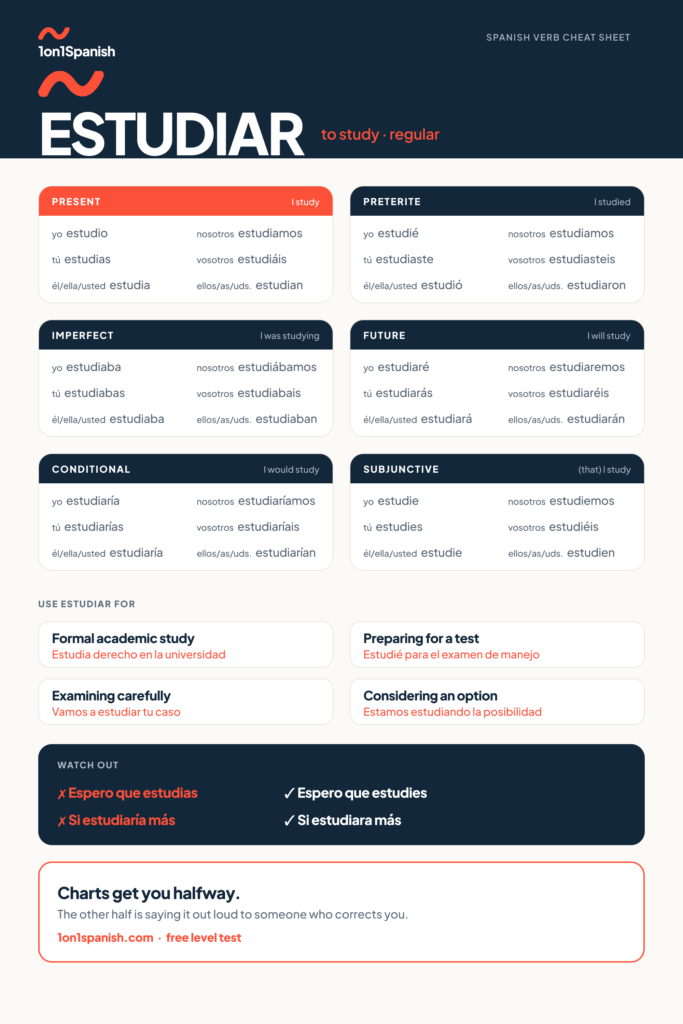
Take the chart with you
The chart is free to view and share. Drop your email and we’ll send the print-ready US Letter PDF — the version you stick on the fridge.
Practice
Practice estudiar with a real teacher
Charts get you halfway. The other half is saying it out loud to someone who corrects you on the spot. At 1on1Spanish you get 25-minute private lessons with a qualified native teacher, exercises built from the mistakes you make in class, and AI practice between lessons.
First month $1. No contracts, cancel anytime.
Grammar you can read. Speaking you cannot. Learn Spanish online and practice it live.
Take your free level testBuilt on RingTeacher's method — 700,000+ classes delivered since 2017, teaching English to Spanish speakers. Now in the other direction.
Frequently asked questions
Is estudiar regular or irregular in Spanish?
Fully regular. Estudiar follows the standard -ar pattern in every tense — present, preterite, imperfect, future, conditional and both subjunctives — with no stem change and no spelling change. The only thing to watch is the meaning, not the forms: it overlaps with aprender and repasar in ways English’s single verb “to study” doesn’t.
What’s the difference between estudiar and aprender?
Estudiar describes the effort — the time you spend with the material. Aprender describes the result — what you actually retain. You can say estudié toda la noche pero no aprendí nada (studied all night but learned nothing), which shows the two aren’t the same thing at all, even though English often uses “study” and “learn” almost interchangeably.
How do you say “I’ve been studying Spanish for two years”?
Llevo dos años estudiando español, using llevar plus a gerund, is the most natural way. You can also say estudio español desde hace dos años. Avoid estudio español hace dos años without desde — it sounds like a direct, incomplete translation from English.
What is the past tense of estudiar in Spanish?
Two options depending on the shape of the action. The preterite — estudié, estudiaste, estudió, estudiamos, estudiasteis, estudiaron — is for a completed session: estudié anoche. The imperfect — estudiaba, estudiabas, estudiaba, estudiábamos, estudiabais, estudiaban — is for a repeated habit: estudiaba todas las noches en la biblioteca.
Do I need the subjunctive of estudiar in everyday conversation?
Yes, mostly after wishes and doubt. Estudie appears after espero que (espero que estudies más), after quiero que (quiero que estudien juntos), and after expressions of doubt like no creo que (no creo que estudie lo suficiente). It’s one of the first subjunctives a learner practices, since it comes up constantly around school and work.