
Conjugating gustar in Spanish: every tense you need, with examples
Gustar is a perfectly regular -ar verb with an irregular job. It doesn’t mean “to like”. It means “to be pleasing to”, so the thing you like is the subject of the sentence and you are the indirect object. That’s why a mí me gusta el café is literally “to me, the coffee is pleasing”, and why you will almost never say yo gusto. In practice you conjugate two forms per tense, gusta and gustan, and change the pronoun in front. Tables and the sentence pattern are below. 1on1Spanish teaches this in 25-minute one-on-one lessons with qualified native teachers, online across the United States.
Reviewed by María Jiménez — Licenciada en Filología Hispánica (BA in Hispanic Philology) · Updated Aug 2026
What gustar means
Gustar expresses that something pleases you. English flips it into “I like it”, which is why the Spanish sentence looks inside out to an English speaker: Me gustan los tacos is “tacos are pleasing to me”, so los tacos is the subject and the verb agrees with it, not with you.
Because the subject is almost always a thing or an activity, gustar lives in the third person: gusta for one thing or for a verb in the infinitive, gustan for more than one thing. The full six-person paradigm exists and is grammatical, and me gustas means “I’m attracted to you”, but it’s rare enough that treating gusta and gustan as the working forms is the honest way to teach it.
It’s a regular -ar verb: no stem change, no spelling change. What’s unusual is the sentence it builds, not the endings. That’s why it feels harder than most Spanish verbs despite being simpler. Participle gustado, gerund gustando, both of which you’ll barely ever need.
How the sentence is built
Every gustar sentence has three slots, and only the middle one changes with the verb:
(a + person, optional) + indirect object pronoun + gustar + what you like
A mi mujer le gusta el vino tinto. — My wife likes red wine.
The pronoun is obligatory. The a + person part is optional and does two jobs: it clears up who le refers to, and it adds emphasis: a mí me gusta, pero a él no.
| Pronoun | Who it points to |
|---|---|
| me | a mí |
| te | a ti |
| le | a él / a ella / a usted |
| nos | a nosotros |
| os | a vosotros |
| les | a ellos / a ellas / a ustedes |
Gustar conjugation: present tense
| Pronoun | One thing / an activity | More than one thing |
|---|---|---|
| me | gusta — Me gusta este barrio. (I like this neighborhood.) | gustan — Me gustan los domingos. (I like Sundays.) |
| te | gusta — ¿Te gusta trabajar aquí? (Do you like working here?) | gustan — ¿Te gustan las clases? (Do you like the classes?) |
| le | gusta — A mi jefe le gusta llegar pronto. (My boss likes getting in early.) | gustan — Le gustan los perros. (He likes dogs.) |
| nos | gusta — Nos gusta el sitio. (We like the place.) | gustan — Nos gustan tus amigos. (We like your friends.) |
| os | gusta — ¿Os gusta el hotel? (Do you like the hotel?) | gustan — ¿Os gustan las vistas? (Do you like the views?) |
| les | gusta — A mis padres les gusta caminar. (My parents like walking.) | gustan — Les gustan los museos. (They like museums.) |
Note the third row: an infinitive is always singular, even two of them. Me gusta leer y cocinar, never me gustan leer y cocinar.
Gustar conjugation: preterite
Used for a reaction to one specific event: how the movie, the meal or the meeting went.
| Pronoun | Singular subject | Plural subject |
|---|---|---|
| me | gustó | gustaron |
| te | gustó | gustaron |
| le | gustó | gustaron |
| nos | gustó | gustaron |
| os | gustó | gustaron |
| les | gustó | gustaron |
Me gustó mucho la presentación. — I really liked the presentation.
Gustar conjugation: imperfect
Used for what you used to like, and for describing tastes in the past.
| Pronoun | Singular subject | Plural subject |
|---|---|---|
| me | gustaba | gustaban |
| te | gustaba | gustaban |
| le | gustaba | gustaban |
| nos | gustaba | gustaban |
| os | gustaba | gustaban |
| les | gustaba | gustaban |
De niño no me gustaban las verduras. — As a kid I didn’t like vegetables.
Gustar conjugation: future
| Pronoun | Singular subject | Plural subject |
|---|---|---|
| me | gustará | gustarán |
| te | gustará | gustarán |
| le | gustará | gustarán |
| nos | gustará | gustarán |
| os | gustará | gustarán |
| les | gustará | gustarán |
Te gustará el restaurante, ya verás. — You’ll like the restaurant, you’ll see.
Gustar conjugation: conditional
The most useful tense of the whole page. Me gustaría is how adults ask for things politely in Spanish: in a restaurant, on the phone, in an email.
| Pronoun | Singular subject | Plural subject |
|---|---|---|
| me | gustaría | gustarían |
| te | gustaría | gustarían |
| le | gustaría | gustarían |
| nos | gustaría | gustarían |
| os | gustaría | gustarían |
| les | gustaría | gustarían |
Me gustaría reservar una mesa para cuatro. — I’d like to reserve a table for four.
Gustar conjugation: present subjunctive
Appears after espero que, ojalá and no creo que, usually about something you’re offering.
| Pronoun | Singular subject | Plural subject |
|---|---|---|
| me | guste | gusten |
| te | guste | gusten |
| le | guste | gusten |
| nos | guste | gusten |
| os | guste | gusten |
| les | guste | gusten |
Espero que te guste el regalo. — I hope you like the present.
Gustar conjugation: imperfect subjunctive
Mostly in si clauses and in extra-polite requests.
| Pronoun | Form (-ra) | Form (-se) |
|---|---|---|
| me | gustara / gustaran | gustase / gustasen |
| te | gustara / gustaran | gustase / gustasen |
| le | gustara / gustaran | gustase / gustasen |
| nos | gustara / gustaran | gustase / gustasen |
| os | gustara / gustaran | gustase / gustasen |
| les | gustara / gustaran | gustase / gustasen |
Si te gustara el jazz, te llevaría a este bar. — If you liked jazz, I’d take you to this bar.
Gustar commands (imperative)
There aren’t any in real use. A command tells a person to do something, and with gustar the person isn’t the one doing anything. The thing is. The forms guste and gusten exist and you’ll hear them in the fixed courtesy phrase cuando guste (“whenever you like”) and como gusten (“as you wish”), but that’s the whole of it.
| Form | What it’s actually used for | |
|---|---|---|
| usted | guste | Pase cuando guste. — Come in whenever you like. |
| ustedes | gusten | Siéntense donde gusten. — Sit wherever you like. |
To tell someone to enjoy something, Spanish uses a different verb: disfruta, que aproveche.
Participle, gerund and compound tenses
Participle gustado, gerund gustando. The compound tenses are grammatical but uncommon in speech; the present perfect is the only one you’ll really meet.
Me ha gustado mucho conocerte (present perfect) · Nunca me había gustado el pescado hasta ahora (past perfect). The gerund is almost never used with this verb.
When to use gustar
Talking about tastes and preferences
The default. Me gusta el barrio, me gustan los vecinos. Match the verb to what you like, not to yourself.
Liking an activity, always singular
Nos gusta salir a cenar los viernes. Infinitives don’t pluralize the verb, however many you stack.
Asking politely with me gustaría
Me gustaría hablar con el responsable. Softer than quiero, which can sound blunt to a stranger. This one sentence pattern will carry you through most service situations in Spanish.
Clarifying or emphasizing with a + person
Le gusta is ambiguous: him, her, or you formal. Add the phrase and it isn’t: A Marta le gusta. Use the same trick to contrast: A mí me gusta, a mi marido no.
Attraction, with the personal forms
Me gustas means “I like you” romantically. To say you like someone as a person, Spanish uses me cae bien. Worth knowing before you use the wrong one at work.
Gustar vs encantar vs querer
Encantar is the same construction with the volume turned up, so it never takes muy or mucho. Querer is a normal verb with a normal subject, and it means wanting or loving a person.
| Say this | It means |
|---|---|
| Me gusta este vino | I like this wine |
| Me encanta este vino | I love this wine (never me encanta mucho) |
| Quiero este vino | I want this wine |
| Quiero a mi hermana | I love my sister |
| Me gusta mi hermana | wrong register — sounds romantic |
Encantar, interesar, importar, doler and faltar all work exactly like gustar. The full family is in gustar and similar verbs.
Common mistakes English speakers make with gustar
The most common error, and it’s structural: you are not the subject. The coffee is.
The verb agrees with what’s liked. Plural thing, plural verb, regardless of who likes it.
Infinitives never trigger the plural, even when there are two of them.
The a + person phrase goes with le, not floating at the end. Put it first and the sentence stops being ambiguous.
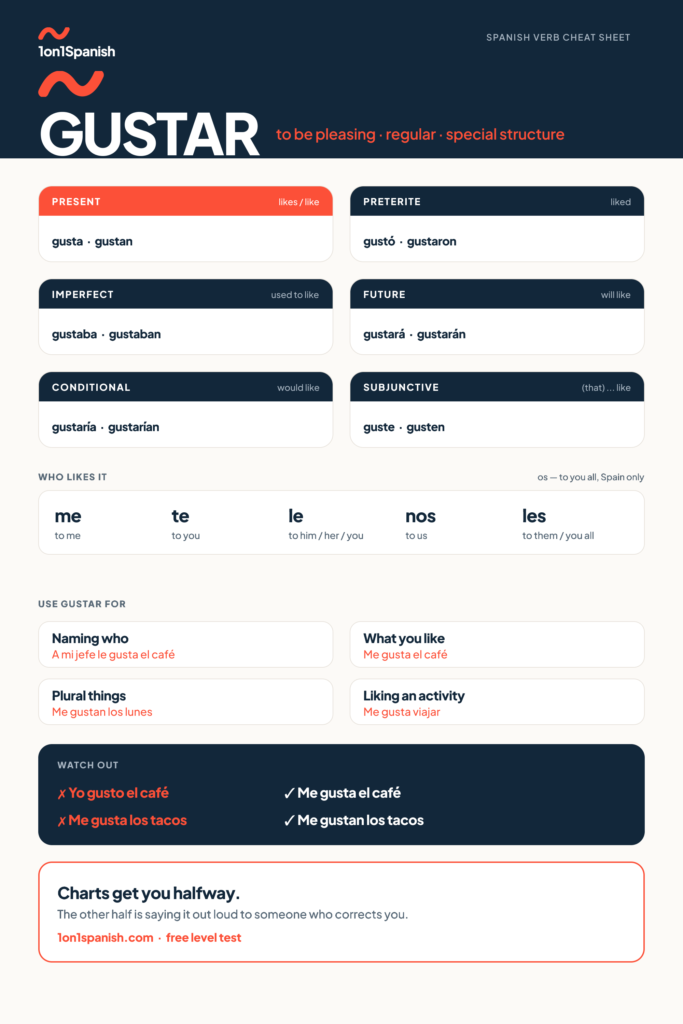
Take the chart with you
The chart is free to view and share. Drop your email and we’ll send the print-ready US Letter PDF — the version you stick on the fridge.
Practice
Practice gustar with a real teacher
Charts get you halfway. The other half is saying it out loud to someone who corrects you on the spot. At 1on1Spanish you get 25-minute private lessons with a qualified native teacher, exercises built from the mistakes you make in class, and AI practice between lessons.
First month $1. No contracts, cancel anytime.
This is one to drill in conversational Spanish, out loud, until it stops feeling backwards.
You can go further with someone listening: Learn Spanish with 1on1Spanish, 25 minutes at a time.
Take your free level testBuilt on RingTeacher's method — 700,000+ classes delivered since 2017, teaching English to Spanish speakers. Now in the other direction.
Frequently asked questions
Why do you say “me gusta” instead of “yo gusto”?
Because gustar means “to be pleasing to”, not “to like”. The thing that pleases you is the grammar subject, and you appear as an indirect object: me gusta el café is “the coffee is pleasing to me”. Yo gusto is technically a form of the verb, but it would mean “I am pleasing”, which is not what you’re trying to say.
When do you use gusta and when gustan?
Match the verb to the thing being liked. One item takes gusta: me gusta la playa. Several items take gustan: me gustan las playas. An infinitive always takes the singular, even in a list: me gusta cocinar y leer. The pronoun in front (me, te, le, nos, os, les) is what tells you who does the liking, and it never changes the verb.
How do you say “I like you” in Spanish?
Me gustas, using the personal form, which carries a romantic meaning. To say you like someone as a colleague or friend, Spanish uses a different expression: me cae bien. Confusing the two is a real workplace hazard: me gusta mi jefa says something quite different from me cae bien mi jefa.
What does “me gustaría” mean and when do you use it?
Me gustaría is the conditional and means “I would like”. It’s the standard polite way to ask for things in Spanish: me gustaría reservar una mesa, me gustaría hablar con usted un momento. It softens a request that quiero would make sound abrupt. The thing requested still governs the verb, so several items give you me gustarían.
Is gustar an irregular verb in Spanish?
No. Gustar takes standard -ar endings in every main tense, with no stem change and no spelling change. What makes it feel irregular is the sentence structure, not the conjugation: because the subject is usually a thing, you only ever meet the third-person forms gusta and gustan, plus their equivalents in the other tenses.