
Hablar conjugation in Spanish: every tense you need, with examples
Hablar means “to speak” and “to talk”, and it is the model regular -ar verb: no stem change, no spelling change, no surprise in any tense. That matters more than the verb itself. Roughly three out of four Spanish verbs end in -ar, so these endings also give you trabajar, estudiar, llamar, cocinar, viajar and thousands more. Below is every tense you need, plus the line where hablar stops and decir or contar takes over. 1on1Spanish teaches this in 25-minute one-on-one lessons with qualified native teachers, online across the United States.
Reviewed by María Jiménez — Licenciada en Filología Hispánica (BA in Hispanic Philology) · Updated Aug 2026
What hablar means
Hablar is both “speak” and “talk”, which English keeps apart and Spanish does not. Hablo español is “I speak Spanish”; Hablé con mi jefe is “I talked to my boss”. Same verb, and the difference sits in the preposition that follows.
Three prepositions carry most of the work. Hablar con is to talk with someone. Hablar de is to talk about a topic. Hablar a is to speak to someone, and it sounds more one-directional, closer to addressing them. There is also a reflexive use, hablarse, meaning to be on speaking terms: Hace meses que no se hablan.
The participle is hablado and the gerund is hablando, both built with the standard rule. Not a single irregular form appears anywhere in this page.
The -ar endings you get from this verb
Take hablar, remove the -ar, and you are left with the stem habl-. Everything after it belongs to the -ar family, not to this verb.
That is why hablar is worth learning properly rather than quickly. The endings below are the same ones you will put on trabajar (trabajo, trabajas), estudiar (estudié, estudiaste) and llamar (llamaba, llamabas). One pattern, thousands of verbs — and the two -ar tenses that trip learners up, the imperfect in -aba and the subjunctive in -e, are visible side by side here. The verbs that break the pattern are listed under Spanish verbs.
Hablar conjugation: present tense
Endings: -o, -as, -a, -amos, -áis, -an.
| Form | Example | |
|---|---|---|
| yo | hablo | Hablo un poco de español. (I speak a little Spanish.) |
| tú | hablas | ¿Hablas con ella todos los días? (Do you talk to her every day?) |
| él / ella / usted | habla | Mi jefa habla muy rápido. (My boss talks very fast.) |
| nosotros | hablamos | Hablamos de dinero en casa. (We talk about money at home.) |
| vosotros | habláis | ¿De qué habláis? (What are you talking about?) |
| ellos / ellas / ustedes | hablan | Mis hijos hablan inglés en casa. (My kids speak English at home.) |
Hablar conjugation: preterite
For one finished conversation, at a point in time.
| Form | |
|---|---|
| yo | hablé |
| tú | hablaste |
| él / ella / usted | habló |
| nosotros | hablamos |
| vosotros | hablasteis |
| ellos / ellas / ustedes | hablaron |
Ayer hablé con el seguro. — Yesterday I talked to the insurance company.
Watch the accents: hablo is “I speak” and habló is “he spoke”. The written accent is the only difference, and in speech it is the stressed syllable that tells them apart.
Hablar conjugation: imperfect
For talking that repeated or went on without a clear end.
| Form | |
|---|---|
| yo | hablaba |
| tú | hablabas |
| él / ella / usted | hablaba |
| nosotros | hablábamos |
| vosotros | hablabais |
| ellos / ellas / ustedes | hablaban |
Antes hablábamos por teléfono todos los domingos. — We used to talk on the phone every Sunday.
Hablar conjugation: future
Regular endings on the full infinitive.
| Form | |
|---|---|
| yo | hablaré |
| tú | hablarás |
| él / ella / usted | hablará |
| nosotros | hablaremos |
| vosotros | hablaréis |
| ellos / ellas / ustedes | hablarán |
Hablaré con el médico el lunes. — I’ll talk to the doctor on Monday.
Hablar conjugation: conditional
| Form | |
|---|---|
| yo | hablaría |
| tú | hablarías |
| él / ella / usted | hablaría |
| nosotros | hablaríamos |
| vosotros | hablaríais |
| ellos / ellas / ustedes | hablarían |
Yo hablaría con él antes de decidir. — I’d talk to him before deciding.
Hablar conjugation: present subjunctive
The -ar verbs swap to e endings in the subjunctive, which is the single most useful thing on this page after the present.
| Form | |
|---|---|
| yo | hable |
| tú | hables |
| él / ella / usted | hable |
| nosotros | hablemos |
| vosotros | habléis |
| ellos / ellas / ustedes | hablen |
Quiero que hables con recursos humanos. — I want you to talk to HR.
Hablar conjugation: imperfect subjunctive
Both sets are correct; the -ra forms are the ones you will hear.
| Form (-ra) | Form (-se) | |
|---|---|---|
| yo | hablara | hablase |
| tú | hablaras | hablases |
| él / ella / usted | hablara | hablase |
| nosotros | habláramos | hablásemos |
| vosotros | hablarais | hablaseis |
| ellos / ellas / ustedes | hablaran | hablasen |
Si hablaras más despacio, te entendería. — If you spoke more slowly, I’d understand you.
Hablar commands (imperative)
| Affirmative | Negative | |
|---|---|---|
| tú | habla | no hables |
| usted | hable | no hable |
| nosotros | hablemos | no hablemos |
| vosotros | hablad | no habléis |
| ustedes | hablen | no hablen |
Habla más alto, por favor. — Speak up, please. Note that the negative tú command is not no habla but no hables: negative commands borrow the subjunctive. The full pattern is in the Spanish imperative.
Participle, gerund and compound tenses
Participle hablado, gerund hablando. Compounds use haber:
He hablado con tu madre (present perfect) · Ya había hablado con ellos (past perfect) · Mañana ya habré hablado con el banco (future perfect).
When to use hablar
Speaking a language
No article: Hablo español, not hablo el español. The article does turn up when the language is qualified or contrasted (el español que se habla aquí), but for “I speak Spanish” you leave it out. Add bien, un poco or con fluidez to grade it.
Having a conversation
Hablar con plus the person: Necesito hablar contigo. Habló con el casero ayer. With contigo and conmigo the pronoun fuses into the preposition.
Talking about a topic
Hablar de: No quiero hablar de política en la cena.
Addressing someone formally
Hablar a leans toward speaking at somebody: No le hables así a tu padre. This is the one that shows up in arguments and in customer service.
Being on speaking terms
Hablarse, reflexive and reciprocal: Mis dos tíos no se hablan.
Hablar vs decir vs contar
All three land on “say”, “tell” and “talk” in English, and they are not interchangeable. Hablar almost never takes a direct object; decir and contar always do.
| Verb | What follows it | Example |
|---|---|---|
| hablar | a preposition — con, de, a | Hablé con mi jefe de las vacaciones. |
| decir | the actual words or message | Me dijo que llegaba tarde. |
| contar | a story, news, something with a plot | Cuéntame qué pasó en la reunión. |
The quick test: if English uses “tell me” or “say that”, it is not hablar. Háblame que llegas tarde is not Spanish; dime que llegas tarde is.
Common mistakes English speakers make with hablar
Habla is the él/ella/usted form, not yo. It’s the most basic verb conjugated in this whole page, and also the easiest slip to make when the mind is on the vocabulary instead of the ending.
Hablar is a regular -ar verb, so the yo preterite ends in -é, not -í. That ending belongs to -er/-ir verbs like comí or viví.
Con plus ti fuses into a single word, contigo. Same with conmigo. There is no con ti in Spanish.
Reporting content is decir. Hablar can only introduce a topic, never a message.
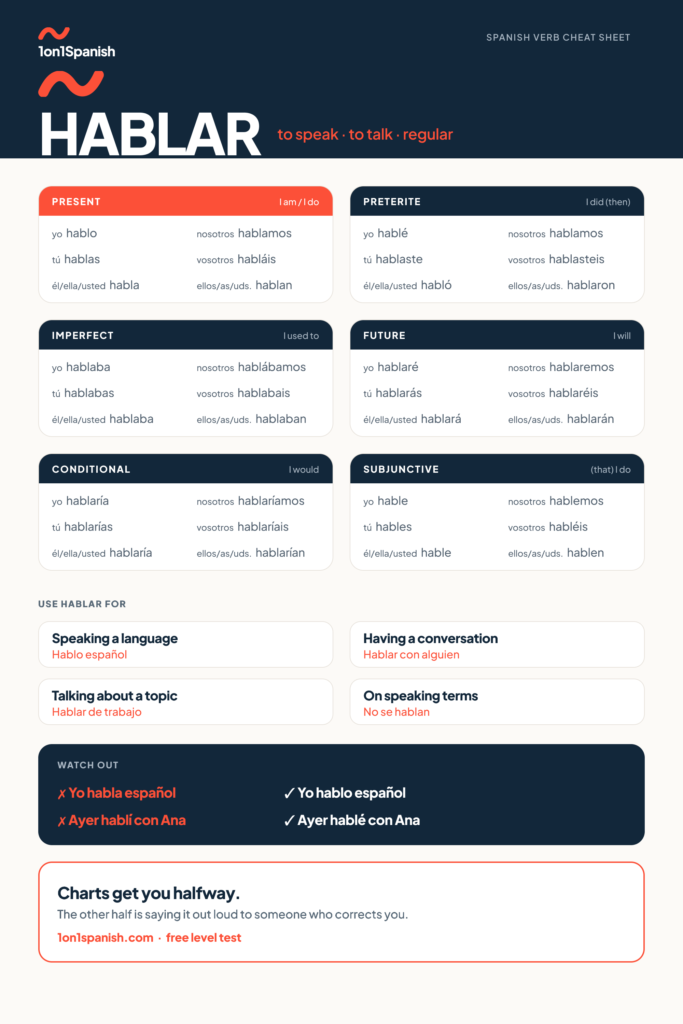
Take the chart with you
The chart is free to view and share. Drop your email and we’ll send the print-ready US Letter PDF — the version you stick on the fridge.
Practice
Practice hablar and the -ar verbs with a real teacher
Charts get you halfway. The other half is saying it out loud to someone who corrects you on the spot. At 1on1Spanish you get 25-minute private lessons with a qualified native teacher, exercises built from the mistakes you make in class, and AI practice between lessons.
First month $1. No contracts, cancel anytime.
Reading about it only gets you so far. Learn Spanish online in 25-minute conversations and use it.
Take your free level testBuilt on RingTeacher's method — 700,000+ classes delivered since 2017, teaching English to Spanish speakers. Now in the other direction.
Frequently asked questions
Is hablar a regular verb in Spanish?
Yes, completely. Hablar has no stem change, no spelling change and no irregular form in any tense, which is why textbooks use it as the model -ar verb. Its endings transfer directly to trabajar, estudiar, cocinar, llamar, viajar and most of the Spanish verb list, since -ar is by far the largest of the three families.
What are the -ar verb endings in Spanish?
Present: -o, -as, -a, -amos, -áis, -an. Preterite: -é, -aste, -ó, -amos, -asteis, -aron. Imperfect: -aba, -abas, -aba, -ábamos, -abais, -aban. Present subjunctive: -e, -es, -e, -emos, -éis, -en. The subjunctive swap from a to e is the one worth memorizing, because it is what separates habla from hable.
What is the difference between hablar and decir?
Hablar is the act of speaking and takes a preposition: hablar con someone, hablar de something. Decir is what you actually say and takes a direct object: decir la verdad, decir que sí. English “I talked to her” is hablé con ella, but “I told her” is le dije. Swapping them is one of the most common learner errors.
How do you say “I speak a little Spanish” in Spanish?
Hablo un poco de español. No article before the language, and un poco de rather than just un poco. If you want to soften it further, hablo español, pero poco is what a native speaker would say. To say you don’t speak it well, no hablo bien español is more natural than a literal translation of “not fluently”.
Do I need the subjunctive of hablar in everyday conversation?
Yes. Hable and hables show up any time you want somebody else to talk: quiero que hables con él, dile que hable conmigo, espero que hablemos pronto. Negative tú commands use it too, so no hables así is already subjunctive even if nobody calls it that. It arrives earlier in real conversation than most learners expect.