
Hacer conjugation in Spanish: every tense you need, with examples
Hacer covers both “to do” and “to make”, and Spanish also hands it the weather and the passage of time: hace frío, hace dos años. It is irregular in most tenses — hago in the present, hice and hizo in the preterite, haré in the future, and the short participle hecho. Every table is below, plus the two uses that have no English equivalent. 1on1Spanish teaches this in 25-minute one-on-one lessons with qualified native teachers, online across the United States.
Reviewed by María Jiménez — Licenciada en Filología Hispánica (BA in Hispanic Philology) · Updated Aug 2026
What hacer means
English splits this verb in two. Hacer is “to do” when the object is an activity (¿Qué haces?, hacer ejercicio, hacer la compra) and “to make” when something is produced (hacer café, hacer una reserva, hacer una pregunta). Spanish sees no difference, so you never have to choose.
Two uses have no direct translation. Impersonal hacer in the third person describes the weather: Hace calor. Hace viento. And hace + a period of time means “ago”: Llegué hace tres horas.
Among the irregular Spanish verbs, this is the one that appears earliest in a real conversation, because small talk about the weather and the weekend depends on it.
The irregularities are worth listing: hago in the present, the preterite stem hic- with the spelling change hizo in the third person singular, the short future and conditional stem har-, and the irregular participle hecho. The gerund is regular, haciendo.
Hacer conjugation: present tense
| Form | Example | |
|---|---|---|
| yo | hago | Hago ejercicio por la mañana. (I work out in the morning.) |
| tú | haces | ¿Qué haces este fin de semana? (What are you doing this weekend?) |
| él / ella / usted | hace | Hace mucho frío en Chicago. (It’s very cold in Chicago.) |
| nosotros | hacemos | Hacemos la compra los sábados. (We do the grocery shopping on Saturdays.) |
| vosotros | hacéis | ¿Hacéis la cena vosotros? (Are you making dinner?) |
| ellos / ellas / ustedes | hacen | Mis padres hacen yoga. (My parents do yoga.) |
Hacer conjugation: preterite
Stem hic-, with hizo in the third person singular. The z keeps the sound; a c before o would be pronounced differently.
| Form | |
|---|---|
| yo | hice |
| tú | hiciste |
| él / ella / usted | hizo |
| nosotros | hicimos |
| vosotros | hicisteis |
| ellos / ellas / ustedes | hicieron |
Hice la reserva anoche. — I made the reservation last night.
Hacer conjugation: imperfect
Regular. No surprises here.
| Form | |
|---|---|
| yo | hacía |
| tú | hacías |
| él / ella / usted | hacía |
| nosotros | hacíamos |
| vosotros | hacíais |
| ellos / ellas / ustedes | hacían |
Antes hacía deporte todos los días. — I used to play sports every day.
Hacer conjugation: future
Short stem har-, regular endings. Nothing of the infinitive survives except the h.
| Form | |
|---|---|
| yo | haré |
| tú | harás |
| él / ella / usted | hará |
| nosotros | haremos |
| vosotros | haréis |
| ellos / ellas / ustedes | harán |
Mañana hará mejor tiempo. — The weather will be better tomorrow. More on this pattern in future tense in Spanish.
Hacer conjugation: conditional
Same short stem har-.
| Form | |
|---|---|
| yo | haría |
| tú | harías |
| él / ella / usted | haría |
| nosotros | haríamos |
| vosotros | haríais |
| ellos / ellas / ustedes | harían |
Yo no haría eso. — I wouldn’t do that.
Hacer conjugation: present subjunctive
Built on hago, so every form keeps the -g-.
| Form | |
|---|---|
| yo | haga |
| tú | hagas |
| él / ella / usted | haga |
| nosotros | hagamos |
| vosotros | hagáis |
| ellos / ellas / ustedes | hagan |
Quiero que hagas la llamada tú. — I want you to make the call.
Hacer conjugation: imperfect subjunctive
From the preterite stem hic-. Both sets are correct; the -ra forms dominate in speech.
| Form (-ra) | Form (-se) | |
|---|---|---|
| yo | hiciera | hiciese |
| tú | hicieras | hicieses |
| él / ella / usted | hiciera | hiciese |
| nosotros | hiciéramos | hiciésemos |
| vosotros | hicierais | hicieseis |
| ellos / ellas / ustedes | hicieran | hiciesen |
Si hiciera menos calor, saldríamos a caminar. — If it were less hot, we’d go for a walk.
Hacer commands (imperative)
The tú command is the short form haz.
| Affirmative | Negative | |
|---|---|---|
| tú | haz | no hagas |
| usted | haga | no haga |
| nosotros | hagamos | no hagamos |
| vosotros | haced | no hagáis |
| ustedes | hagan | no hagan |
Haz una lista antes de ir al súper. — Make a list before you go to the store.
Participle, gerund and compound tenses
Participle hecho, gerund haciendo. The participle is also an everyday adjective and noun: bien hecho (well done), un hecho (a fact). Compounds take haber:
He hecho todo lo que pude (present perfect) · Había hecho la maleta (past perfect) · Habré hecho algo mal (future perfect).
When to use hacer
Activities and chores
Hacer la cama, hacer la compra, hacer los deberes, hacer una llamada. If English says “do the …”, Spanish almost always says hacer.
Making and producing
Hago café todas las mañanas. ¿Quién hizo este pastel?
The weather
Impersonal, always third person singular: Hace sol. Hace mucho viento. ¿Qué tiempo hace? The only weather words that don’t use hacer are llover, nevar and estar nublado.
“Ago” and elapsed time
Hace + time: Me mudé hace cinco años (I moved five years ago). Hace + time + que + present: Hace dos meses que no lo veo (I haven’t seen him in two months).
Causing someone to do something
Hacer + infinitive: Me hizo esperar una hora (He made me wait an hour).
Hacer vs ser for weather and time
Not a meaning pair like ser and estar, but the source of a constant error: English uses “to be” for both weather and clock time, while Spanish splits them between hacer and ser.
| Spanish uses hacer | Spanish uses ser |
|---|---|
| Hace frío — It’s cold | Son las tres — It’s three o’clock |
| Hace buen tiempo — The weather is nice | Es lunes — It’s Monday |
| Hace dos años — Two years ago | Es temprano — It’s early |
Common mistakes English speakers make with hacer
Weather takes hacer, not ser and not estar. Está frío would mean a specific object is cold to the touch.
The third person preterite is hizo, written with z. Hació doesn’t exist, and it’s the most common invented form on this verb.
Compound tenses are built with haber, never tener, and the participle hecho never changes to agree with anything.
In Spanish you make a question, you don’t ask one. Preguntar takes the question itself, not the word pregunta: Le pregunté la hora.
With hace … que for something still going on, the verb stays in the present.
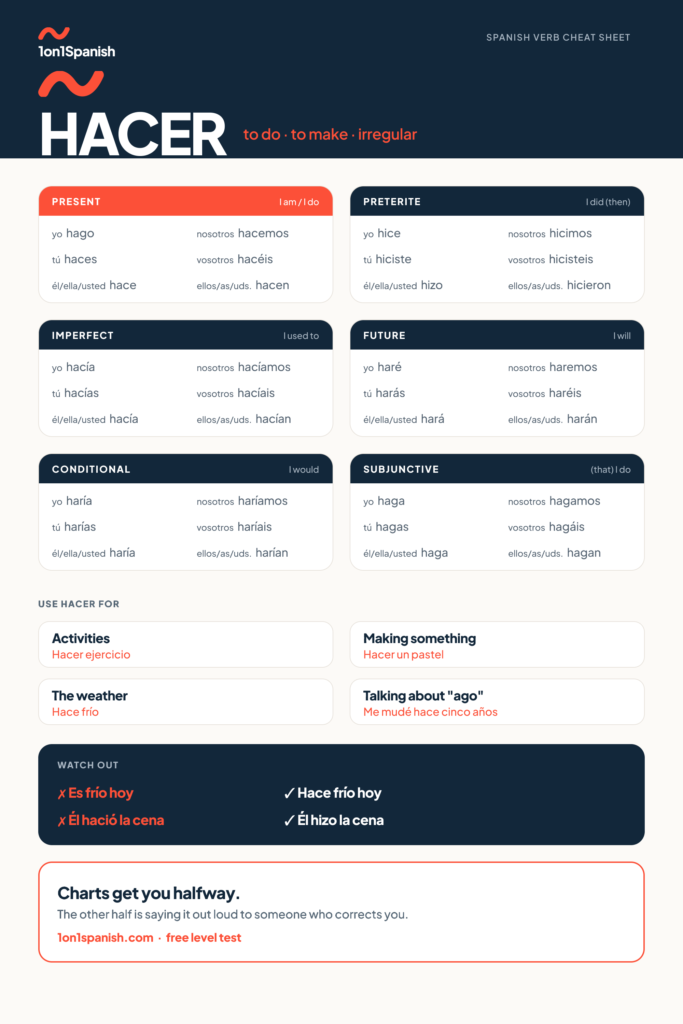
Take the chart with you
The chart is free to view and share. Drop your email and we’ll send the print-ready US Letter PDF — the version you stick on the fridge.
Practice
Practice hacer with a real teacher
Charts get you halfway. The other half is saying it out loud to someone who corrects you on the spot. At 1on1Spanish you get 25-minute private lessons with a qualified native teacher, exercises built from the mistakes you make in class, and AI practice between lessons.
First month $1. No contracts, cancel anytime.
Talking about your weekend, the weather and what you did is exactly what conversational Spanish lessons are for.
The fastest way to make this stick is to say it to someone. Learn Spanish online with a real teacher.
Take your free level testBuilt on RingTeacher's method — 700,000+ classes delivered since 2017, teaching English to Spanish speakers. Now in the other direction.
Frequently asked questions
Is hacer regular or irregular in Spanish?
Hacer is irregular in almost every tense you need. The present takes hago, the preterite runs on hic- with the spelling change hizo, the future and conditional shorten to har-, and the participle is hecho instead of the expected hacido. The imperfect (hacía) is the only simple tense that follows the regular -er pattern.
What is the preterite of hacer in Spanish?
Hice, hiciste, hizo, hicimos, hicisteis, hicieron. The form worth memorizing on its own is hizo, written with z so the sound stays the same before o. None of these forms carries a written accent, which sets them apart from regular preterites like comí and comió.
How do you talk about the weather with hacer?
Use the third person singular and nothing else: Hace calor, hace frío, hace sol, hace viento, hace buen tiempo, hace mal tiempo. To ask, say ¿Qué tiempo hace? Rain and snow are exceptions with their own verbs, llueve and nieva, and cloud cover uses estar: está nublado.
What does hace mean when it’s followed by a time period?
Hace + a length of time means “ago”: Empecé hace tres semanas is “I started three weeks ago”. Put que after it and add a present-tense verb, and the meaning flips to something still going on: Hace tres semanas que estudio español means “I’ve been studying Spanish for three weeks”.
Do I need the subjunctive of hacer in everyday conversation?
Yes. Haga and hagas appear whenever you ask someone to do something indirectly or express doubt: quiero que hagas, dile que haga, no creo que haga frío mañana, aunque haga sol. Since the subjunctive comes directly from hago, learning that one present form gives you the whole set.