
Jugar conjugation in Spanish: every tense you need, with examples
Jugar means “to play”: games and sports, never musical instruments. It is the only verb in Spanish whose stem changes from u to ue: juego, juegas, juega. On top of that, the g becomes gu before an e, which is why the preterite yo form is jugué and the subjunctive is juegue. Everything else takes regular -ar endings. The tables are below, followed by the jugar / tocar split and the jugar a question. 1on1Spanish teaches this in 25-minute one-on-one lessons with qualified native teachers, online across the United States.
Reviewed by María Jiménez — Licenciada en Filología Hispánica (BA in Hispanic Philology) · Updated Sep 2026
What jugar means
Jugar covers anything with rules and a result: sports, board games, cards, video games, and what children do. Juego al tenis los sábados, Jugamos a las cartas después de cenar, Los niños juegan en el parque.
What it does not cover is music. Playing an instrument is tocar: toco la guitarra. English uses one verb for both, which makes this the single most common jugar mistake.
Two changes make the paradigm look harder than it is. The stem vowel becomes ue whenever the stress falls on it, so juego and juegan, but jugamos and jugáis, where the stress moves to the ending. And the g is written gu before e so the sound stays hard: jugué, juegue, juguemos. Participle jugado and gerund jugando are both regular.
Jugar conjugation: present tense
Stem change in every form except nosotros and vosotros.
| Form | Example | |
|---|---|---|
| yo | juego | Juego al pádel los martes. (I play paddle tennis on Tuesdays.) |
| tú | juegas | ¿Juegas al golf con tu jefe? (Do you play golf with your boss?) |
| él / ella / usted | juega | Mi hijo juega en el equipo del colegio. (My son plays on the school team.) |
| nosotros | jugamos | Jugamos a las cartas los domingos. (We play cards on Sundays.) |
| vosotros | jugáis | ¿Jugáis esta tarde? (Are you playing this afternoon?) |
| ellos / ellas / ustedes | juegan | Los niños juegan en el jardín. (The kids are playing in the yard.) |
Jugar conjugation: preterite
No stem change here. The ue is gone, and the only irregularity is the spelling of the yo form.
| Form | |
|---|---|
| yo | jugué |
| tú | jugaste |
| él / ella / usted | jugó |
| nosotros | jugamos |
| vosotros | jugasteis |
| ellos / ellas / ustedes | jugaron |
Jugué al baloncesto en la universidad. — I played basketball in college.
Jugar conjugation: imperfect
Completely regular, and the tense you’ll want for childhood and old habits.
| Form | |
|---|---|
| yo | jugaba |
| tú | jugabas |
| él / ella / usted | jugaba |
| nosotros | jugábamos |
| vosotros | jugabais |
| ellos / ellas / ustedes | jugaban |
De pequeños jugábamos en la calle hasta que anochecía. — As kids we played in the street until it got dark.
Jugar conjugation: future
Regular: endings on the full infinitive, no stem change.
| Form | |
|---|---|
| yo | jugaré |
| tú | jugarás |
| él / ella / usted | jugará |
| nosotros | jugaremos |
| vosotros | jugaréis |
| ellos / ellas / ustedes | jugarán |
El sábado jugaremos contra el equipo de mi hermano. — On Saturday we’ll play against my brother’s team.
Jugar conjugation: conditional
Also regular.
| Form | |
|---|---|
| yo | jugaría |
| tú | jugarías |
| él / ella / usted | jugaría |
| nosotros | jugaríamos |
| vosotros | jugaríais |
| ellos / ellas / ustedes | jugarían |
Yo no jugaría con ese dinero. — I wouldn’t gamble with that money.
Jugar conjugation: present subjunctive
Both changes at once: the stem becomes jueg- where it’s stressed, and the g is written gu.
| Form | |
|---|---|
| yo | juegue |
| tú | juegues |
| él / ella / usted | juegue |
| nosotros | juguemos |
| vosotros | juguéis |
| ellos / ellas / ustedes | jueguen |
No creo que juegue este fin de semana; está lesionado. — I don’t think he’ll play this weekend; he’s injured.
Jugar conjugation: imperfect subjunctive
Regular, on the preterite stem juga-.
| Form (-ra) | Form (-se) | |
|---|---|---|
| yo | jugara | jugase |
| tú | jugaras | jugases |
| él / ella / usted | jugara | jugase |
| nosotros | jugáramos | jugásemos |
| vosotros | jugarais | jugaseis |
| ellos / ellas / ustedes | jugaran | jugasen |
Si jugara más a menudo, no me dolería tanto la espalda al día siguiente. — If I played more often, my back wouldn’t hurt so much the next day.
Jugar commands (imperative)
| Affirmative | Negative | |
|---|---|---|
| tú | juega | no juegues |
| usted | juegue | no juegue |
| nosotros | juguemos | no juguemos |
| vosotros | jugad | no juguéis |
| ustedes | jueguen | no jueguen |
No juegues con eso, que es caro. — Don’t play with that, it’s expensive.
Participle, gerund and compound tenses
Participle jugado, gerund jugando, both regular. Compounds use haber:
He jugado dos partidos esta semana (present perfect) · Nunca había jugado en pista cubierta (past perfect) · Para junio ya habré jugado la liga entera (future perfect).
When to use jugar
Sports
Juego al tenis. Mi hija juega al fútbol los sábados. In Spain the preposition a is standard; across most of Latin America people say juego tenis, without it. Both are accepted, and neither will cause a misunderstanding.
Games, cards and board games
Jugamos a las cartas. ¿Jugamos una partida de ajedrez?
Children playing
Los niños están jugando en el patio. No preposition needed when there’s no named game.
Gambling and risk
Jugó todos sus ahorros. Nos estamos jugando el contrato. The reflexive jugarse means putting something on the line.
Playing with something, literally or not
No juegues con el mando. No juegues con mi tiempo.
Jugar vs tocar
Both are “to play” in English, and they never overlap in Spanish. Games take jugar; instruments and music take tocar.
| Jugar — games and sports | Tocar — instruments and music |
|---|---|
| Juego al fútbol — I play soccer | Toco la guitarra — I play the guitar |
| ¿Jugamos una partida? — Shall we play a round? | ¿Tocas algo? — Do you play anything? |
| Jugó en el equipo del instituto — He played on the high school team | Tocó en una banda diez años — He played in a band for ten years |
| Los niños juegan en casa — The kids play at home | Toca el piano desde los seis años — She’s played piano since she was six |
Common mistakes English speakers make with jugar
The stem changes to ue whenever it carries the stress. Jugo exists as a noun meaning juice, which makes the slip easy to hear.
Without the u, the g before e would be pronounced like an English h. The spelling protects the sound, and the same happens in pagué and llegué.
Instruments are never jugar. This is the mistake native speakers notice first, because the sentence is grammatical but says something odd.
The subjunctive stacks both changes at once: ue in the stem and gu in the spelling.
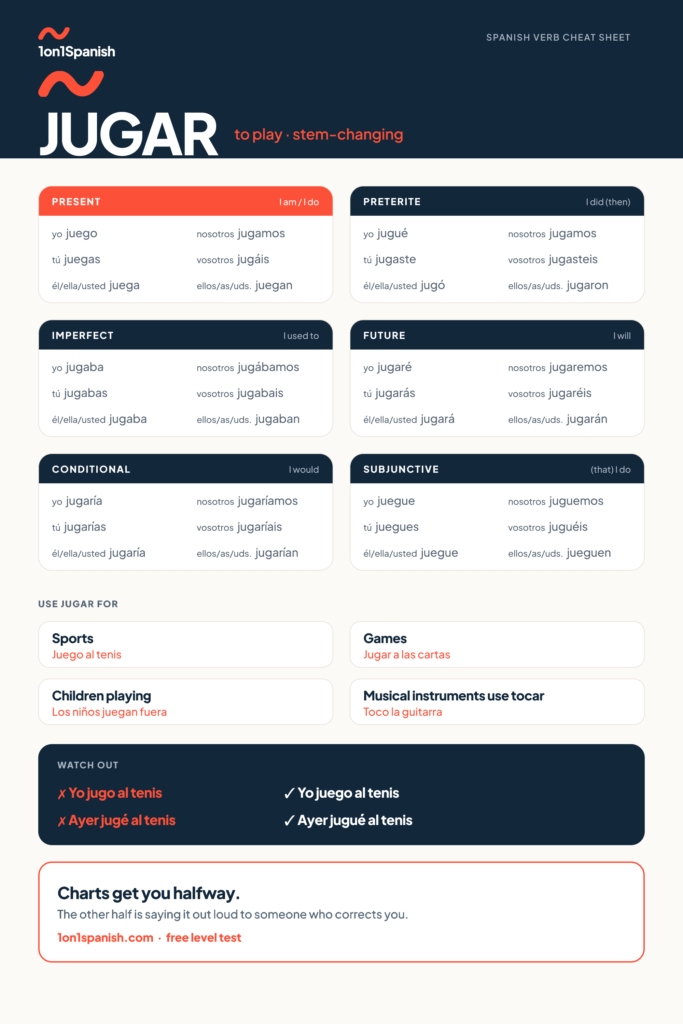
Take the chart with you
The chart is free to view and share. Drop your email and we’ll send the print-ready US Letter PDF — the version you stick on the fridge.
Practice
Practice jugar and tocar with a real teacher
Charts get you halfway. The other half is saying it out loud to someone who corrects you on the spot. At 1on1Spanish you get 25-minute private lessons in conversational Spanish with a qualified native teacher, exercises built from the mistakes you make in class, and AI practice between lessons.
First month $1. No contracts, cancel anytime.
Reading about it only gets you so far. Learn Spanish online in 25-minute conversations and use it.
Take your free level testBuilt on RingTeacher's method — 700,000+ classes delivered since 2017, teaching English to Spanish speakers. Now in the other direction.
Frequently asked questions
Is jugar regular or irregular in Spanish?
Jugar is irregular, but in a predictable way. It’s the only Spanish verb that changes u to ue in the stem when the stress falls there: juego, juegas, juega, juegan, but jugamos and jugáis. It also spells the g as gu before an e, giving jugué and juegue. The imperfect, future, conditional, participle and gerund are all regular.
Why is the preterite jugué and not jugé?
Because Spanish spelling has to keep the g sound hard. Before a, o and u the letter g sounds like the g in “go”, but before e and i it sounds like an English h. Adding a silent u preserves the original sound: jugué. Every -gar verb does this in the yo preterite (pagué, llegué, entregué) and throughout the subjunctive.
What’s the difference between jugar and tocar?
Jugar is for games and sports; tocar is for musical instruments. Juego al baloncesto but toco el piano. English uses “play” for both, so the sentence juego el piano is grammatically fine and completely wrong in meaning: it suggests you’re using the piano as a toy. There is no context where the two are interchangeable.
Do you say “jugar a” or just “jugar” with a sport?
Both are correct, and the choice is regional. In Spain the preposition is standard: juego al tenis, jugamos al fútbol. In most of Latin America it’s usually dropped: juego tenis. Nobody will misunderstand you either way. When there’s no named game, as with children playing, no preposition appears at all: los niños juegan.
What is the past tense of jugar in Spanish?
There are two, and they answer different questions. The preterite jugué, jugaste, jugó marks a specific match or session: jugué el sábado. The imperfect jugaba, jugabas, jugaba describes a habit, which is why childhood memories use it: de pequeño jugaba al béisbol. The distinction is explained in preterite vs imperfect, and more stem-changing verbs are listed under Spanish verbs.