
Leer conjugation in Spanish: every tense you need, with examples
Leer means “to read”. Its endings are regular, so most learners assume the whole verb is — and then hit leyó, leyeron and leyendo, where an unstressed i between two vowels turns into a y. That’s a spelling rule, not an irregularity, and it also explains the accent in leí and leído. Every tense is below. 1on1Spanish teaches this in 25-minute one-on-one lessons with qualified native teachers, online across the United States.
Reviewed by María Jiménez — Licenciada en Filología Hispánica (BA in Hispanic Philology) · Updated Aug 2026
What leer means
Leer is “to read” in every sense English uses it: a book, a text message, a contract, a room. Leo mucho means I read a lot; leer entre líneas is to read between the lines, exactly as in English.
Two constructions come up early. Leer en voz alta is “to read out loud”, the phrase your teacher will use in a lesson. And leer sobre algo means to read about a topic: He leído sobre eso.
The stem never changes. What changes is the spelling: because the stem ends in a vowel, an unstressed i in the ending becomes y (leyó, leyendo), and a stressed one takes a written accent to break the hiatus (leí, leído). Creer and caer follow the same pattern, so learning leer gives you three verbs.
Leer conjugation: present tense
Completely regular -er endings.
| Form | Example | |
|---|---|---|
| yo | leo | Leo el periódico en el metro. (I read the paper on the subway.) |
| tú | lees | ¿Lees mucho en español? (Do you read much in Spanish?) |
| él / ella / usted | lee | Mi madre lee dos libros al mes. (My mom reads two books a month.) |
| nosotros | leemos | Leemos el contrato antes de firmar. (We read the contract before signing.) |
| vosotros | leéis | ¿Leéis las reseñas antes de comprar? (Do you read the reviews before buying?) |
| ellos / ellas / ustedes | leen | Mis hijos leen antes de dormir. (My kids read before bed.) |
Leer conjugation: preterite
This is the table people come for. The i of the ending becomes y in the third person, and the first person keeps a written accent.
| Form | |
|---|---|
| yo | leí |
| tú | leíste |
| él / ella / usted | leyó |
| nosotros | leímos |
| vosotros | leísteis |
| ellos / ellas / ustedes | leyeron |
Leyó el correo y no contestó. — He read the email and didn’t reply.
Leer conjugation: imperfect
Regular, with the accent on the í in every form. This is the tense for reading as a habit or a background action.
| Form | |
|---|---|
| yo | leía |
| tú | leías |
| él / ella / usted | leía |
| nosotros | leíamos |
| vosotros | leíais |
| ellos / ellas / ustedes | leían |
Leía en el sofá cuando llamaste. — I was reading on the couch when you called. The choice between leía and leyó is the whole point of preterite vs imperfect.
Leer conjugation: future
Regular endings on the infinitive.
| Form | |
|---|---|
| yo | leeré |
| tú | leerás |
| él / ella / usted | leerá |
| nosotros | leeremos |
| vosotros | leeréis |
| ellos / ellas / ustedes | leerán |
Leer conjugation: conditional
| Form | |
|---|---|
| yo | leería |
| tú | leerías |
| él / ella / usted | leería |
| nosotros | leeríamos |
| vosotros | leeríais |
| ellos / ellas / ustedes | leerían |
Yo no leería ese contrato sin un abogado. — I wouldn’t read that contract without a lawyer.
Leer conjugation: present subjunctive
Regular. Note the accent in leáis.
| Form | |
|---|---|
| yo | lea |
| tú | leas |
| él / ella / usted | lea |
| nosotros | leamos |
| vosotros | leáis |
| ellos / ellas / ustedes | lean |
Quiero que lo lea un abogado. — I want a lawyer to read it.
Leer conjugation: imperfect subjunctive
Built on the third-person preterite stem leyer-, so the y runs through every form.
| Form (-ra) | Form (-se) | |
|---|---|---|
| yo | leyera | leyese |
| tú | leyeras | leyeses |
| él / ella / usted | leyera | leyese |
| nosotros | leyéramos | leyésemos |
| vosotros | leyerais | leyeseis |
| ellos / ellas / ustedes | leyeran | leyesen |
Me pidió que leyera el informe antes de la reunión. — He asked me to read the report before the meeting.
Leer commands (imperative)
| Affirmative | Negative | |
|---|---|---|
| tú | lee | no leas |
| usted | lea | no lea |
| nosotros | leamos | no leamos |
| vosotros | leed | no leáis |
| ustedes | lean | no lean |
Lee la letra pequeña. — Read the fine print. No spelling change anywhere in the imperative.
Participle, gerund and compound tenses
Participle leído — with an accent on the í, because e and i would otherwise glue into one syllable. Gerund leyendo, with the same i→y switch as the preterite. Compounds use haber:
He leído las condiciones (present perfect) · Ya había leído ese libro (past perfect) · Para el lunes habré leído el informe entero (future perfect).
When to use leer
Talking about what you’re reading right now
Estoy leyendo una novela de Isabel Allende. The gerund with estar is how you answer ¿qué estás leyendo? at a dinner table.
Reading as a habit
Leo antes de dormir, leía mucho de pequeño. Habits go in the present or the imperfect, never in the preterite.
Reading documents
This is the adult use: ¿Has leído el contrato?, Lee la política de cancelación antes de reservar. Insurance, leases, terms of service.
Reading as language practice
Leer en voz alta is one of the fastest ways to fix pronunciation, because it forces you to produce sounds you’d otherwise skip over silently.
Common mistakes English speakers make with leer
Between two vowels the unstressed i of the ending becomes y. Same in leyeron, leyendo, leyera.
Without the accent, leido would be read as one syllable-and-a-half and stressed on the wrong vowel. The accent is not optional.
The gerund follows the same rule as the preterite, so leiendo doesn’t exist.
A repeated habit in the past takes the imperfect. The preterite would turn it into a single finished act.
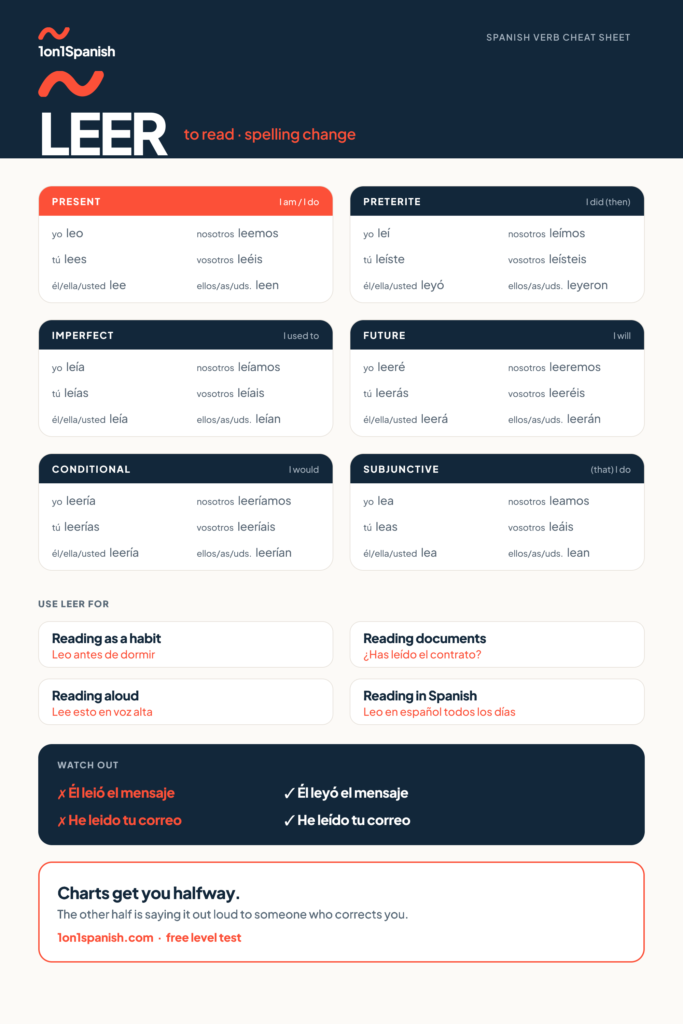
Take the chart with you
The chart is free to view and share. Drop your email and we’ll send the print-ready US Letter PDF — the version you stick on the fridge.
Practice
Practice leer with a real teacher
Charts get you halfway. The other half is saying it out loud to someone who corrects you on the spot. At 1on1Spanish you get 25-minute private lessons with a qualified native teacher, exercises built from the mistakes you make in class, and AI practice between lessons.
First month $1. No contracts, cancel anytime.
Reading about it only gets you so far. Learn Spanish online in 25-minute conversations and use it.
Take your free level testBuilt on RingTeacher's method — 700,000+ classes delivered since 2017, teaching English to Spanish speakers. Now in the other direction.
Frequently asked questions
Is leer regular or irregular in Spanish?
Leer is regular in its endings and irregular only in spelling. Where a regular -er verb would have an unstressed i between two vowels, leer writes y: leyó, leyeron, leyendo, leyera. Where the i is stressed, it takes a written accent: leí, leíste, leído, leía. Nothing else changes, and the same pattern governs creer, caer and poseer.
Why is it “leyó” and not “leió”?
Spanish avoids an unstressed i sitting between two vowels, so it converts it to y. The stem le- already ends in a vowel, and the third-person preterite ending is -ió, which would produce leió. The rule rewrites it as leyó. The same thing happens in the gerund leyendo and throughout the imperfect subjunctive.
How do you pronounce leer in Spanish?
Two syllables: le-er, roughly “leh-EHR”, with the stress on the second. Both e sounds are short and identical, and the double e is not a long vowel as it would be in English. In leí and leído the accent splits the vowels apart, so leí is “leh-EE” and leído is “leh-EE-doh”.
What is the past tense of leer in Spanish?
There are two. The preterite is leí, leíste, leyó, leímos, leísteis, leyeron, for a reading that started and finished: leyó el contrato anoche. The imperfect is leía, leías, leía, leíamos, leíais, leían, for a habit or a background action: leía todas las noches. Compound past tenses use haber plus leído.
Do I need the subjunctive of leer in everyday conversation?
Yes, mostly with requests and opinions. Lea appears whenever someone wants somebody else to read: quiero que lo lea un abogado, dile que lea el correo. The past form leyera shows up in reported requests: me pidió que leyera el informe. Neither is advanced or literary — both are normal in an office or a doctor’s waiting room.