
Mostrar conjugation in Spanish: every tense you need, with examples
Mostrar means “to show”, and it follows the same o→ue pattern as contar or recordar: the o becomes ue wherever the stress lands on the stem, so muestro replaces the plain o of the infinitive. Nosotros and vosotros never change, in any tense. Every tense is below, along with the line between mostrar and enseñar, which learners mix up more often than the grammar itself. 1on1Spanish teaches this in 25-minute one-on-one lessons with qualified native teachers, online across the United States.
Reviewed by María Jiménez — Licenciada en Filología Hispánica (BA in Hispanic Philology) · Updated Sep 2026
What mostrar means
Mostrar is “to show” or “to display”: muéstrame tu identificación, el informe muestra un aumento en las ventas. It works for physical objects — showing an ID, a document, a photo — and for data or results: los números muestran una mejora este trimestre.
It also covers showing an emotion or an attitude: mostró mucho interés en el proyecto, no muestra ningún respeto. This is a very natural, adult use — describing how someone comes across in a meeting or a conversation.
Grammatically it’s a stem-changing verb (o→ue), in the same family as contar, costar and recordar. Participle mostrado and gerund mostrando are both regular.
Mostrar conjugation: present tense
Stem change in every form except nosotros and vosotros.
| Form | Example | |
|---|---|---|
| yo | muestro | Te muestro el documento en un momento. (I’ll show you the document in a moment.) |
| tú | muestras | ¿Me muestras cómo funciona esto? (Can you show me how this works?) |
| él / ella / usted | muestra | El médico me muestra los resultados. (The doctor shows me the results.) |
| nosotros | mostramos | Mostramos el proyecto en la junta del lunes. (We showed the project at Monday’s meeting.) |
| vosotros | mostráis | ¿Vosotros mostráis los datos en la presentación? (Are you showing the data in the presentation?) |
| ellos / ellas / ustedes | muestran | Los reportes muestran un aumento en las ventas. (The reports show an increase in sales.) |
Mostrar conjugation: preterite
Regular endings, no stem change — the preterite of -ar stem-changing verbs never changes.
| Form | |
|---|---|
| yo | mostré |
| tú | mostraste |
| él / ella / usted | mostró |
| nosotros | mostramos |
| vosotros | mostrasteis |
| ellos / ellas / ustedes | mostraron |
Nos mostró la casa antes de firmar el contrato. — She showed us the house before we signed the lease.
Mostrar conjugation: imperfect
Fully regular.
| Form | |
|---|---|
| yo | mostraba |
| tú | mostrabas |
| él / ella / usted | mostraba |
| nosotros | mostrábamos |
| vosotros | mostrabais |
| ellos / ellas / ustedes | mostraban |
El agente siempre nos mostraba las mismas tres casas. — The agent always used to show us the same three houses.
Mostrar conjugation: future
Regular endings on the infinitive.
| Form | |
|---|---|
| yo | mostraré |
| tú | mostrarás |
| él / ella / usted | mostrará |
| nosotros | mostraremos |
| vosotros | mostraréis |
| ellos / ellas / ustedes | mostrarán |
Le mostraré el reporte final el viernes. — I’ll show him the final report on Friday.
Mostrar conjugation: conditional
| Form | |
|---|---|
| yo | mostraría |
| tú | mostrarías |
| él / ella / usted | mostraría |
| nosotros | mostraríamos |
| vosotros | mostraríais |
| ellos / ellas / ustedes | mostrarían |
Yo te mostraría los planos si los tuviera aquí. — I’d show you the blueprints if I had them here.
Mostrar conjugation: present subjunctive
Stem change in the stressed forms, same pattern as the indicative.
| Form | |
|---|---|
| yo | muestre |
| tú | muestres |
| él / ella / usted | muestre |
| nosotros | mostremos |
| vosotros | mostréis |
| ellos / ellas / ustedes | muestren |
Quiero que me muestres el contrato antes de firmar. — I want you to show me the contract before signing.
Mostrar conjugation: imperfect subjunctive
Built on the regular preterite stem, no stem change.
| Form (-ra) | Form (-se) | |
|---|---|---|
| yo | mostrara | mostrase |
| tú | mostraras | mostrases |
| él / ella / usted | mostrara | mostrase |
| nosotros | mostráramos | mostrásemos |
| vosotros | mostrarais | mostraseis |
| ellos / ellas / ustedes | mostraran | mostrasen |
Si me mostrara los números, entendería mejor la situación. — If she showed me the numbers, I’d understand the situation better.
Mostrar commands (imperative)
| Affirmative | Negative | |
|---|---|---|
| tú | muestra | no muestres |
| usted | muestre | no muestre |
| nosotros | mostremos | no mostremos |
| vosotros | mostrad | no mostréis |
| ustedes | muestren | no muestren |
Muéstrame tu pasaporte, por favor. — Show me your passport, please.
Participle, gerund and compound tenses
Participle mostrado, gerund mostrando. Both regular. Compounds take haber:
Me ha mostrado tres opciones distintas (present perfect) · Ya nos había mostrado el apartamento antes de la mudanza (past perfect) · Para entonces habrá mostrado todos los resultados (future perfect).
When to use mostrar
Showing an object or a document
Muéstrame tu identificación, por favor. One of the most practical, everyday uses — banks, clinics and government offices ask for this constantly.
Showing data or results
El informe muestra un aumento en las ventas. Common in business and workplace Spanish, describing what a chart, report or study reveals.
Showing an emotion or attitude
Mostró mucho interés en el proyecto. Natural in conversations about how someone reacted or came across.
Demonstrating how something works
Te muestro cómo se hace, es fácil. A normal way to offer help before doing something for someone.
Mostrar vs enseñar
Both can be translated “to show”, and this is the pair that actually confuses learners — not the conjugation. Mostrar is simply displaying or pointing something out. Enseñar leans toward teaching or instructing, though it also means “to show” in casual speech.
| Spanish | What it means |
|---|---|
| El médico me mostró la radiografía. | The doctor showed me the X-ray. (simply displayed it) |
| Mi papá me enseñó a manejar. | My dad taught me to drive. (instruction) |
| Muéstrame el documento. | Show me the document. |
| Enséñame cómo se hace. | Show/teach me how it’s done. |
If there’s real instruction involved, enseñar fits better. If you’re just pointing something out or displaying it, mostrar is the more precise choice.
Common mistakes English speakers make with mostrar
Simply displaying something calls for mostrar; enseñar implies instruction, which doesn’t fit here.
The third-person present needs the stem change: muestra, not mostra.
After quiero que, the verb needs the subjunctive, and mostrar‘s subjunctive keeps the stem change: muestres.
Nosotros never changes, in any tense — a common overcorrection once learners notice the diphthong elsewhere.
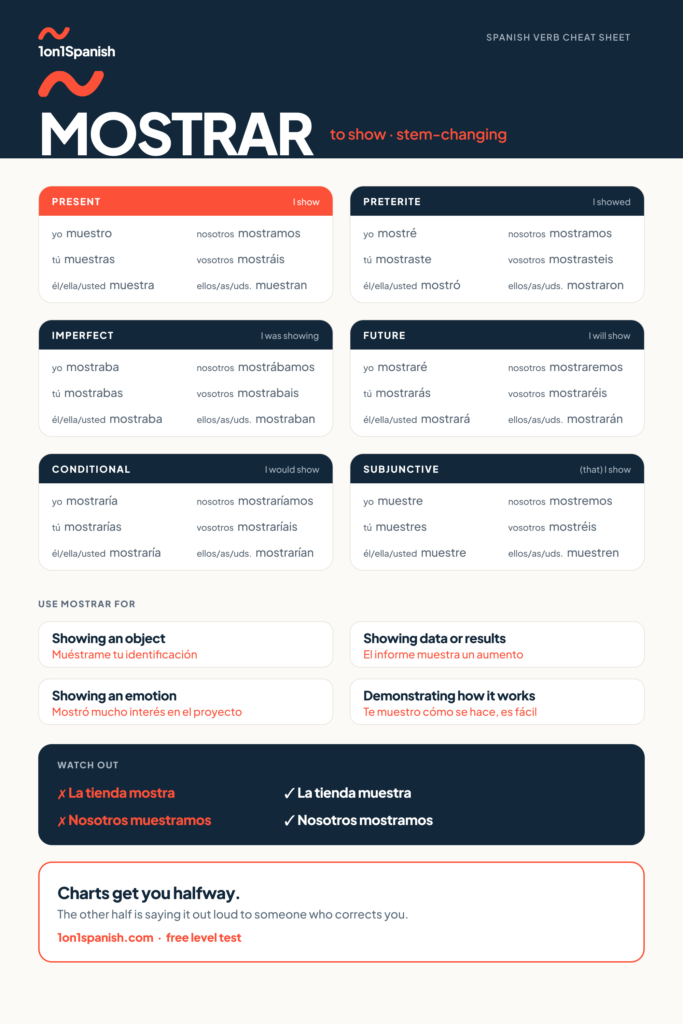
Take the chart with you
The chart is free to view and share. Drop your email and we’ll send the print-ready US Letter PDF — the version you stick on the fridge.
Practice
Practice mostrar with a real teacher
Charts get you halfway. The other half is saying it out loud to someone who corrects you on the spot. At 1on1Spanish you get 25-minute private lessons with a qualified native teacher, exercises built from the mistakes you make in class, and AI practice between lessons.
First month $1. No contracts, cancel anytime.
When you are ready to speak it out loud, try online Spanish lessons with a native teacher.
Take your free level testBuilt on RingTeacher's method — 700,000+ classes delivered since 2017, teaching English to Spanish speakers. Now in the other direction.
Frequently asked questions
Is mostrar regular or irregular in Spanish?
Irregular in one specific way: it’s a stem-changing verb, o→ue, in the same family as contar and recordar. The o becomes ue wherever it’s stressed — present muestro, muestras, muestra, muestran, and the matching subjunctive forms. The preterite, imperfect, future, conditional and participle are all completely regular, with no trace of the change.
What’s the difference between mostrar and enseñar?
Mostrar is simply displaying or pointing something out: me mostró el documento. Enseñar leans toward teaching or instructing, though it’s also used casually to mean “to show”: me enseñó a manejar is about instruction, while me mostró la casa is about a straightforward viewing. When in doubt, mostrar is the safer, more precise choice for “show” without a teaching component.
How do you say “show me” in Spanish?
Muéstrame, with the pronoun attached to the command and a written accent to keep the stress in place: muéstrame el documento, muéstrame cómo funciona. With usted, it’s muéstreme: por favor, muéstreme su identificación. Both keep the same stem change as the rest of the present tense — muestr-, not mostr- — because the stress still falls on that syllable.
What is the past tense of mostrar in Spanish?
Two forms, and neither carries a stem change. The preterite — mostré, mostraste, mostró, mostramos, mostrasteis, mostraron — marks a specific act: nos mostró la casa el sábado. The imperfect — mostraba, mostrabas, mostraba, mostrábamos, mostrabais, mostraban — marks a repeated or ongoing one: siempre nos mostraba las mismas fotos.
Do I need the subjunctive of mostrar in everyday conversation?
Yes, mainly after wishes and requests. Muestre appears after quiero que (quiero que me muestres el reporte) and after espero que (espero que los datos muestren una mejora). It keeps the same o→ue change as the indicative present, so it’s predictable once you know the pattern.