
Oír conjugation in Spanish: every tense you need, with examples
Oír means “to hear”: sound reaching your ears, whether you were paying attention or not. It’s irregular twice over: the yo form adds a g (oigo), and wherever an unstressed i falls between two vowels it turns into a y (oyes, oyó, oyeron, oyendo). The accents on oí, oímos and oído are doing real work too. All the tables are below, plus the difference between oír and escuchar, which English blurs. 1on1Spanish teaches this in 25-minute one-on-one lessons with qualified native teachers, online across the United States.
Reviewed by María Jiménez — Licenciada en Filología Hispánica (BA in Hispanic Philology) · Updated Sep 2026
What oír means
Oír is passive perception: the sound arrives, you register it. Oí un ruido en el garaje, No te oigo, hay mucho ruido. It says nothing about intent, which is exactly what separates it from escuchar.
Two structures carry most of its daily use. Oír que reports something you learned: He oído que van a cerrar la oficina. Oír hablar de means “to have heard of”: ¿Has oído hablar de esa clínica?
And then there’s oye, the tú command used as a conversation opener, roughly “hey” or “listen”: Oye, ¿tienes un minuto? With usted it becomes oiga, which is how you get a stranger’s attention politely: Oiga, perdone.
The participle is oído (also a noun: the ear) and the gerund is oyendo.
Oír conjugation: present tense
Three irregularities at once: the g in oigo, the y in oyes / oye / oyen, and the accents that break the vowels apart into separate syllables: o-í-mos, o-ís.
| Form | Example | |
|---|---|---|
| yo | oigo | No te oigo bien. (I can’t hear you well.) |
| tú | oyes | ¿Oyes ese ruido? (Do you hear that noise?) |
| él / ella / usted | oye | Mi padre ya no oye del oído izquierdo. (My father can’t hear out of his left ear anymore.) |
| nosotros | oímos | Desde aquí oímos el tráfico. (We can hear the traffic from here.) |
| vosotros | oís | ¿Me oís al fondo? (Can you hear me in the back?) |
| ellos / ellas / ustedes | oyen | Los vecinos lo oyen todo. (The neighbors hear everything.) |
Oír conjugation: preterite
The third person takes y because the i would sit between two vowels. The first and second person forms keep a written accent.
| Form | |
|---|---|
| yo | oí |
| tú | oíste |
| él / ella / usted | oyó |
| nosotros | oímos |
| vosotros | oísteis |
| ellos / ellas / ustedes | oyeron |
Oí la noticia en la radio de camino al trabajo. — I heard the news on the radio on my way to work.
Oír conjugation: imperfect
Regular endings; the accent on the í is what keeps the syllables apart.
| Form | |
|---|---|
| yo | oía |
| tú | oías |
| él / ella / usted | oía |
| nosotros | oíamos |
| vosotros | oíais |
| ellos / ellas / ustedes | oían |
De niño oía a mis abuelos hablar en español todo el día. — As a kid I’d hear my grandparents speaking Spanish all day.
Oír conjugation: future
Regular: endings on the full infinitive, which loses its accent because the ending carries the stress.
| Form | |
|---|---|
| yo | oiré |
| tú | oirás |
| él / ella / usted | oirá |
| nosotros | oiremos |
| vosotros | oiréis |
| ellos / ellas / ustedes | oirán |
Con este aparato oirás mucho mejor. — With this device you’ll hear much better.
Oír conjugation: conditional
Also regular.
| Form | |
|---|---|
| yo | oiría |
| tú | oirías |
| él / ella / usted | oiría |
| nosotros | oiríamos |
| vosotros | oiríais |
| ellos / ellas / ustedes | oirían |
Sin el ruido de la obra lo oiríamos perfectamente. — Without the construction noise we’d hear it perfectly.
Oír conjugation: present subjunctive
Built on oig-, the same stem as oigo.
| Form | |
|---|---|
| yo | oiga |
| tú | oigas |
| él / ella / usted | oiga |
| nosotros | oigamos |
| vosotros | oigáis |
| ellos / ellas / ustedes | oigan |
Habla más alto para que te oigan. — Speak up so they can hear you.
Oír conjugation: imperfect subjunctive
Built on the oy- preterite stem.
| Form (-ra) | Form (-se) | |
|---|---|---|
| yo | oyera | oyese |
| tú | oyeras | oyeses |
| él / ella / usted | oyera | oyese |
| nosotros | oyéramos | oyésemos |
| vosotros | oyerais | oyeseis |
| ellos / ellas / ustedes | oyeran | oyesen |
Bajé la voz para que no me oyeran los niños. — I lowered my voice so the kids wouldn’t hear me.
Oír commands (imperative)
Oye and oiga are used far more as attention-getters than as real orders.
| Affirmative | Negative | |
|---|---|---|
| tú | oye | no oigas |
| usted | oiga | no oiga |
| nosotros | oigamos | no oigamos |
| vosotros | oíd | no oigáis |
| ustedes | oigan | no oigan |
Oiga, perdone, ¿esta es la cola para urgencias? — Excuse me, is this the line for the ER?
Participle, gerund and compound tenses
Participle oído, with an obligatory accent; gerund oyendo, with the same i → y change as the preterite. Compounds use haber:
He oído que se jubila en junio (present perfect) · Nunca había oído hablar de ese barrio (past perfect) · Para entonces ya habré oído la respuesta (future perfect).
When to use oír
Perceiving sound, with no effort involved
Oigo el tráfico desde el dormitorio. ¿Oyes ese pitido?
Checking a connection
¿Me oyes? is what you say on a bad phone or video call. ¿Me escuchas? asks something else entirely: whether the person is paying attention.
Getting attention
Oye with people you address as tú, oiga with strangers and in formal settings. Neither one is rude, but oiga is the safe choice with a stranger.
Oír vs escuchar
Oír is what your ears do; escuchar is what you decide to do. Latin American Spanish uses escuchar more loosely, including for perception, but the distinction below always holds in the other direction: deliberate attention is never oír.
| Oír — the sound reaches you | Escuchar — you pay attention |
|---|---|
| No oigo nada — I can’t hear anything | No me estás escuchando — You’re not listening to me |
| Oí un ruido en el garaje — I heard a noise in the garage | Escucho un pódcast al manejar — I listen to a podcast while driving |
| ¿Me oyes? — Can you hear me? (bad line) | ¿Me escuchas? — Are you listening to me? |
| Se oye la tele desde aquí — You can hear the TV from here | Escucha lo que te dice el médico — Listen to what the doctor tells you |
Common mistakes English speakers make with oír
The yo form takes the same -g- as pongo, salgo and traigo. Oyo doesn’t exist.
An unstressed i between two vowels becomes y. The same change gives you oyeron, oyendo and oyera.
Without the accent, oi collapses into one syllable. The participle of oír always carries it, and so do oí, oíste, oímos and oía.
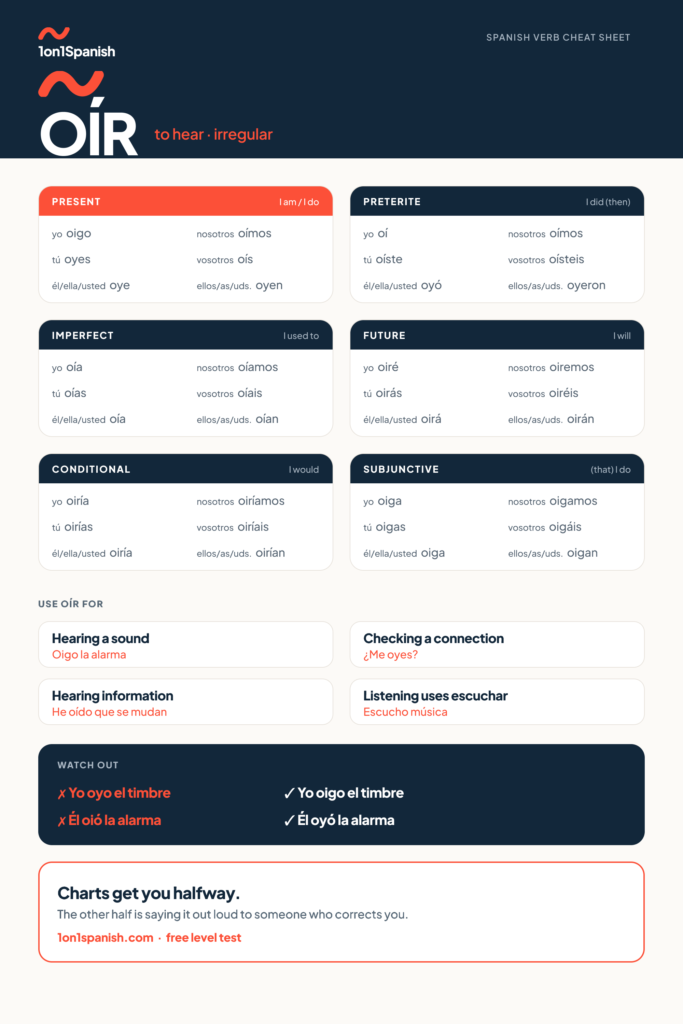
Take the chart with you
The chart is free to view and share. Drop your email and we’ll send the print-ready US Letter PDF — the version you stick on the fridge.
Practice
Practice oír and escuchar with a real teacher
Charts get you halfway. The other half is saying it out loud to someone who corrects you on the spot. At 1on1Spanish you get 25-minute private lessons with a qualified native Spanish tutor, exercises built from the mistakes you make in class, and AI practice between lessons.
First month $1. No contracts, cancel anytime.
You can go further with someone listening: Learn Spanish with 1on1Spanish, 25 minutes at a time.
Take your free level testBuilt on RingTeacher's method — 700,000+ classes delivered since 2017, teaching English to Spanish speakers. Now in the other direction.
Frequently asked questions
Is oír regular or irregular in Spanish?
Oír is irregular. The yo form takes a g (oigo), which carries into the whole subjunctive (oiga, oigas, oigan), and an unstressed i between vowels becomes y: oyes, oye, oyen, oyó, oyeron, oyendo, oyera. The future, conditional and imperfect follow regular endings, though the written accents in oí, oímos and oído are not optional.
Why is it oyó and not oió?
Spanish doesn’t allow an unstressed i to sit between two vowels. It becomes y. Since oír ends in a vowel before the ending, the third person preterite endings -ió and -ieron turn into -yó and -yeron: oyó, oyeron. The same rule produces leyó, creyó and cayó, and the gerund oyendo.
What’s the difference between oír and escuchar?
Perception is oír: the sound reaches you whether you wanted it or not. Escuchar is attention: you choose to focus on it. You oyes the neighbors through the wall, and you escuchas a podcast. On a bad phone line you ask ¿me oyes?, but if someone is ignoring you, ¿me escuchas?. Latin American Spanish stretches escuchar into the first meaning too.
What does “oye” mean in Spanish?
Literally it’s the tú command of oír, “hear”, but in practice it’s how Spanish speakers open a sentence: “hey”, “listen”. Oye, ¿tienes un minuto? With someone you address as usted, whether a stranger, a receptionist or an older person, the form is oiga: Oiga, perdone. Neither is impolite, but oiga is safer with people you don’t know.
How do you say “I heard that…” in Spanish?
He oído que… or Oí que…, the first for recent news, the second for a specific moment: He oído que suben el alquiler, Oí que se jubila en junio. For “I’ve heard of it”, the fixed phrase is he oído hablar de. When you replace the thing heard with a pronoun, you’ll need direct object pronouns: lo oí ayer. More irregular verbs are listed under Spanish verbs.