
Spanish direct object pronouns: lo, la, los, las and where they go
A direct object pronoun — me, te, lo, la, nos, os, los, las — replaces the noun that receives the action and agrees with it in gender and number. Its place in the sentence is immediately before the conjugated verb, not after it. English puts the pronoun where the noun was (“I called him“), Spanish moves it in front of the verb, and that reordering is the whole difficulty. 1on1Spanish teaches this in 25-minute one-on-one lessons with qualified native teachers, online across the United States.
Reviewed by María Jiménez — Licenciada en Filología Hispánica (BA in Hispanic Philology) · Updated Sep 2026
Which pronoun replaces which noun
The direct object is what answers “what?” or “whom?” after the verb. In Vi la película, the película is what I saw, so it becomes la: La vi.
| Replaces | Pronoun | Example |
|---|---|---|
| me | me | Mi jefe me llamó. |
| you (informal) | te | Te vi en la oficina. |
| him, it (masculine) | lo | El informe: lo terminé ayer. |
| her, it (feminine) | la | La factura: la pagué el lunes. |
| us | nos | El médico nos atendió rápido. |
| you all (Spain, informal) | os | Os esperamos abajo. |
| them (masculine or mixed) | los | Los documentos: los envié. |
| them (feminine) | las | Las llaves: las perdí. |
Two details that trip people up. The pronoun matches the noun’s gender, not the person’s: a laptop is la computadora in Mexico and el ordenador in Spain, so the same object is la on one side of the Atlantic and lo on the other. And the personal a changes nothing: ¿Conoces a mi hermana? — Sí, la conozco.
There’s also a neuter lo that replaces a whole idea rather than a noun: No lo sé. Ya lo sabía. Here lo isn’t standing in for a masculine word; it’s standing in for the entire thing that was said.
Where the pronoun goes
Three positions, and only one of them is optional.
Before a conjugated verb. This is the default with ordinary finite verb forms: La conozco. No lo compré. ¿Los viste? Even with a negative, the no goes first and the pronoun stays glued to the verb. The exception is the affirmative command, where the pronoun attaches to the end instead — Llámalo, Hazlo, Dímelo — and that one is two rows down. Conocer shows up a lot with these pronouns because its object is usually a person — la conozco, los conozco — and the full conocer conjugation is on its own page.
Attached to an infinitive or a gerund — or in front of the whole phrase. Both are correct and both are common: Voy a llamarlo and Lo voy a llamar. Estoy leyéndolo and Lo estoy leyendo. Attaching to a gerund adds a written accent to keep the stress: leyéndolo, haciéndola.
Attached to an affirmative command, in front of a negative one. Llámalo ahora. No lo llames todavía. This split catches everyone, because the two commands look like the same sentence. The command forms themselves, including the eight irregular tú commands, are on the Spanish command forms page.
What you can’t do is put the pronoun after a conjugated verb. Veo lo isn’t accented Spanish; it’s unparseable.
Reference chart
| Situation | Position | Example | English |
|---|---|---|---|
| Conjugated verb | before | Lo compré. | I bought it. |
| Negative sentence | after no | No la vi. | I didn’t see her. |
| Verb + infinitive | either | Quiero verte / Te quiero ver. | I want to see you. |
| Verb + gerund | either | Estoy haciéndolo / Lo estoy haciendo. | I’m doing it. |
| Affirmative command | attached | Hazlo. | Do it. |
| Negative command | before | No lo hagas. | Don’t do it. |
| Whole idea, not a noun | before | No lo sé. | I don’t know. |
| Question | before | ¿Me escuchas? | Can you hear me? |
Lo or le: the leísmo question
You will hear le vi and le llamé for a man, and you will also hear lo vi and lo llamé. Both are real Spanish, and the split is regional rather than random.
The grammatical form for a masculine direct object is lo. It is the standard form, it is what you will hear across most of Latin America, and it is the safest choice for a learner — though leísmo is not exclusively Spanish either, and there are pockets of it in the Americas too. In central and northern Spain, le is used instead when the direct object is a male person — not for an object, and traditionally not for a woman. The Real Academia accepts that specific case as correct, which is why both appear in edited writing.
Practical advice: use lo. It’s correct everywhere, and it keeps the direct and indirect systems separate in your head. Nobody in Madrid will hear it as a mistake. If your teacher is from Valladolid and says le llamé, that’s their variety, not a slip.
Watch out for the mirror error, though: le for a thing — el informe, le terminé — is wrong in every variety.
Le belongs to the other set, the Spanish indirect object pronouns, which mark who receives something rather than what gets acted on. When the two sets meet in one sentence, le turns into se.
The pairs that change meaning
| Sentence | What it means |
|---|---|
| La escribí. | I wrote it (the letter). |
| Le escribí. | I wrote to her. |
| Lo pegué. | I glued it. |
| Le pegué. | I hit him. |
| La llamo mañana. | I’ll call her tomorrow. |
| Le llamo mañana. | Accepted in Spain for a man; elsewhere it reads as an indirect object. |
| Lo dije. | I said it (the whole thing). |
| Le dije. | I told him. |
| No lo conozco. | I don’t know him / I’m not familiar with it. |
| No lo sé. | I don’t know (that fact). |
Common mistakes English speakers make
English word order survives the translation and the pronoun ends up after the verb. With a conjugated verb the pronoun goes in front, every time.
Él is a subject pronoun. It can only follow a preposition (con él, a él), never sit as the object on its own.
or ✓ Tengo que hacerlo. Pick one position. Doubling it is a very common overcorrection once the two options are learned.
Attaching the pronoun to a negative command produces a sentence Spanish doesn’t have. Negative commands take the pronoun in front, and the verb changes form too.
Le for a thing is wrong in every Spanish-speaking country, including the ones where le vi is normal for a man.
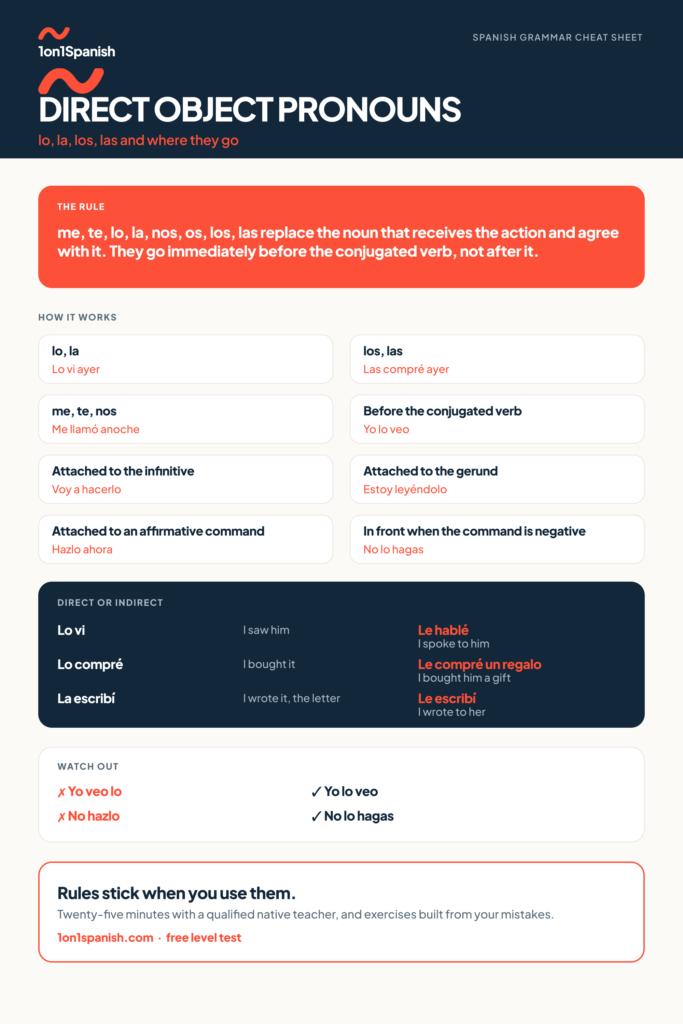
Take the chart with you
The chart is free to view and share. Drop your email and we’ll send the print-ready US Letter PDF — the version you stick on the fridge.
Practice
Practice direct object pronouns with a real teacher
Charts get you halfway. The other half is saying it out loud to someone who corrects you on the spot. At 1on1Spanish you get 25-minute private lessons with a qualified native teacher, exercises built from the mistakes you make in class, and AI practice between lessons.
First month $1. No contracts, cancel anytime.
You can go further with someone listening: Learn Spanish with 1on1Spanish, 25 minutes at a time.
Take your free level testBuilt on RingTeacher's method — 700,000+ classes delivered since 2017, teaching English to Spanish speakers. Now in the other direction.
Frequently asked questions
What is a direct object pronoun in Spanish?
It’s the word that replaces the noun receiving the action, so you don’t repeat it: Compré el carro becomes Lo compré. The forms are me, te, lo, la, nos, os, los, las, and they agree with the noun they replace in gender and number. Unlike English, they go in front of the conjugated verb rather than after it.
How do I know whether to use lo or la?
Match the gender of the noun you’re replacing, not the person you’re talking about. El contrato takes lo, la reunión takes la, regardless of who’s involved. For people it’s the same logic: a man is lo, a woman is la. When you’re replacing a whole idea instead of a noun — I know that — the form is always lo.
Where does the pronoun go with two verbs?
Either in front of the first verb or attached to the second, and both are equally correct: Lo voy a llamar and Voy a llamarlo, La estoy leyendo and Estoy leyéndola. The only rule is that you choose one. Attaching to a gerund adds a written accent so the stress doesn’t move: leyéndola, haciéndolo.
Is le instead of lo actually correct?
For a male person, yes, in central and northern Spain, and the Real Academia accepts it. Latin America uses lo consistently. Using le for an object — el carro, le vendí — is not accepted anywhere. As a learner, lo is the safer choice: it’s correct in every country and it keeps direct and indirect pronouns from blurring together.
What’s the most common mistake with direct object pronouns?
Leaving the pronoun after the verb, as in veo lo instead of lo veo. English keeps the object in its original slot, so the reordering has to be built deliberately. The second most common is doubling — lo tengo que hacerlo — which appears right after someone learns that both positions are allowed with an infinitive.