
Pagar conjugation in Spanish: every tense you need, with examples
Pagar means “to pay”, and it carries one spelling change: the g becomes gu any time the ending starts with e, so the sound stays hard instead of turning soft. That’s what produces pagué in the preterite and pague across the subjunctive. The bigger question learners actually have is whether pagar needs “for” in front of what’s being paid — and the answer depends on what follows. Every tense is below. 1on1Spanish teaches this in 25-minute one-on-one lessons with qualified native teachers, online across the United States.
Reviewed by María Jiménez — Licenciada en Filología Hispánica (BA in Hispanic Philology) · Updated Sep 2026
What pagar means
Pagar is “to pay”, for bills, purchases, rent, people: pago la renta el primero de cada mes, pagué la cuenta con tarjeta. When the thing being paid is a direct object — a bill, a service, an item — no preposition goes in between: pagué la cuenta, never pagué por la cuenta.
Pagar por does exist, but it means something slightly different: it emphasizes the exchange or the reason. Pagué mucho por ese carro highlights the price relative to the value; pagó por su error means he paid the consequences for a mistake, not money at all.
To pay a person, Spanish uses pagarle a alguien: le pagué al plomero doscientos dólares, with the indirect object pronoun le doubling the a phrase, which is standard and not optional.
Grammatically it’s regular with a spelling change (g→gu before e). The change shows up in the preterite yo form and the entire present subjunctive.
Pagar conjugation: present tense
Fully regular here — the endings start with o, a or nothing, so the g stays a g.
| Form | Example | |
|---|---|---|
| yo | pago | Pago la renta el día primero. (I pay rent on the first.) |
| tú | pagas | ¿Pagas con tarjeta o en efectivo? (Do you pay by card or in cash?) |
| él / ella / usted | paga | Mi empresa paga cada quincena. (My company pays every two weeks.) |
| nosotros | pagamos | Pagamos la mitad cada uno. (We each pay half.) |
| vosotros | pagáis | ¿Vosotros pagáis el alquiler juntos? (Do you pay rent together?) |
| ellos / ellas / ustedes | pagan | Mis padres pagan la mitad de la colegiatura. (My parents pay half the tuition.) |
Pagar conjugation: preterite
The yo form needs the spelling change, because the ending starts with e.
| Form | |
|---|---|
| yo | pagué |
| tú | pagaste |
| él / ella / usted | pagó |
| nosotros | pagamos |
| vosotros | pagasteis |
| ellos / ellas / ustedes | pagaron |
Pagué la renta dos días tarde este mes. — I paid rent two days late this month.
Pagar conjugation: imperfect
Fully regular, no spelling change.
| Form | |
|---|---|
| yo | pagaba |
| tú | pagabas |
| él / ella / usted | pagaba |
| nosotros | pagábamos |
| vosotros | pagabais |
| ellos / ellas / ustedes | pagaban |
Antes pagábamos menos por el mismo apartamento. — We used to pay less for the same apartment.
Pagar conjugation: future
Regular endings on the infinitive.
| Form | |
|---|---|
| yo | pagaré |
| tú | pagarás |
| él / ella / usted | pagará |
| nosotros | pagaremos |
| vosotros | pagaréis |
| ellos / ellas / ustedes | pagarán |
Te pagaré en cuanto me depositen. — I’ll pay you as soon as I get direct deposit.
Pagar conjugation: conditional
| Form | |
|---|---|
| yo | pagaría |
| tú | pagarías |
| él / ella / usted | pagaría |
| nosotros | pagaríamos |
| vosotros | pagaríais |
| ellos / ellas / ustedes | pagarían |
Yo pagaría más por un buen seguro médico. — I’d pay more for good health insurance.
Pagar conjugation: present subjunctive
Every form takes the spelling change, because every -ar subjunctive ending starts with e.
| Form | |
|---|---|
| yo | pague |
| tú | pagues |
| él / ella / usted | pague |
| nosotros | paguemos |
| vosotros | paguéis |
| ellos / ellas / ustedes | paguen |
Necesito que pagues antes del viernes. — I need you to pay before Friday.
Pagar conjugation: imperfect subjunctive
Built on the preterite stem pagaron-. No spelling change here — the endings start with a.
| Form (-ra) | Form (-se) | |
|---|---|---|
| yo | pagara | pagase |
| tú | pagaras | pagases |
| él / ella / usted | pagara | pagase |
| nosotros | pagáramos | pagásemos |
| vosotros | pagarais | pagaseis |
| ellos / ellas / ustedes | pagaran | pagasen |
Si pagara al contado, me darían un descuento. — If I paid in cash, they’d give me a discount.
Pagar commands (imperative)
| Affirmative | Negative | |
|---|---|---|
| tú | paga | no pagues |
| usted | pague | no pague |
| nosotros | paguemos | no paguemos |
| vosotros | pagad | no paguéis |
| ustedes | paguen | no paguen |
Pague en la caja, por favor. — Please pay at the register.
Participle, gerund and compound tenses
Participle pagado, gerund pagando. Both regular, no spelling change. Compounds take haber:
He pagado el préstamo por completo (present perfect) · Ya había pagado la fianza antes de firmar (past perfect) · Para diciembre habré pagado toda la deuda (future perfect).
When to use pagar
Paying a bill or a purchase directly
Pagué la cuenta de la luz esta mañana. No preposition needed — the bill is a direct object.
Paying by a specific method
Pago con tarjeta casi siempre. Common in everyday transactions, from a coffee shop to a car dealership.
Paying a person
Le pagué al plomero después de que terminó. This is where le… a doubles up, marking the person who gets paid.
Common mistakes English speakers make with pagar
Pagar takes a direct object with no preposition when what’s being paid is a specific bill or item. Adding por here is a calque of English “pay for”.
Spanish doesn’t write ge with a hard “g” sound. The yo preterite takes gu: pagué, not pagé.
When you name the person being paid, Spanish needs a before them, doubled by the indirect object pronoun le.
After necesito que, the verb needs the subjunctive, which keeps the spelling change: pagues, not pagas.
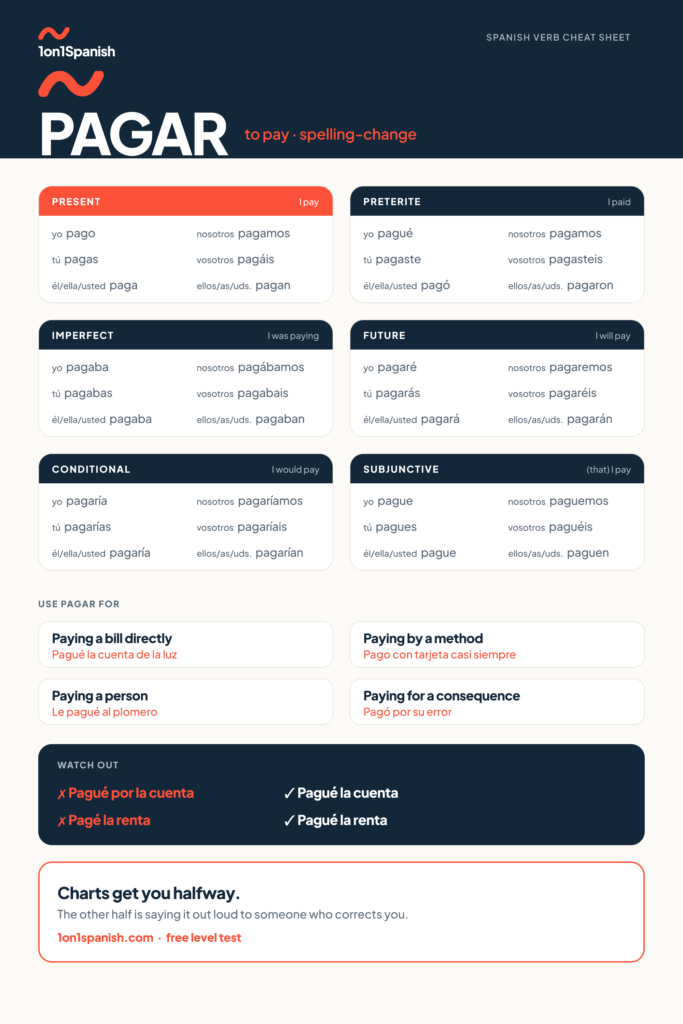
Take the chart with you
The chart is free to view and share. Drop your email and we’ll send the print-ready US Letter PDF — the version you stick on the fridge.
Practice
Practice pagar with a real teacher
Charts get you halfway. The other half is saying it out loud to someone who corrects you on the spot. At 1on1Spanish you get 25-minute private lessons with a qualified native teacher, exercises built from the mistakes you make in class, and AI practice between lessons.
First month $1. No contracts, cancel anytime.
You can go further with someone listening: Learn Spanish with 1on1Spanish, 25 minutes at a time.
Take your free level testBuilt on RingTeacher's method — 700,000+ classes delivered since 2017, teaching English to Spanish speakers. Now in the other direction.
Frequently asked questions
Is pagar regular or irregular in Spanish?
Regular in meaning, with one spelling change: the g becomes gu whenever the ending starts with e, to keep the hard “g” sound of the infinitive. That affects the preterite yo form (pagué) and the entire present subjunctive (pague, pagues, paguemos, paguéis, paguen). Every other tense follows the standard -ar pattern with no change at all.
Do you say “pagar” or “pagar por” in Spanish?
Both exist, and they mean different things. Pagar plus a direct object is for a specific bill or item: pagué la cuenta. Pagar por is for the exchange or the reason behind a payment: pagué mucho por ese reloj, or figuratively, pagó por su error. Using por where a direct object would do is the most common mistake with this verb.
Why is it “pagué” and not “pagé”?
Spanish spelling doesn’t allow g before e or i to keep the hard “g” sound — that combination would be read as a soft “h” sound instead. So the spelling switches to gu, which preserves the pronunciation of the infinitive. Every verb ending in -gar does the same thing: llegar becomes llegué, jugar becomes jugué, entregar becomes entregué.
What is the past tense of pagar in Spanish?
Two forms. The preterite — pagué, pagaste, pagó, pagamos, pagasteis, pagaron — describes a single completed payment: pagué la renta el lunes. The imperfect — pagaba, pagabas, pagaba, pagábamos, pagabais, pagaban — describes a recurring payment or a general past habit: pagaba menos por el mismo servicio.
Do I need the subjunctive of pagar in everyday conversation?
Yes, often, because money comes with deadlines and deadlines take the subjunctive. Pague appears after necesito que (necesito que pagues antes del viernes), after es importante que (es importante que paguemos a tiempo), and after cuando pointing at the future (cuando pagues, te mando el recibo). Note the u in every one of those forms. It’s an everyday construction, not an advanced one.