
Conjugate pedir in Spanish: every tense you need, with examples
Pedir means “to ask for”, “to request” and “to order”. It’s the verb you use at a restaurant, at a counter and in a work email. It’s a stem-changing verb of the e→i type, so the vowel shifts in the present (pido, pides, pide), in the third person of the preterite (pidió, pidieron) and in the gerund (pidiendo). All the tables are below, plus the line that separates it from preguntar. 1on1Spanish teaches this in 25-minute one-on-one lessons with qualified native teachers, online across the United States.
Reviewed by María Jiménez — Licenciada en Filología Hispánica (BA in Hispanic Philology) · Updated Aug 2026
What pedir means
Pedir is asking for a thing or an action, not asking a question. You pides the check, a raise, a favor, a refund, an extension on a deadline. English hides the difference because “ask” does both jobs; Spanish splits them, and pedir takes the object directly, with no preposition: pido la cuenta, never pido por la cuenta.
In a restaurant it also means “to order”, which is its most frequent use for visitors: ¿Ya han pedido? is what a server asks a table.
It’s a stem-changing verb (e→i), regular in its endings. The participle is pedido, which is also a noun meaning “an order”, and the gerund is the irregular pidiendo.
Pedir conjugation: present tense
The e becomes i in every form except nosotros and vosotros.
| Form | Example | |
|---|---|---|
| yo | pido | Pido la cuenta, por favor. (I’d like the check, please.) |
| tú | pides | ¿Qué pides de segundo? (What are you ordering as a main?) |
| él / ella / usted | pide | Mi jefe pide un informe cada lunes. (My boss asks for a report every Monday.) |
| nosotros | pedimos | Pedimos dos cafés y la cuenta. (We’ll have two coffees and the check.) |
| vosotros | pedís | ¿Pedís vosotros o pido yo? (Are you ordering or should I?) |
| ellos / ellas / ustedes | piden | Los vecinos piden silencio después de las diez. (The neighbors ask for quiet after ten.) |
Pedir conjugation: preterite
Endings are regular; the stem changes only in the third person, singular and plural. That pair is the whole difficulty of this verb.
| Form | |
|---|---|
| yo | pedí |
| tú | pediste |
| él / ella / usted | pidió |
| nosotros | pedimos |
| vosotros | pedisteis |
| ellos / ellas / ustedes | pidieron |
Pidió un aumento en enero. — She asked for a raise in January.
Note that pedimos is identical in the present and the preterite. Context, or a time marker like ayer, does the work.
Pedir conjugation: imperfect
Completely regular, no stem change anywhere.
| Form | |
|---|---|
| yo | pedía |
| tú | pedías |
| él / ella / usted | pedía |
| nosotros | pedíamos |
| vosotros | pedíais |
| ellos / ellas / ustedes | pedían |
De niño siempre pedía lo mismo: pollo con arroz. — As a kid I always ordered the same thing.
Pedir conjugation: future
Regular endings on the full infinitive.
| Form | |
|---|---|
| yo | pediré |
| tú | pedirás |
| él / ella / usted | pedirá |
| nosotros | pediremos |
| vosotros | pediréis |
| ellos / ellas / ustedes | pedirán |
Pedir conjugation: conditional
| Form | |
|---|---|
| yo | pediría |
| tú | pedirías |
| él / ella / usted | pediría |
| nosotros | pediríamos |
| vosotros | pediríais |
| ellos / ellas / ustedes | pedirían |
Yo pediría el pescado. — I’d go with the fish.
Pedir conjugation: present subjunctive
Here the i shows up in every single form, including nosotros and vosotros.
| Form | |
|---|---|
| yo | pida |
| tú | pidas |
| él / ella / usted | pida |
| nosotros | pidamos |
| vosotros | pidáis |
| ellos / ellas / ustedes | pidan |
Espero que no pidan más cambios. — I hope they don’t ask for more changes.
Pedir conjugation: imperfect subjunctive
Built on the third-person preterite stem pidi-, so the i carries through. Both endings are correct; the -ra set is the one you’ll hear.
| Form (-ra) | Form (-se) | |
|---|---|---|
| yo | pidiera | pidiese |
| tú | pidieras | pidieses |
| él / ella / usted | pidiera | pidiese |
| nosotros | pidiéramos | pidiésemos |
| vosotros | pidierais | pidieseis |
| ellos / ellas / ustedes | pidieran | pidiesen |
Me dijo que pidiera cita por internet. — She told me to make an appointment online.
Pedir commands (imperative)
| Affirmative | Negative | |
|---|---|---|
| tú | pide | no pidas |
| usted | pida | no pida |
| nosotros | pidamos | no pidamos |
| vosotros | pedid | no pidáis |
| ustedes | pidan | no pidan |
Pide lo que quieras. — Order whatever you like. Only the vosotros affirmative keeps the e.
Participle, gerund and compound tenses
Participle pedido, gerund pidiendo. Compounds use haber:
He pedido una copia del contrato (present perfect) · Había pedido el día libre (past perfect) · Para el viernes ya habré pedido el reembolso (future perfect).
Pedido is also a noun: mi pedido no ha llegado means “my order hasn’t arrived”, which is what you write to customer service.
When to use pedir
Ordering food and drinks
Vamos a pedir is what a table says when it’s ready. ¿Qué vas a pedir? is what a friend asks you.
Asking for something concrete
A favor, a discount, an extension, the check, a doctor’s appointment: Pedí cita para el martes.
Asking someone to do something
This is the structure that trips people up, because it needs the subjunctive: Te pido que me avises. Two subjects, so the second verb changes. The full trigger list is in subjunctive.
Set phrases you’ll hear immediately
Pedir perdón (to apologize), pedir permiso (to ask permission), pedir prestado (to borrow), pedir la mano (to propose). Pedir prestado is the standard way to say “borrow”, because Spanish has no single verb for it.
Pedir vs preguntar
English “ask” splits in two. Pedir wants an object or an action; preguntar wants information.
| Pedir | Preguntar |
|---|---|
| Pidió la cuenta — He asked for the check | Preguntó cuánto era — He asked how much it was |
| Le pedí un favor — I asked her for a favor | Le pregunté si podía ayudarme — I asked if she could help |
| Pide una habitación doble — Ask for a double room | Pregunta si queda alguna — Ask whether any are left |
| Pedir perdón — to apologize | Preguntar por alguien — to ask after someone |
Quick test: if the English sentence could take “ask for“, it’s pedir. If it’s followed by a question word or “if”, it’s preguntar.
Common mistakes English speakers make with pedir
Pedir never takes por for the thing requested. The “for” is already inside the verb.
Questions aren’t asked with pedir, and they aren’t asked with preguntar either when the noun is pregunta: you make a question in Spanish.
Pedir que forces the subjunctive, exactly like querer que.
The third person of the preterite is pidió, not pedió. Same pattern in pidieron, pidiendo, pidiera.
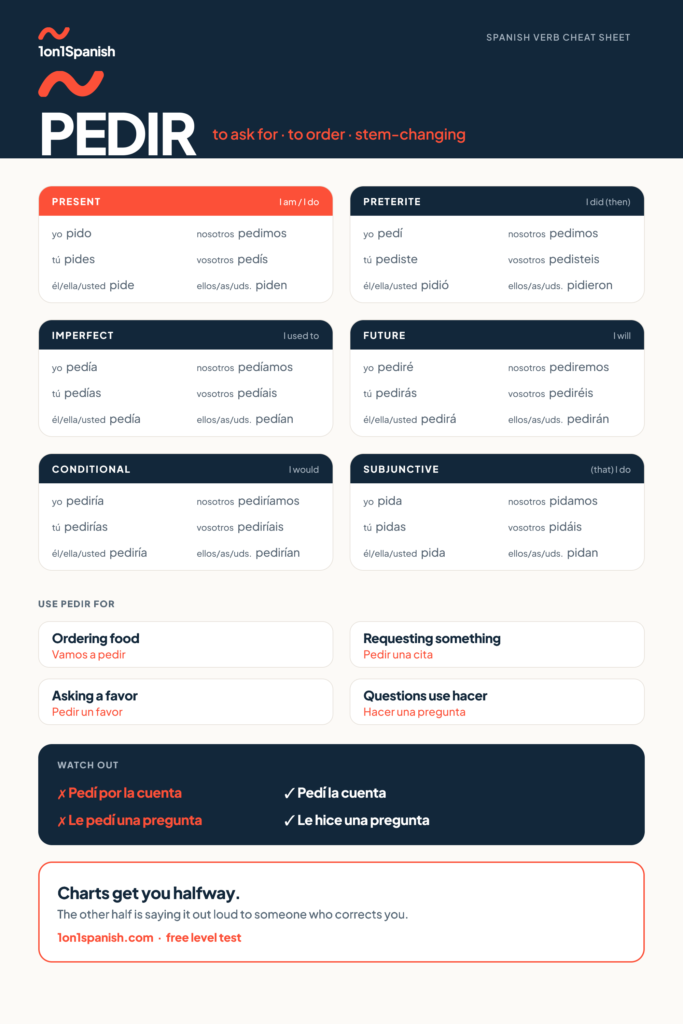
Take the chart with you
The chart is free to view and share. Drop your email and we’ll send the print-ready US Letter PDF — the version you stick on the fridge.
Practice
Practice pedir with a real teacher
Charts get you halfway. The other half is saying it out loud to someone who corrects you on the spot. At 1on1Spanish you get 25-minute private lessons with a qualified native teacher, exercises built from the mistakes you make in class, and AI practice between lessons.
First month $1. No contracts, cancel anytime.
Prefer to practice with a person? Take one-on-one Spanish lessons online with a qualified native teacher.
Take your free level testBuilt on RingTeacher's method — 700,000+ classes delivered since 2017, teaching English to Spanish speakers. Now in the other direction.
Frequently asked questions
Is pedir regular or irregular in Spanish?
Pedir is a stem-changing verb, not a fully irregular one. Its endings are the standard -ir endings, but the stem vowel e becomes i whenever it’s stressed or followed by certain endings: pido, pidió, pidiendo, pida, pidiera. The forms that keep the e are pedimos, pedís, the whole imperfect, the future and the conditional.
What’s the difference between pedir and preguntar?
Pedir is asking for something you want: the check, a favor, a day off. Preguntar is asking for information: a price, a direction, whether something is possible. Le pedí ayuda means I asked her for help; le pregunté si podía ayudarme means I asked her whether she could help. English uses “ask” for both, which is why the pair has to be learned as a pair.
How do you order food in Spanish using pedir?
Say ¿Me pone…? or Para mí… to the server, and use pedir to talk about the act itself: ya hemos pedido, ¿qué vas a pedir?, voy a pedir la sopa. To ask for the check, la cuenta, por favor is enough. Quisiera pedir is a polite full sentence if you’d rather not shorten it.
What is the preterite of pedir in Spanish?
Pedí, pediste, pidió, pedimos, pedisteis, pidieron. Only the third person changes the stem vowel, which is the form learners get wrong most often. Pedió doesn’t exist. Note that pedimos is the same in the present and the preterite, so a time marker like ayer or esta mañana usually carries the meaning.
Does pedir always need the subjunctive?
Only when you’re asking someone else to act. Pido un café takes no subjunctive because there’s one subject and a direct object. Te pido que llames al médico has two subjects, so the second verb becomes llames. In the past the same structure gives te pedí que llamaras. Without a second subject, an infinitive is enough.