
Pensar conjugation in Spanish: every tense you need, with examples
Pensar means “to think”, and it’s a stem-changing verb (e→ie): the e turns into ie when the syllable is stressed, which gives you pienso, piensas, piensa against a plain pensamos. Endings stay regular -ar everywhere. The table isn’t the hard part. The hard part is choosing between pensar en, pensar de and pensar que, and knowing that a negated pensar que pulls the subjunctive behind it. All of that is below. 1on1Spanish teaches it in 25-minute one-on-one lessons with qualified native teachers, online across the United States.
Reviewed by María Jiménez — Licenciada en Filología Hispánica (BA in Hispanic Philology) · Updated Aug 2026
What pensar means
Pensar on its own is the mental act: Déjame pensar (Let me think). With que it introduces an opinion: Pienso que tiene razón. With en it means having someone or something on your mind: Pienso mucho en mi padre. With de it asks for a judgment: ¿Qué piensas de la propuesta?
There’s a fourth use that surprises English speakers: pensar + infinitive means to plan or intend to do something. Pienso mudarme en junio is “I’m planning to move in June”, not “I think about moving”.
Endings are regular. The only irregularity is the e→ie stem change under stress, so nosotros and vosotros keep the e. It’s the same pattern you’ll meet in querer, empezar and entender, and one of the biggest families of Spanish verbs. Participle pensado, gerund pensando.
Pensar conjugation: present tense
| Form | Example | |
|---|---|---|
| yo | pienso | Pienso que deberíamos esperar. (I think we should wait.) |
| tú | piensas | ¿En qué piensas? (What are you thinking about?) |
| él / ella / usted | piensa | Mi hermano piensa comprarse una casa. (My brother is planning to buy a house.) |
| nosotros | pensamos | Pensamos ir en carro. (We’re planning to drive.) |
| vosotros | pensáis | ¿Qué pensáis del precio? (What do you think about the price?) |
| ellos / ellas / ustedes | piensan | Piensan mucho en el futuro. (They think a lot about the future.) |
Pensar conjugation: preterite
Completely regular. The only thing to watch is the accent on pensé and pensó.
| Form | |
|---|---|
| yo | pensé |
| tú | pensaste |
| él / ella / usted | pensó |
| nosotros | pensamos |
| vosotros | pensasteis |
| ellos / ellas / ustedes | pensaron |
Lo pensé toda la noche y dije que no. — I thought about it all night and said no.
Pensar conjugation: imperfect
| Form | |
|---|---|
| yo | pensaba |
| tú | pensabas |
| él / ella / usted | pensaba |
| nosotros | pensábamos |
| vosotros | pensabais |
| ellos / ellas / ustedes | pensaban |
Pensaba llamarte, pero se me hizo tarde. — I was planning to call you, but it got late.
Pensar conjugation: future
| Form | |
|---|---|
| yo | pensaré |
| tú | pensarás |
| él / ella / usted | pensará |
| nosotros | pensaremos |
| vosotros | pensaréis |
| ellos / ellas / ustedes | pensarán |
Pensar conjugation: conditional
| Form | |
|---|---|
| yo | pensaría |
| tú | pensarías |
| él / ella / usted | pensaría |
| nosotros | pensaríamos |
| vosotros | pensaríais |
| ellos / ellas / ustedes | pensarían |
Nadie pensaría mal de ti por eso. — Nobody would think badly of you for that.
Pensar conjugation: present subjunctive
Same stress rule, and the -ar subjunctive endings in -e.
| Form | |
|---|---|
| yo | piense |
| tú | pienses |
| él / ella / usted | piense |
| nosotros | pensemos |
| vosotros | penséis |
| ellos / ellas / ustedes | piensen |
No quiero que pienses que me da igual. — I don’t want you to think I don’t care.
Pensar conjugation: imperfect subjunctive
Built on the preterite stem, so the vowel never changes.
| Form (-ra) | Form (-se) | |
|---|---|---|
| yo | pensara | pensase |
| tú | pensaras | pensases |
| él / ella / usted | pensara | pensase |
| nosotros | pensáramos | pensásemos |
| vosotros | pensarais | pensaseis |
| ellos / ellas / ustedes | pensaran | pensasen |
Si lo pensaras dos veces, no lo harías. — If you thought it over twice, you wouldn’t do it.
Pensar commands (imperative)
| Affirmative | Negative | |
|---|---|---|
| tú | piensa | no pienses |
| usted | piense | no piense |
| nosotros | pensemos | no pensemos |
| vosotros | pensad | no penséis |
| ustedes | piensen | no piensen |
Piénsalo con calma y me dices. — Think it over and let me know.
Participle, gerund and compound tenses
Participle pensado, gerund pensando. Both are regular, and the stem never changes in either one: it’s pensando, never piensando.
He pensado en lo que dijiste (present perfect) · No lo había pensado así (past perfect) · Para mañana ya lo habré pensado (future perfect).
When to use pensar
Stating an opinion, with pensar que
Pienso que el precio es alto. This is the everyday way to say “I think that…”, and it behaves like English until you make it negative, which changes the mood of the next verb.
Pensar en, for what’s on your mind
Estoy pensando en cambiar de trabajo. Use en for the thing occupying your head: a person, a plan, a memory. Never de, never nothing.
Asking for a verdict, with pensar de
¿Qué piensas de mi jefe? This one shows up almost exclusively in questions with qué. In the answer you switch back: Pienso que es buen tipo.
Pensar + infinitive, for plans
Pensamos quedarnos tres noches. No preposition, no que. It’s the fastest way to say what you intend to do, and it’s more common in speech than tener la intención de.
Sleeping on it, with pensarlo
Déjame pensarlo. The attached lo is doing real work here; without it the sentence sounds unfinished.
Pensar vs creer
Both translate as “to think” or “to believe”, and Spanish speakers swap them constantly. The difference is weight: creer leans toward belief and conviction, pensar toward reasoning and opinion. Negated, both take the subjunctive.
| With pensar | With creer |
|---|---|
| Pienso que es la mejor opción — reasoned opinion | Creo que es la mejor opción — slightly softer, more personal |
| Lo estoy pensando — I’m weighing it up | Lo creo — I believe it |
| No pienso que sea grave — subjunctive after negation | No creo que sea grave — subjunctive after negation |
| Pienso mudarme — I plan to move | Creo mudarme — not Spanish |
That subjunctive after a negated opinion verb is the same rule that governs no creo que, no me parece que and dudo que. It’s covered in full in the Spanish subjunctive.
Common mistakes English speakers make with pensar
“Think about” is pensar en. Pensar de only works when you’re asking someone’s opinion of something.
The stem change only happens on stressed syllables, so nosotros and vosotros keep the plain e.
Affirmative pienso que takes the indicative; negated, it takes the subjunctive. Same for no creo que.
Sobre is not the preposition here. Either drop it entirely for a plan, or use en for a thought: pienso en cambiar de trabajo.
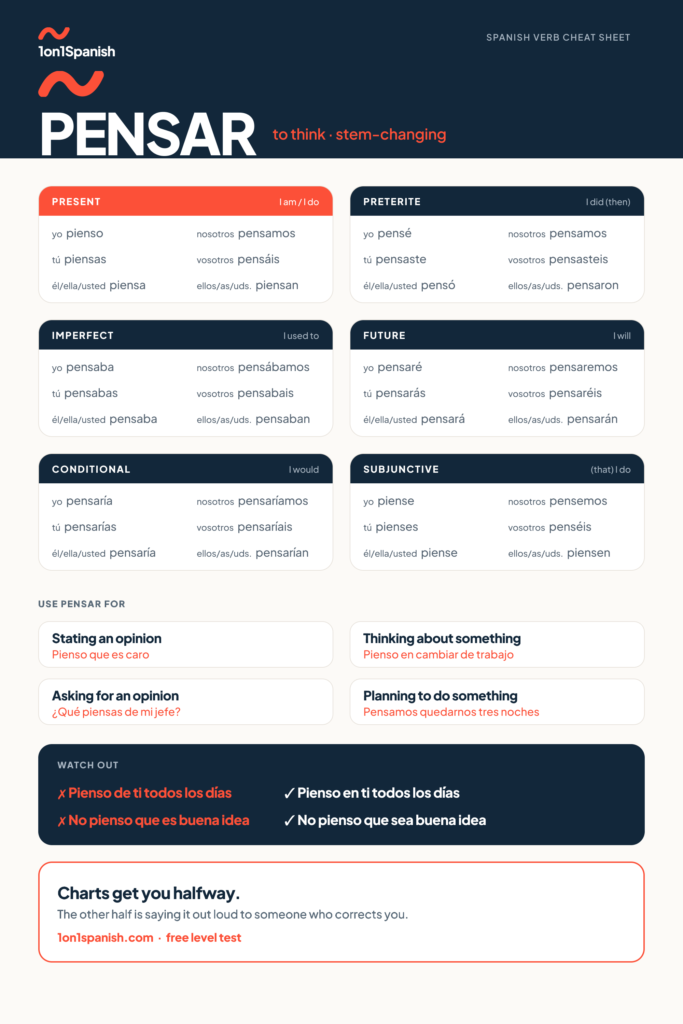
Take the chart with you
The chart is free to view and share. Drop your email and we’ll send the print-ready US Letter PDF — the version you stick on the fridge.
Practice
Practice pensar with a real teacher
Charts get you halfway. The other half is saying it out loud to someone who corrects you on the spot. At 1on1Spanish you get 25-minute private lessons with a qualified native teacher, exercises built from the mistakes you make in class, and AI practice between lessons.
First month $1. No contracts, cancel anytime.
Work on it with a Spanish tutor who hears the mistake as you make it.
When you are ready to speak it out loud, try online Spanish lessons with a native teacher.
Take your free level testBuilt on RingTeacher's method — 700,000+ classes delivered since 2017, teaching English to Spanish speakers. Now in the other direction.
Frequently asked questions
Is pensar regular or irregular in Spanish?
Pensar is a stem-changing verb of the e→ie type. The stem changes only when it carries the stress, so you get pienso, piensas, piensa, piensan but pensamos and pensáis. All the endings are regular -ar endings, and the preterite, imperfect, future and conditional show no change at all. Nothing else about it is irregular.
What’s the difference between pensar en and pensar de?
Pensar en means to have something on your mind: pienso en mi familia, estoy pensando en mudarme. Pensar de asks for an evaluation and appears almost only in questions: ¿Qué piensas de la película? When you answer, you switch to pensar que: Pienso que estuvo bien. Using de for “think about” is the most frequent error.
Does pensar take the subjunctive in Spanish?
Only when it’s negated or questioned. Pienso que viene uses the indicative because you’re asserting something. No pienso que venga uses the subjunctive because the assertion is withdrawn. The same flip happens with creer, parecer and estar seguro. In affirmative statements, pensar que is followed by the indicative every time.
How do you say “I’m planning to” using pensar?
Use pensar + infinitive with no preposition: Pienso llamarle mañana (I’m planning to call him tomorrow), Pensamos quedarnos una semana. It’s the everyday way to talk about intentions, lighter than tengo la intención de. In the imperfect it means a plan that didn’t happen: pensaba ir, pero al final me quedé.
What is the past tense of pensar in Spanish?
There are two, and they don’t overlap. The preterite pensé, pensaste, pensó describes a completed act of thinking: Lo pensé y decidí que no. The imperfect pensaba, pensabas, pensaba describes an ongoing thought or an old intention: Pensaba que eras mayor, pensaba llamarte. Both stems stay regular, with no ie.