
Poner conjugation in Spanish: every tense you need, with examples
Poner means “to put” or “to place”, and it’s irregular almost everywhere you look: pongo in the present, puse in the preterite, pondré in the future, pon as a command and puesto as a participle. Only the imperfect behaves. The tables below cover every tense you need, and then the reflexive ponerse, which is how most Americans will actually use this verb: for putting on clothes and for becoming something. 1on1Spanish teaches this in 25-minute one-on-one lessons with qualified native teachers, online across the United States.
Reviewed by María Jiménez — Licenciada en Filología Hispánica (BA in Hispanic Philology) · Updated Sep 2026
What poner means
The core sense is placing something somewhere: Pon las llaves en la mesa, Puso el carro en el garaje. From that, Spanish builds a long list of everyday uses that have no “put” in their English translation: poner la mesa (to set the table), poner música (to play music), poner la calefacción (to turn the heat on), mandar un correo (to send an email), ponerle un nombre a alguien (to name someone).
The reflexive ponerse is a separate habit worth learning at the same time. With clothing it means “to put on”: Me pongo el abrigo. With an adjective it means “to become”, for a change that’s quick and usually visible: Se puso rojo, Se puso nerviosa antes de la entrevista.
Irregularity summary: -g- in the yo form, a pus- preterite, a pondr- future stem, the short command pon, and the irregular participle puesto. The gerund poniendo is regular.
Poner conjugation: present tense
Only yo is irregular.
| Form | Example | |
|---|---|---|
| yo | pongo | Pongo la mesa mientras cocinas. (I’ll set the table while you cook.) |
| tú | pones | ¿Pones tú el aire acondicionado? (Will you turn on the AC?) |
| él / ella / usted | pone | Mi mujer pone la alarma a las seis. (My wife sets the alarm for six.) |
| nosotros | ponemos | Ponemos el dinero a partes iguales. (We’re splitting the cost evenly.) |
| vosotros | ponéis | ¿Dónde ponéis las maletas? (Where do you put the suitcases?) |
| ellos / ellas / ustedes | ponen | Ponen una película los domingos. (They play a movie on Sundays.) |
Poner conjugation: preterite
Fully irregular on the stem pus-, with unaccented endings.
| Form | |
|---|---|
| yo | puse |
| tú | pusiste |
| él / ella / usted | puso |
| nosotros | pusimos |
| vosotros | pusisteis |
| ellos / ellas / ustedes | pusieron |
Puse el dinero en la cuenta el viernes. — I put the money in the account on Friday.
Poner conjugation: imperfect
The only tense with no surprises.
| Form | |
|---|---|
| yo | ponía |
| tú | ponías |
| él / ella / usted | ponía |
| nosotros | poníamos |
| vosotros | poníais |
| ellos / ellas / ustedes | ponían |
Mi padre siempre ponía las noticias durante la cena. — My father always put the news on at dinner.
Poner conjugation: future
A d replaces the e of the infinitive: the stem is pondr-.
| Form | |
|---|---|
| yo | pondré |
| tú | pondrás |
| él / ella / usted | pondrá |
| nosotros | pondremos |
| vosotros | pondréis |
| ellos / ellas / ustedes | pondrán |
Pondremos la casa en venta en primavera. — We’ll put the house on the market in the spring.
Poner conjugation: conditional
Same pondr- stem.
| Form | |
|---|---|
| yo | pondría |
| tú | pondrías |
| él / ella / usted | pondría |
| nosotros | pondríamos |
| vosotros | pondríais |
| ellos / ellas / ustedes | pondrían |
Yo pondría el sofá junto a la ventana. — I’d put the couch by the window.
Poner conjugation: present subjunctive
Built on pong-.
| Form | |
|---|---|
| yo | ponga |
| tú | pongas |
| él / ella / usted | ponga |
| nosotros | pongamos |
| vosotros | pongáis |
| ellos / ellas / ustedes | pongan |
Dile que ponga la reunión el jueves. — Tell her to schedule the meeting for Thursday.
Poner conjugation: imperfect subjunctive
Built on the preterite stem pus-.
| Form (-ra) | Form (-se) | |
|---|---|---|
| yo | pusiera | pusiese |
| tú | pusieras | pusieses |
| él / ella / usted | pusiera | pusiese |
| nosotros | pusiéramos | pusiésemos |
| vosotros | pusierais | pusieseis |
| ellos / ellas / ustedes | pusieran | pusiesen |
Le pedí que pusiera mi nombre en la lista. — I asked him to put my name on the list.
Poner commands (imperative)
The affirmative tú command is pon, with no ending.
| Affirmative | Negative | |
|---|---|---|
| tú | pon | no pongas |
| usted | ponga | no ponga |
| nosotros | pongamos | no pongamos |
| vosotros | poned | no pongáis |
| ustedes | pongan | no pongan |
Pon el celular en silencio. — Put your phone on silent. With pronouns attached the stress is written: ponlo ahí, póngamelo por escrito.
Participle, gerund and compound tenses
Participle puesto, irregular, and also used as an adjective (la mesa está puesta). Gerund poniendo, regular. Compounds use haber:
He puesto una reclamación (present perfect) · Había puesto la lavadora antes de salir (past perfect) · Para el lunes ya habré puesto la denuncia (future perfect).
When to use poner
Placing something
Pon el vaso en la mesa. Puse las maletas en el maletero. The literal sense, and the one all the others grow out of.
Turning something on or playing it
¿Pones la tele? Pon música, por favor. Puso el aire a veinte grados. English switches verbs here; Spanish doesn’t.
Setting the table, an alarm, an appointment
Pongo la mesa. Puse la alarma a las seis. Nos pusieron cita para el martes.
Ponerse with clothing
Me pongo el abrigo y salimos. Note the definite article: Spanish says “the coat”, not “my coat”, because the reflexive already tells you whose it is.
Ponerse with an adjective, for a change of state
Se puso nervioso. Me puse enfermo el fin de semana. Se pusieron muy contentos con la noticia.
Poner vs meter
Both translate as “put”. Poner places something on or at a surface; meter pushes it inside something. When the object ends up enclosed, Spanish prefers meter.
| Poner — on a surface, or set | Meter — inside something |
|---|---|
| Pon el vaso en la mesa — Put the glass on the table | Mete la leche en el refrigerador — Put the milk in the fridge |
| Puso el cuadro en la pared — He hung the picture on the wall | Metió el celular en el bolsillo — He put his phone in his pocket |
| Pon la calefacción — Turn the heat on | Metió el carro en el garaje — He put the car in the garage |
| Puso una reclamación — He filed a complaint | Metió la ropa en la maleta — She put the clothes in the suitcase |
Common mistakes English speakers make with poner
The g belongs to the yo form and then runs through the entire subjunctive: ponga, pongas, pongamos.
The preterite doesn’t use the infinitive stem at all. Pon- becomes pus-: puse, pusiste, puso.
The participle is puesto, and it’s the same form you need in every compound tense and in the passive.
With reflexive verbs and clothing or body parts, Spanish uses the definite article. The possessive is redundant and marks the sentence as translated.
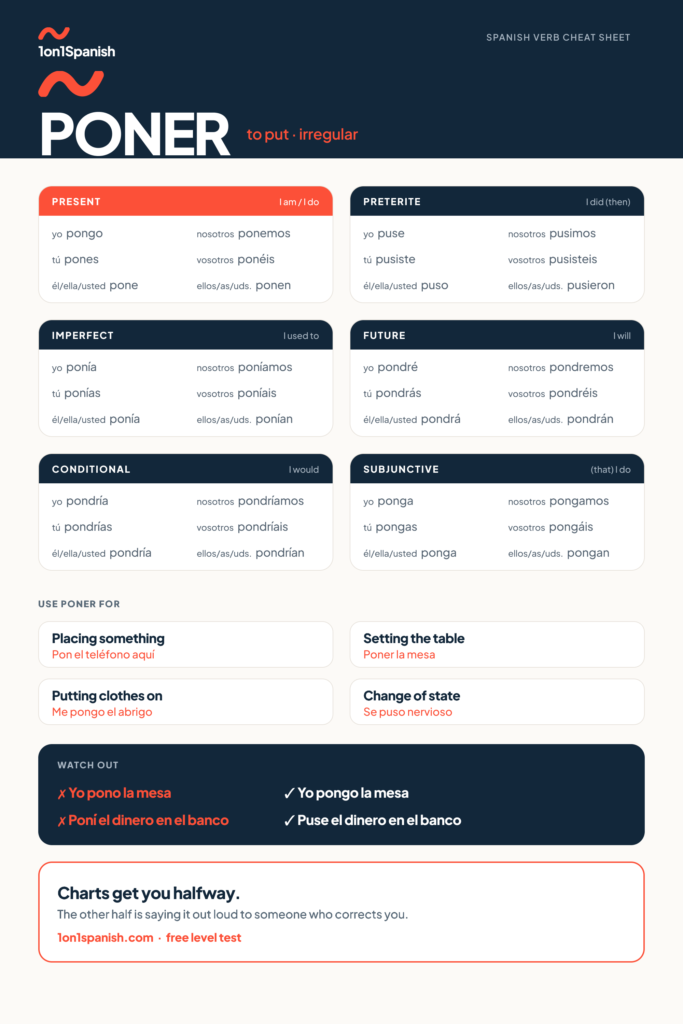
Take the chart with you
The chart is free to view and share. Drop your email and we’ll send the print-ready US Letter PDF — the version you stick on the fridge.
Practice
Practice poner and ponerse with a real teacher
Charts get you halfway. The other half is saying it out loud to someone who corrects you on the spot. At 1on1Spanish you get 25-minute private lessons in conversational Spanish with a qualified native teacher, exercises built from the mistakes you make in class, and AI practice between lessons.
First month $1. No contracts, cancel anytime.
These guides are free. When you want someone correcting you out loud, learn Spanish online with a qualified native teacher.
Take your free level testBuilt on RingTeacher's method — 700,000+ classes delivered since 2017, teaching English to Spanish speakers. Now in the other direction.
Frequently asked questions
Is poner regular or irregular in Spanish?
Poner is irregular in every main tense except the imperfect. The present adds a g in the yo form (pongo), the preterite runs on pus-, the future and conditional use the stem pondr-, the tú command is the bare pon, and the participle is puesto rather than ponido. The gerund poniendo is the other regular form.
What does ponerse mean in Spanish?
Two things. With clothing it means “to put on”: me pongo los zapatos. With an adjective it means “to become”, for a fast change you can see or feel: se puso rojo, me puse nervioso, se pusieron contentos. It’s one of several verbs Spanish uses for “become”, and the one for quick emotional or physical shifts. Reflexive verbs in general are covered in our guide to Spanish reflexive verbs.
What’s the difference between poner and meter?
Poner puts something on or at a place; meter puts it inside one. Pon el vaso en la mesa but mete la leche en el refrigerador. When the container encloses the object, as a pocket, a drawer, a suitcase or a garage does, Spanish speakers reach for meter. Using poner there isn’t wrong in every case, but it sounds less natural.
What is the past tense of poner in Spanish?
The preterite is puse, pusiste, puso, pusimos, pusisteis, pusieron, and it’s used for a single completed act: puse el dinero en la cuenta. The imperfect ponía describes a habit or a background action: siempre ponía las noticias. The compound he puesto covers something done recently or still relevant today.
How do you say “put your phone on silent” in Spanish?
Pon el celular en silencio with tú, ponga el celular en silencio with usted. In much of Latin America celular replaces móvil: pon el celular en silencio. The verb stays the same either way. It’s the same poner used for turning devices on and off. More irregular verbs like this one are listed under Spanish verbs.