
Probar conjugation in Spanish: every tense you need, with examples
Probar means “to try”, and it does that job in three different senses: trying food, trying an idea, and putting something to the test. Grammatically it’s simpler than it looks — the stem vowel o becomes ue under stress (pruebo, pruebas, prueba), but probamos and probáis keep the o, and every other tense is completely regular. The tables are below, along with the line between probar, intentar and tratar de, which is where most learners actually get stuck. 1on1Spanish teaches this in 25-minute one-on-one lessons with qualified native teachers, online across the United States.
Reviewed by María Jiménez — Licenciada en Filología Hispánica (BA in Hispanic Philology) · Updated Sep 2026
What probar means
Probar covers more ground than English “to try”. With food and drink it means to taste: ¿Ya probaste el mole? With an object or a plan it means to try out or test: Vamos a probar esta receta. With a claim or a fact, it means to prove: Eso no prueba nada.
The reflexive probarse narrows the meaning to clothes and shoes: Me probé la chaqueta antes de comprarla. That’s a different verb form, not a different verb, and it’s one of the most useful phrases for a store visit.
Technically it’s a stem-changing verb (o→ue). The participle probado and the gerund probando are both regular, and there’s no spelling change anywhere in the conjugation. It’s the same o→ue pattern as costar, which you’ll be using in the same store: ¿cuánto cuesta? right after me la pruebo.
Probar conjugation: present tense
Stem change in every form except nosotros and vosotros.
| Form | Example | |
|---|---|---|
| yo | pruebo | Pruebo la comida antes de servirla. (I taste the food before serving it.) |
| tú | pruebas | ¿Pruebas el café sin azúcar? (Do you try the coffee without sugar?) |
| él / ella / usted | prueba | Mi doctora prueba varios tratamientos. (My doctor tries several treatments.) |
| nosotros | probamos | Probamos suerte con esa agencia. (We’re trying our luck with that agency.) |
| vosotros | probáis | ¿Probáis el plato nuevo hoy? (Are you trying the new dish today?) |
| ellos / ellas / ustedes | prueban | Mis vecinos prueban un negocio nuevo. (My neighbors are trying a new business.) |
Probar conjugation: preterite
Regular endings, no stem change and no spelling change.
| Form | |
|---|---|
| yo | probé |
| tú | probaste |
| él / ella / usted | probó |
| nosotros | probamos |
| vosotros | probasteis |
| ellos / ellas / ustedes | probaron |
Probé el tratamiento por dos semanas y no funcionó. — I tried the treatment for two weeks and it didn’t work.
Probar conjugation: imperfect
Fully regular.
| Form | |
|---|---|
| yo | probaba |
| tú | probabas |
| él / ella / usted | probaba |
| nosotros | probábamos |
| vosotros | probabais |
| ellos / ellas / ustedes | probaban |
De niño probaba de todo sin quejarse. — As a kid he’d try anything without complaining.
Probar conjugation: future
Regular endings on the infinitive.
| Form | |
|---|---|
| yo | probaré |
| tú | probarás |
| él / ella / usted | probará |
| nosotros | probaremos |
| vosotros | probaréis |
| ellos / ellas / ustedes | probarán |
Probaremos otro médico si esto no mejora. — We’ll try another doctor if this doesn’t get better.
Probar conjugation: conditional
| Form | |
|---|---|
| yo | probaría |
| tú | probarías |
| él / ella / usted | probaría |
| nosotros | probaríamos |
| vosotros | probaríais |
| ellos / ellas / ustedes | probarían |
Yo probaría con un monto más bajo primero. — I’d try a lower amount first.
Probar conjugation: present subjunctive
The stem change carries over wherever the vowel is stressed.
| Form | |
|---|---|
| yo | pruebe |
| tú | pruebes |
| él / ella / usted | pruebe |
| nosotros | probemos |
| vosotros | probéis |
| ellos / ellas / ustedes | prueben |
Te recomiendo que pruebes el nuevo plan antes de firmar. — I recommend you try the new plan before signing.
Probar conjugation: imperfect subjunctive
Built on the preterite stem, and fully regular: no stem change anywhere.
| Form (-ra) | Form (-se) | |
|---|---|---|
| yo | probara | probase |
| tú | probaras | probases |
| él / ella / usted | probara | probase |
| nosotros | probáramos | probásemos |
| vosotros | probarais | probaseis |
| ellos / ellas / ustedes | probaran | probasen |
El médico me sugirió que probara otra dosis. — The doctor suggested I try a different dose.
Probar commands (imperative)
| Affirmative | Negative | |
|---|---|---|
| tú | prueba | no pruebes |
| usted | pruebe | no pruebe |
| nosotros | probemos | no probemos |
| vosotros | probad | no probéis |
| ustedes | prueben | no prueben |
Prueba esto antes de decidir. — Try this before you decide. The stem change shows up in every singular and plural third-person command, but not in nosotros or vosotros.
Participle, gerund and compound tenses
Participle probado, gerund probando. Both regular. Compounds use haber:
He probado tres restaurantes esta semana (present perfect) · Ya había probado esa marca antes (past perfect) · Para el viernes habré probado los dos planes (future perfect).
When to use probar
Tasting food or drink
¿Ya probaste el mole poblano? This is the most common everyday use, and the one visitors need first at any family meal.
Trying something new — an idea, a product, a route
Vamos a probar otra estrategia. This covers work decisions, recipes and travel plans equally well.
Testing whether something works
Prueba el micrófono antes de la llamada. Common in offices and doctor’s appointments alike: el médico probó varios medicamentos.
Probar vs intentar vs tratar de
All three can translate as “to try”, but they answer different questions.
| Spanish | What it means |
|---|---|
| Probé el plato nuevo. | I tried (tasted/tested) the new dish. |
| Intenté llamarte tres veces. | I tried (attempted) to call you three times. |
| Traté de llegar a tiempo. | I tried (made an effort) to arrive on time. |
| Prueba esta ruta, es más rápida. | Try this route, it’s faster. |
| Intenta no llegar tarde. | Try not to be late. |
Probar is for testing or tasting something concrete. Intentar and tratar de both mean to attempt an action, and they’re close to interchangeable, though tratar de leans slightly more toward effort against difficulty. Both intentar and tratar de take an infinitive directly; tratar needs the de.
Common mistakes English speakers make with probar
The yo form needs the stem change: o becomes ue wherever the syllable is stressed.
The stem only changes when it’s stressed, and in probamos the stress falls on the ending, not the stem.
Probar doesn’t take a bare infinitive for “attempt to do something” the way intentar does. Use probar for testing an object, not for attempting an action.
Without the reflexive me, probé la camisa sounds like you tasted the shirt. Trying on clothes always needs probarse.
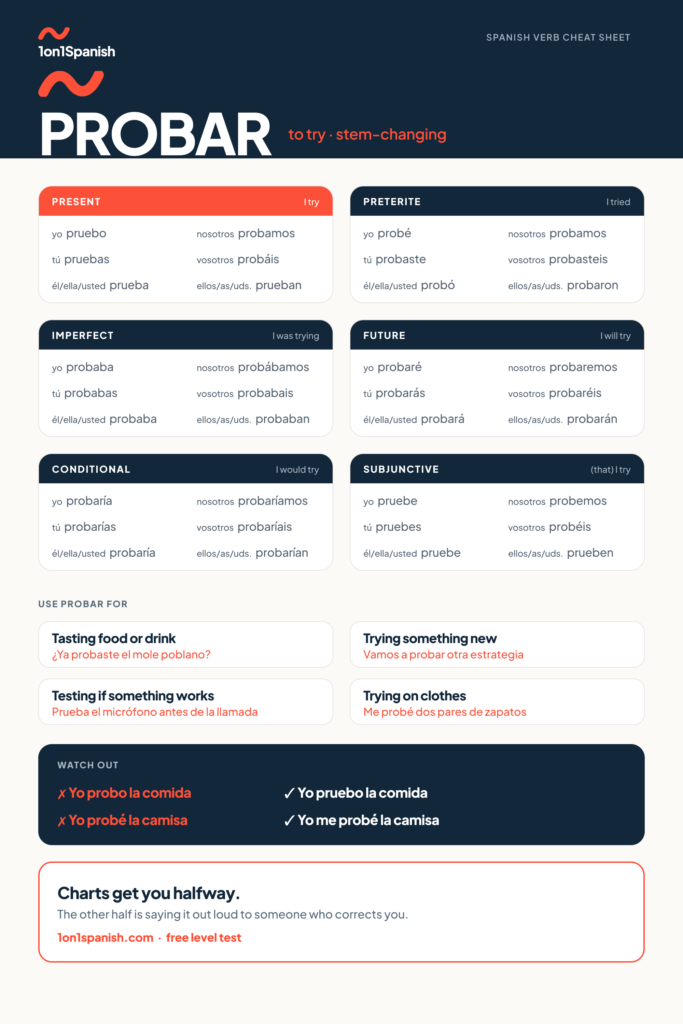
Take the chart with you
The chart is free to view and share. Drop your email and we’ll send the print-ready US Letter PDF — the version you stick on the fridge.
Practice
Practice probar with a real teacher
Charts get you halfway. The other half is saying it out loud to someone who corrects you on the spot. At 1on1Spanish you get 25-minute private lessons with a qualified native teacher, exercises built from the mistakes you make in class, and AI practice between lessons.
First month $1. No contracts, cancel anytime.
Reading about it only gets you so far. Learn Spanish online in 25-minute conversations and use it.
Take your free level testBuilt on RingTeacher's method — 700,000+ classes delivered since 2017, teaching English to Spanish speakers. Now in the other direction.
Frequently asked questions
Is probar regular or irregular in Spanish?
Probar is a stem-changing verb, not a fully irregular one. The o of the stem becomes ue whenever the syllable is stressed: pruebo, pruebas, prueba, prueban. The forms probamos and probáis keep the plain o because the stress falls on the ending. The preterite, future, conditional, participle and gerund are all completely regular.
What’s the difference between probar, intentar and tratar de?
Probar is for testing or tasting something concrete: food, a product, a plan. Intentar and tratar de both mean to attempt an action and take an infinitive — intenté llamarte, traté de llegar a tiempo. Tratar needs the preposition de before the infinitive; intentar doesn’t. All three can appear in the same conversation without sounding wrong.
How do you say “try on” in Spanish?
Use the reflexive form, probarse: me pruebo la chaqueta, ¿te probaste los zapatos? Without the reflexive pronoun, probar la chaqueta would sound like tasting the jacket. This is the phrase to know before any clothing store visit in a Spanish-speaking country.
What is the past tense of probar in Spanish?
Two, and the choice depends on whether it’s a single event or a background habit. The preterite is probé, probaste, probó, probamos, probasteis, probaron, for one specific attempt: probé la sopa y estaba fría. The imperfect is probaba, probabas, probaba, probábamos, probabais, probaban, for a repeated action: probaba un restaurante nuevo cada mes.
Do I need the subjunctive of probar in everyday conversation?
Yes, mostly after recommendations and suggestions. Pruebe and pruebes show up after te recomiendo que, sugiero que and ojalá que: sugiero que pruebe este medicamento primero. This is common in doctor’s offices, stores and any conversation where someone is recommending an option rather than describing a fact.