
Conjugate querer in Spanish: every tense you need, with examples
Querer means “to want”, and with a person as the object it also means “to love”. It’s a stem-changing verb: the e turns into ie when the stress falls on it (quiero, quieres, quiere), and the preterite goes somewhere else entirely (quise, quisiste, quiso). Every tense is below, along with the forms you need for polite requests, which is where most Americans meet this verb first. 1on1Spanish teaches this in 25-minute one-on-one lessons with qualified native teachers, online across the United States.
Reviewed by María Jiménez — Licenciada en Filología Hispánica (BA in Hispanic Philology) · Updated Aug 2026
What querer means
Querer covers two things English keeps apart. With a thing or an action it means “to want”: Quiero un café, Quiero cambiar de trabajo. With a person it means “to love” — the everyday, family-and-friends kind: Te quiero mucho, Quiere a sus nietos. Spanish keeps amar for declarations and lyrics; querer is what people actually say at home.
Two more senses show up constantly. Querer decir means “to mean” (¿Qué quiere decir esta palabra?), and no querer in the preterite means “refused” rather than “didn’t want”.
It’s a stem-changing verb (e→ie) with an irregular preterite and an irregular future stem querr-. The participle is querido and the gerund is queriendo, both regular.
Querer conjugation: present tense
The stem changes in every form except nosotros and vosotros, where the stress moves to the ending.
| Form | Example | |
|---|---|---|
| yo | quiero | Quiero hablar con el gerente. (I want to speak with the manager.) |
| tú | quieres | ¿Quieres que te llame luego? (Do you want me to call you later?) |
| él / ella / usted | quiere | Mi hija quiere estudiar medicina. (My daughter wants to study medicine.) |
| nosotros | queremos | Queremos una mesa fuera. (We’d like a table outside.) |
| vosotros | queréis | ¿Queréis postre? (Do you all want dessert?) |
| ellos / ellas / ustedes | quieren | Mis padres me quieren mucho. (My parents love me a lot.) |
Querer conjugation: preterite
Fully irregular: the stem becomes quis- and the endings lose their accents.
| Form | |
|---|---|
| yo | quise |
| tú | quisiste |
| él / ella / usted | quiso |
| nosotros | quisimos |
| vosotros | quisisteis |
| ellos / ellas / ustedes | quisieron |
Quise llamarte, pero era muy tarde. — I wanted to call you, but it was too late.
Querer conjugation: imperfect
Regular. This is the tense you use for a want that was simply there, with no beginning or end.
| Form | |
|---|---|
| yo | quería |
| tú | querías |
| él / ella / usted | quería |
| nosotros | queríamos |
| vosotros | queríais |
| ellos / ellas / ustedes | querían |
Quería preguntarte una cosa. — I wanted to ask you something. This is softer than quiero and is the standard way to open a request.
Querer conjugation: future
Irregular stem querr-, with regular endings.
| Form | |
|---|---|
| yo | querré |
| tú | querrás |
| él / ella / usted | querrá |
| nosotros | querremos |
| vosotros | querréis |
| ellos / ellas / ustedes | querrán |
Querer conjugation: conditional
Same irregular stem. Querría is the textbook polite form, though quisiera is heard more.
| Form | |
|---|---|
| yo | querría |
| tú | querrías |
| él / ella / usted | querría |
| nosotros | querríamos |
| vosotros | querríais |
| ellos / ellas / ustedes | querrían |
Querer conjugation: present subjunctive
Built on the present stem, so the e→ie change stays put.
| Form | |
|---|---|
| yo | quiera |
| tú | quieras |
| él / ella / usted | quiera |
| nosotros | queramos |
| vosotros | queráis |
| ellos / ellas / ustedes | quieran |
Haz lo que quieras. — Do whatever you want.
Querer conjugation: imperfect subjunctive
Built on the preterite stem quis-. Both sets of endings are correct; the -ra forms dominate in speech.
| Form (-ra) | Form (-se) | |
|---|---|---|
| yo | quisiera | quisiese |
| tú | quisieras | quisieses |
| él / ella / usted | quisiera | quisiese |
| nosotros | quisiéramos | quisiésemos |
| vosotros | quisierais | quisieseis |
| ellos / ellas / ustedes | quisieran | quisiesen |
Quisiera reservar una mesa para dos. — I’d like to book a table for two. Used this way, quisiera isn’t past at all: it’s the politest way to ask for something in Spanish.
Querer commands (imperative)
Rare, because you don’t usually order someone to want something. The forms exist and appear in set phrases like no quieras engañarme.
| Affirmative | Negative | |
|---|---|---|
| tú | quiere | no quieras |
| usted | quiera | no quiera |
| nosotros | queramos | no queramos |
| vosotros | quered | no queráis |
| ustedes | quieran | no quieran |
Participle, gerund and compound tenses
Participle querido, gerund queriendo. Both regular. Compounds are built with haber:
Siempre he querido aprender español (present perfect) · Había querido decírtelo antes (past perfect) · Para entonces ya habré querido cambiar de plan (future perfect).
Note that querido doubles as an adjective and a noun: un amigo querido, Querida Ana at the top of an email.
When to use querer
Ordering and asking in a store or restaurant
Quiero is direct and perfectly acceptable, but quería and quisiera are what adults use with strangers: Quería una mesa junto a la ventana.
Saying you love someone
Te quiero is what you say to a partner, a parent or a close friend. Te amo exists, but in most of Latin America and Spain it’s reserved for weighty moments.
Wanting someone else to do something
This is where querer pulls the subjunctive: Quiero que vengas. One subject wants, another acts, and the second verb changes form. The rule and the trigger list live in subjunctive.
Refusing
No quiso firmar doesn’t mean he didn’t want to sign — it means he refused. The preterite of no querer is an action, not a state.
Asking what a word means
¿Qué quiere decir “madrugar”? is how you ask mid-conversation without breaking into English.
Querer vs amar and gustar
Three verbs land on English “want” and “love”, and the split isn’t where Americans expect it.
| Verb | What it does |
|---|---|
| Te quiero | I love you — partner, family, close friends. The default |
| Te amo | I love you — solemn, romantic, or written. Not everyday speech |
| Me gustas | I’m attracted to you / I like you. Not love |
| Quiero un café | I want a coffee. Amar is impossible here |
Gustar also works backwards compared to querer: the thing liked is the subject (me gustan los tacos), while with querer you are (quiero tacos).
Common mistakes English speakers make with querer
After querer que the second verb goes into the subjunctive. This is the single most common error with this verb, and it happens because English says “I want you to come” with a plain infinitive.
The personal a goes before people, not things. Quiero a mi hermana is right; quiero a un café is not.
The preterite no quise means you refused and didn’t go. If you went anyway, the reluctance was a state: use the imperfect.
Amar with food sounds strange in Spanish. For strong liking, use encantar.
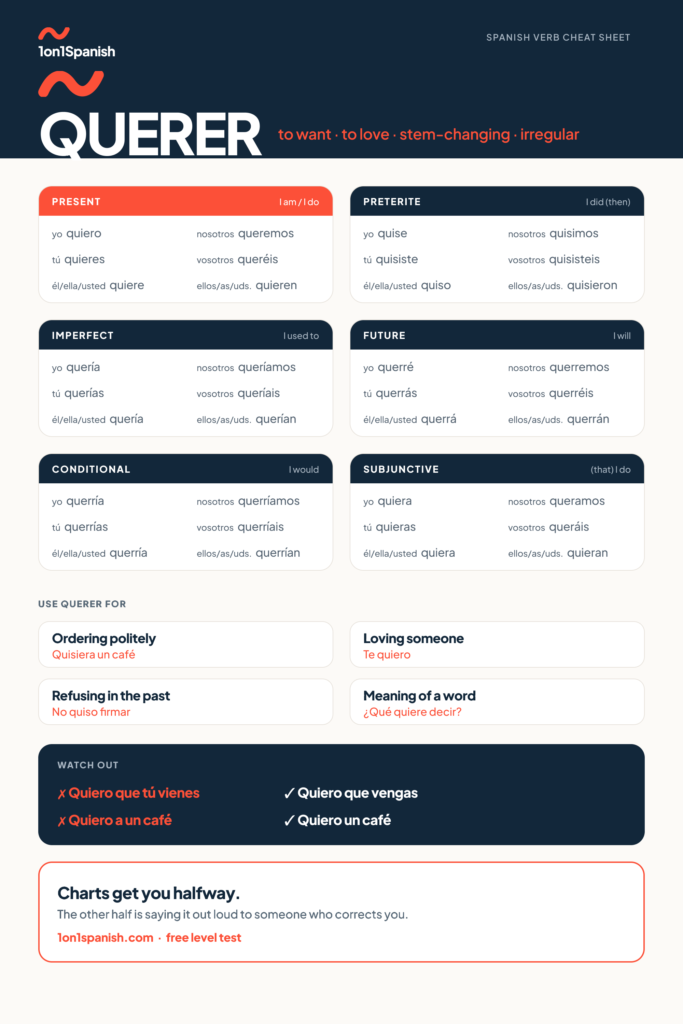
Take the chart with you
The chart is free to view and share. Drop your email and we’ll send the print-ready US Letter PDF — the version you stick on the fridge.
Practice
Practice querer with a real teacher
Charts get you halfway. The other half is saying it out loud to someone who corrects you on the spot. At 1on1Spanish you get 25-minute private lessons with a qualified native teacher, exercises built from the mistakes you make in class, and AI practice between lessons.
First month $1. No contracts, cancel anytime.
You can go further with someone listening: Learn Spanish with 1on1Spanish, 25 minutes at a time.
Take your free level testBuilt on RingTeacher's method — 700,000+ classes delivered since 2017, teaching English to Spanish speakers. Now in the other direction.
Frequently asked questions
Is querer regular or irregular in Spanish?
Querer is irregular. In the present, present subjunctive and imperative the stem vowel changes from e to ie whenever it carries the stress: quiero, but queremos. The preterite and the imperfect subjunctive use a different stem entirely, quis-, and the future and conditional build on querr-. Only the imperfect, the participle and the gerund behave normally.
Does querer mean “to want” or “to love”?
Both, and the object decides. With a thing or an action it means “to want”: quiero un café, quiero salir temprano. With a person, marked by the personal a, it means “to love”: quiero a mi hermana, te quiero. Spanish speakers say te quiero far more often than te amo, which sounds formal or romantic in most contexts.
What is the past tense of querer in Spanish?
There are two, and they don’t mean the same thing. The preterite is quise, quisiste, quiso, quisimos, quisisteis, quisieron, and in the negative it means “refused”: no quiso ayudar. The imperfect is quería, querías, quería, queríamos, queríais, querían, and it describes a want with no clear end: quería preguntarte algo.
Why do people say “quisiera” instead of “quiero”?
Quisiera is the imperfect subjunctive used as a courtesy form. Grammatically it’s a past tense, but in a shop, a restaurant or an office it functions as the politest way to ask for something: quisiera cambiar mi cita. Quiero is not rude, just blunt. Querría is an equally polite alternative that you’ll see more in writing than in speech.
Why does querer que need the subjunctive?
Because two different people are involved. Quiero salir keeps one subject and takes an infinitive, but quiero que salgas has you wanting and someone else doing, so the second verb moves into the subjunctive: quiero que vengas, quería que llamaras. English hides this with “I want you to come”, which is why the structure has to be relearned rather than translated.