
Repetir conjugation in Spanish: every tense you need, with examples
Repetir means “to repeat”, and it’s a stem-changing verb: the e of the stem becomes an i whenever the stress falls on it, so yo repito and él repitió look nothing like the infinitive. It’s the verb you say most in your first month of Spanish — ¿puede repetir, por favor? — and the one whose gerund, repitiendo, surprises everybody. Full tables below. 1on1Spanish teaches stem-changing verbs in 25-minute one-on-one lessons with qualified native teachers, online across the United States.
Reviewed by María Jiménez — Licenciada en Filología Hispánica (BA in Hispanic Philology) · Updated Aug 2026
What repetir means
Repetir covers “to repeat” and “to say something again”: Repite tu apellido, por favor. It also means “to do something a second time” — a class, a year of school, a medical test: Tengo que repetir el análisis de sangre.
Two uses have no clean English twin. At the table, repetir is “to have seconds”: ¿Repites? means “Do you want more?”, not “Do you say it again?”. And food that comes back on you repite: El ajo me repite.
Grammatically it belongs to the e→i family, alongside pedir, servir, seguir and vestir. Those verbs change the stem vowel in the present (except nosotros and vosotros), in the third person of the preterite, in the whole present subjunctive, and in the gerund. The participle, repetido, is regular; the gerund, repitiendo, is not.
Repetir conjugation: present tense
| Form | Example | |
|---|---|---|
| yo | repito | Repito la pregunta. (I’ll repeat the question.) |
| tú | repites | Siempre repites lo mismo. (You always say the same thing.) |
| él / ella / usted | repite | Mi jefe repite cada instrucción dos veces. (My boss repeats every instruction twice.) |
| nosotros | repetimos | Repetimos el pedido al mesero. (We repeat the order to the waiter.) |
| vosotros | repetís | ¿Repetís el viaje este año? (Are you doing the trip again this year?) |
| ellos / ellas / ustedes | repiten | Los niños repiten todo lo que oyen. (Kids repeat everything they hear.) |
Repetir conjugation: preterite
Only the third persons change the vowel. That single detail is what most learners get wrong.
| Form | |
|---|---|
| yo | repetí |
| tú | repetiste |
| él / ella / usted | repitió |
| nosotros | repetimos |
| vosotros | repetisteis |
| ellos / ellas / ustedes | repitieron |
El médico repitió la dosis por la noche. — The doctor repeated the dose at night.
Repetir conjugation: imperfect
Fully regular. No stem change anywhere, because the stress lands on the ending.
| Form | |
|---|---|
| yo | repetía |
| tú | repetías |
| él / ella / usted | repetía |
| nosotros | repetíamos |
| vosotros | repetíais |
| ellos / ellas / ustedes | repetían |
De pequeño repetía todo lo que decía mi hermano. — As a kid I repeated everything my brother said.
Repetir conjugation: future
Regular endings on the full infinitive.
| Form | |
|---|---|
| yo | repetiré |
| tú | repetirás |
| él / ella / usted | repetirá |
| nosotros | repetiremos |
| vosotros | repetiréis |
| ellos / ellas / ustedes | repetirán |
Repetir conjugation: conditional
| Form | |
|---|---|
| yo | repetiría |
| tú | repetirías |
| él / ella / usted | repetiría |
| nosotros | repetiríamos |
| vosotros | repetiríais |
| ellos / ellas / ustedes | repetirían |
No repetiría esa experiencia. — I wouldn’t do that again.
Repetir conjugation: present subjunctive
Here every single form changes, nosotros and vosotros included. That’s the difference between an -ir stem-changer and an -er one like perder.
| Form | |
|---|---|
| yo | repita |
| tú | repitas |
| él / ella / usted | repita |
| nosotros | repitamos |
| vosotros | repitáis |
| ellos / ellas / ustedes | repitan |
Necesito que me lo repitas más despacio. — I need you to say it again more slowly.
Repetir conjugation: imperfect subjunctive
Built on the third-person preterite, so the i carries through. Both sets of endings are correct; the -ra forms dominate in speech.
| Form (-ra) | Form (-se) | |
|---|---|---|
| yo | repitiera | repitiese |
| tú | repitieras | repitieses |
| él / ella / usted | repitiera | repitiese |
| nosotros | repitiéramos | repitiésemos |
| vosotros | repitierais | repitieseis |
| ellos / ellas / ustedes | repitieran | repitiesen |
Le pedí que repitiera el precio. — I asked him to say the price again.
Repetir commands (imperative)
| Affirmative | Negative | |
|---|---|---|
| tú | repite | no repitas |
| usted | repita | no repita |
| nosotros | repitamos | no repitamos |
| vosotros | repetid | no repitáis |
| ustedes | repitan | no repitan |
Repítalo, por favor. — Say it again, please. With a pronoun attached, the command takes a written accent: repítelo, repítamelo.
Participle, gerund and compound tenses
Participle repetido, gerund repitiendo. Compounds use haber:
He repetido el examen (present perfect) · Había repetido la pregunta tres veces (past perfect) · Habré repetido esto mil veces (future perfect).
When to use repetir
Asking someone to say it again
The single most useful sentence for a new speaker: ¿Puede repetir, por favor? Formal and safe with anyone. With a friend: ¿Me lo repites?
Doing something a second time
A test, a semester, a trip, a treatment: Voy a repetir la asignatura en verano. Repetimos el viaje a Oaxaca cada dos años.
Seconds at the table
¿Repites de postre? Yes, this is a real invitation to a second helping, and answering no, gracias is enough.
Insisting
When someone keeps making the same point, Spanish uses repetir where English might use “keep saying”: Repite que no tiene tiempo.
Repetir vs volver a
Both express doing something again, but they’re not interchangeable. Repetir takes the thing as a direct object. Volver a takes another verb.
| Repetir + noun | Volver a + infinitive |
|---|---|
| Repite la frase. — Say the sentence again | Vuelve a decirlo. — Say it again |
| Repetí el examen. — I retook the exam | Volví a hacer el examen. — I took the exam again |
| Repite el plato. — He has a second helping | Vuelve a comer. — He eats again |
When in doubt, volver a works with almost any verb, which makes it the safer choice in conversation. Both tenses behind these examples are explained in preterite and imperfect.
Common mistakes English speakers make with repetir
The stem vowel changes in yo, tú, él and ellos. Only nosotros repetimos and vosotros repetís keep the e.
In the preterite, the change hits exactly two forms: repitió and repitieron. Everything else stays regular.
The gerund of every -ir stem-changer takes the i: repitiendo, pidiendo, sirviendo.
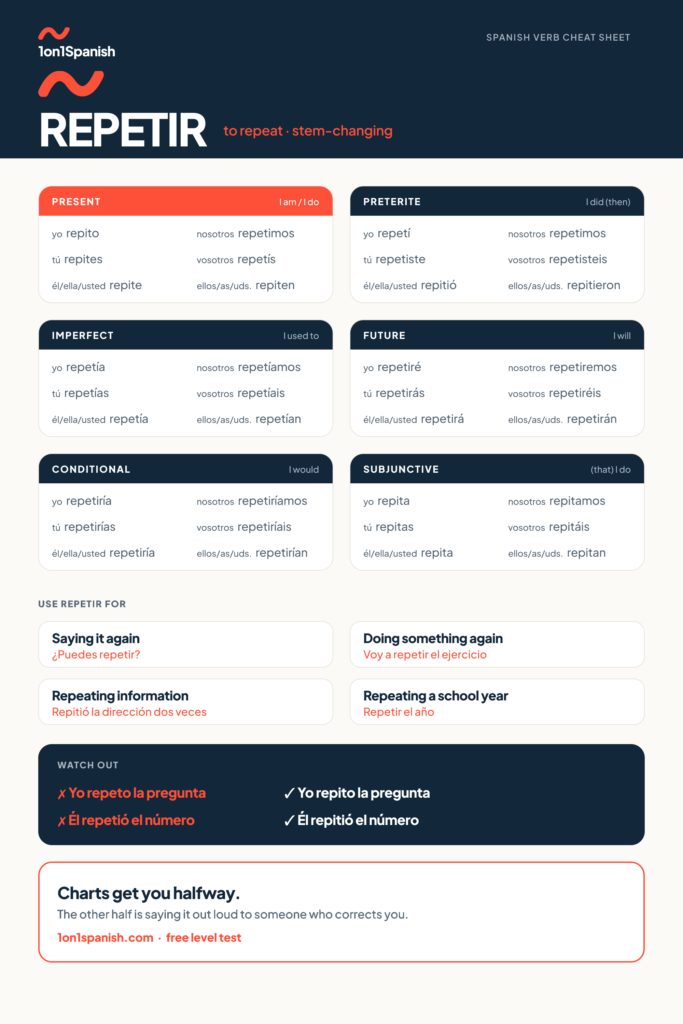
Take the chart with you
The chart is free to view and share. Drop your email and we’ll send the print-ready US Letter PDF — the version you stick on the fridge.
Practice
Practice repetir and stem-changing verbs with a real teacher
Charts get you halfway. The other half is saying it out loud to someone who corrects you on the spot. At 1on1Spanish you get 25-minute private lessons with a qualified native teacher, exercises built from the mistakes you make in class, and AI practice between lessons.
First month $1. No contracts, cancel anytime.
Browse every conjugation table in our guide to Spanish verbs.
Want a teacher listening while you practice? Learn Spanish online with us, one lesson at a time.
Take your free level testBuilt on RingTeacher's method — 700,000+ classes delivered since 2017, teaching English to Spanish speakers. Now in the other direction.
Frequently asked questions
Is repetir regular or irregular in Spanish?
Repetir is a stem-changing verb, not a fully irregular one. Its endings are those of any regular -ir verb, but the e of the stem becomes i when the stress falls on it: repito, repites, repite, repiten, plus repitió and repitieron in the preterite, the entire present subjunctive, and the gerund repitiendo.
How do you say “can you repeat that?” in Spanish?
¿Puede repetir, por favor? is the version to use with a stranger, a doctor or a customer service agent. With someone you address as tú, say ¿Me lo repites? or ¿Puedes repetirlo?. If you want it slower rather than louder, add más despacio. Native speakers rarely add otra vez, because repetir already carries “again”.
What is the past tense of repetir in Spanish?
There are two. The preterite is repetí, repetiste, repitió, repetimos, repetisteis, repitieron, used for a finished act: Repitió la pregunta. The imperfect is repetía, repetías, repetía, repetíamos, repetíais, repetían, used for something habitual: Repetía la misma historia cada Navidad. Only the preterite shows the stem change, and only in the third person.
What’s the difference between repetir and volver a?
Repetir takes a noun as its object: Repite la frase. Volver a takes an infinitive: Vuelve a decir la frase. The meaning is the same, but the grammar isn’t, so you can’t swap them without rebuilding the sentence. Volver a combines with almost any verb, which makes it the more flexible of the two in conversation.
Do I need the subjunctive of repetir in everyday conversation?
Yes. Repitas and repita appear every time you ask someone to say something again politely: ¿Puede repetírmelo? is a request, but Necesito que me lo repita and No quiero que lo repitas are subjunctive. Negative commands are subjunctive too, so no repitas eso is a form you’ll use long before you study the tense formally.