
Salir conjugation in Spanish: every tense you need, with examples
Salir means “to go out” and “to leave a place”. It’s irregular in two spots that matter: the yo form takes a g (salgo) and the future and conditional insert a d (saldré, saldría). The tú command is a single syllable, sal. Everything else follows regular -ir endings. The tables are below, along with the line between salir, irse and dejar, three verbs that all come out as “leave” in English. 1on1Spanish teaches this in 25-minute one-on-one lessons with qualified native teachers, online across the United States.
Reviewed by María Jiménez — Licenciada en Filología Hispánica (BA in Hispanic Philology) · Updated Aug 2026
What salir means
The base sense is physical: leaving an enclosed space. Salgo de casa a las siete, Salió del edificio corriendo. It almost always pairs with de when the place is named.
From there it branches. Salir is what you do on a Friday night (Salimos a cenar) and what a plane or a train does: El vuelo sale a las seis y media. It’s also how something turns out: La operación salió bien, Las fotos salieron oscuras. And with con, it means dating: Sale con un compañero del trabajo.
Grammatically it’s a -g- verb, like poner, tener and venir: salgo, subjunctive salga, future stem saldr-. The participle salido and the gerund saliendo are both regular.
Salir conjugation: present tense
Only yo breaks the pattern.
| Form | Example | |
|---|---|---|
| yo | salgo | Salgo de la oficina a las seis. (I leave the office at six.) |
| tú | sales | ¿Sales esta noche? (Are you going out tonight?) |
| él / ella / usted | sale | El tren sale del andén 4. (The train leaves from platform 4.) |
| nosotros | salimos | Salimos a cenar los viernes. (We go out to dinner on Fridays.) |
| vosotros | salís | ¿A qué hora salís del trabajo? (What time do you get off work?) |
| ellos / ellas / ustedes | salen | Mis hijos salen del colegio a las tres. (My kids get out of school at three.) |
Salir conjugation: preterite
Completely regular -ir endings.
| Form | |
|---|---|
| yo | salí |
| tú | saliste |
| él / ella / usted | salió |
| nosotros | salimos |
| vosotros | salisteis |
| ellos / ellas / ustedes | salieron |
La entrevista salió mejor de lo que esperaba. — The interview went better than I expected.
Salir conjugation: imperfect
Also regular.
| Form | |
|---|---|
| yo | salía |
| tú | salías |
| él / ella / usted | salía |
| nosotros | salíamos |
| vosotros | salíais |
| ellos / ellas / ustedes | salían |
Antes salíamos mucho más los fines de semana. — We used to go out a lot more on weekends.
Salir conjugation: future
A d replaces the i of the infinitive: the stem is saldr-.
| Form | |
|---|---|
| yo | saldré |
| tú | saldrás |
| él / ella / usted | saldrá |
| nosotros | saldremos |
| vosotros | saldréis |
| ellos / ellas / ustedes | saldrán |
Los resultados saldrán el lunes. — The results will come out on Monday.
Salir conjugation: conditional
Same saldr- stem.
| Form | |
|---|---|
| yo | saldría |
| tú | saldrías |
| él / ella / usted | saldría |
| nosotros | saldríamos |
| vosotros | saldríais |
| ellos / ellas / ustedes | saldrían |
Yo no saldría con este tiempo. — I wouldn’t go out in this weather.
Salir conjugation: present subjunctive
Built on salg-.
| Form | |
|---|---|
| yo | salga |
| tú | salgas |
| él / ella / usted | salga |
| nosotros | salgamos |
| vosotros | salgáis |
| ellos / ellas / ustedes | salgan |
Espero que todo salga bien. — I hope everything goes well.
Salir conjugation: imperfect subjunctive
Regular, built on the preterite stem sali-.
| Form (-ra) | Form (-se) | |
|---|---|---|
| yo | saliera | saliese |
| tú | salieras | salieses |
| él / ella / usted | saliera | saliese |
| nosotros | saliéramos | saliésemos |
| vosotros | salierais | salieseis |
| ellos / ellas / ustedes | salieran | saliesen |
Si saliera antes del trabajo, llegaría a la cita. — If I left work earlier, I’d make the appointment.
Salir commands (imperative)
The affirmative tú command is sal: one syllable, no ending. It’s the same short pattern as pon, ten, ven and haz.
| Affirmative | Negative | |
|---|---|---|
| tú | sal | no salgas |
| usted | salga | no salga |
| nosotros | salgamos | no salgamos |
| vosotros | salid | no salgáis |
| ustedes | salgan | no salgan |
Sal por la puerta de atrás. — Go out through the back door. With a pronoun attached it takes no accent, because salte is stressed on its first syllable like any two-syllable word ending in a vowel: salte de ahí (from salirse).
Participle, gerund and compound tenses
Participle salido, gerund saliendo, both regular. Compounds use haber:
He salido tarde del médico (present perfect) · Había salido justo antes de la llamada (past perfect) · Para las nueve ya habré salido de la reunión (future perfect).
When to use salir
Going out socially
Salimos a cenar el sábado. ¿Sales con nosotros? Used on its own, with no destination, it means going out for the evening.
Departures
El vuelo sale a las seis. El autobús sale de la estación central.
How something turns out
El presupuesto salió más caro. Salió bien la mudanza. Often with an adverb rather than an adjective.
Salir vs irse and dejar
All three land on “leave” in English, but they answer different questions: salir is about exiting a space, irse about departing for good, dejar about what you leave behind.
| Salir | Irse / dejar |
|---|---|
| Salí de la oficina a las seis — I left the office at six | Me fui a las seis — I took off at six |
| Sal de ahí — Get out of there | Vete — Go away |
| Salgo del trabajo tarde — I get off work late | Dejé el trabajo en marzo — I quit my job in March |
| Salió del carro — He got out of the car | Dejó las llaves en el carro — He left the keys in the car |
Common mistakes English speakers make with salir
English “leave the house” takes a direct object; Spanish needs de. Without it the sentence isn’t grammatical.
Sale is the él/ella/usted form, so as a command it addresses usted wrongly and sounds like a flat statement, not an order. The tú command is the bare sal.
Quitting is dejar. Salir del trabajo means finishing your shift, which is a very different piece of news.
The g is part of the yo form, the same insertion found in pongo, tengo and vengo.
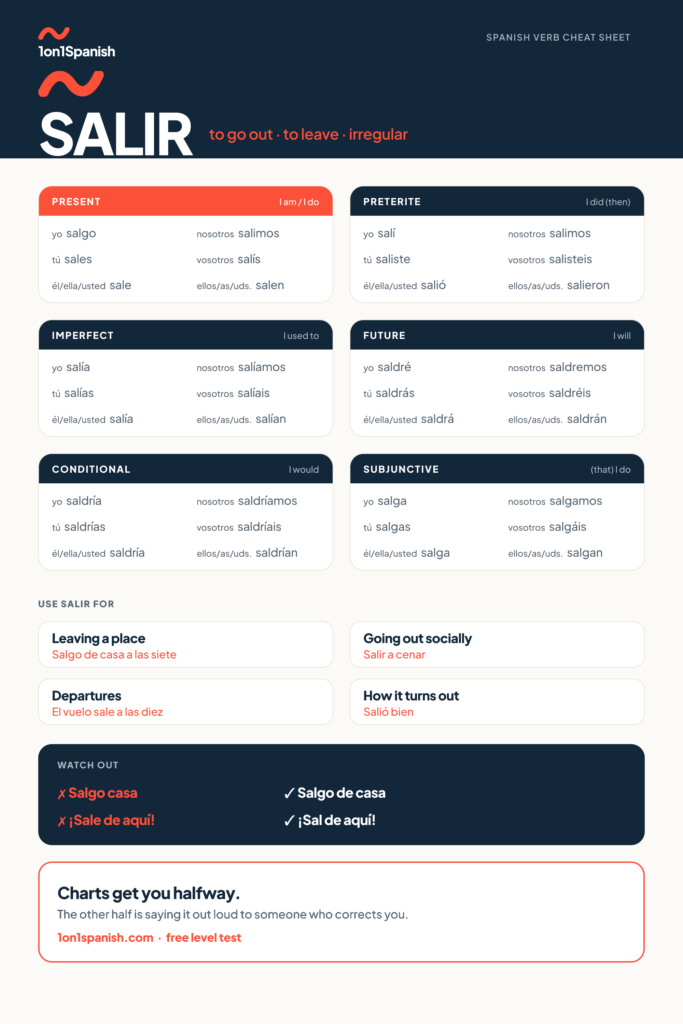
Take the chart with you
The chart is free to view and share. Drop your email and we’ll send the print-ready US Letter PDF — the version you stick on the fridge.
Practice
Practice salir and irse with a real teacher
Charts get you halfway. The other half is saying it out loud to someone who corrects you on the spot. At 1on1Spanish you get 25-minute private lessons with a qualified native Spanish tutor, exercises built from the mistakes you make in class, and AI practice between lessons.
First month $1. No contracts, cancel anytime.
Grammar you can read. Speaking you cannot. Learn Spanish online and practice it live.
Take your free level testBuilt on RingTeacher's method — 700,000+ classes delivered since 2017, teaching English to Spanish speakers. Now in the other direction.
Frequently asked questions
Is salir regular or irregular in Spanish?
Salir is irregular in two places only. The yo form of the present adds a g (salgo), which carries into the whole subjunctive (salga, salgas, salga), and the future and conditional insert a d into the stem (saldré, saldría). The preterite, imperfect, participle and gerund are all regular, which makes it far easier than it looks at first.
What’s the difference between salir and irse?
Salir focuses on exiting a place and usually names it: salí de la oficina. Irse focuses on departure itself, with no interest in what you left: me fui. In practice, salir de X answers “where from”, and irse answers “did you stay or not”. For quitting a job or leaving an object behind, neither works. That’s dejar.
What is the tú command of salir?
It’s sal, with no ending at all: Sal de aquí. Spanish has eight short irregular tú commands that behave this way, including pon, ten, ven, haz, di and sé. The negative version goes back to the subjunctive: no salgas. The full pattern is in our guide to Spanish commands.
How do you say “it turned out well” using salir?
Salió bien. Spanish uses salir plus an adverb for outcomes: salió bien, salió mal, salió carísimo, me salió mejor de lo que esperaba. It applies to surgeries, job interviews, moves and recipes alike. The subject is the event, not the person, so the verb agrees with the thing that turned out.
Do I need the subjunctive of salir in everyday conversation?
Yes, and one phrase alone justifies it: espero que salga bien, which Spanish speakers say before exams, surgeries and interviews. You’ll also need salgas in negative commands (no salgas tan tarde) and saliera in conditionals. More verbs with this -g- stem are listed under Spanish verbs.