
Sentir conjugation in Spanish: every tense you need, with examples
Sentir means “to feel” and also “to be sorry”, and it carries two different stem changes: e→ie when the stress falls on the stem (siento) and e→i when it doesn’t (sintió, sintiendo). Most of the time you will actually need its reflexive twin, sentirse, which is what Spanish uses to say how you feel: me siento cansado. Every tense is below, for both. 1on1Spanish teaches this in 25-minute one-on-one lessons with qualified native teachers, online across the United States.
Reviewed by María Jiménez — Licenciada en Filología Hispánica (BA in Hispanic Philology) · Updated Aug 2026
What sentir means
Sentir is what you perceive with your body or your emotions, and it takes a direct object: siento un dolor en la espalda, siento mucha presión en el trabajo. It is also the verb of apology: lo siento is literally “I feel it”.
Sentirse is the same verb with a reflexive pronoun, and it means something different: how you are, not what you perceive. It is followed by an adjective or an adverb, never by a noun: me siento bien, me siento culpable, se siente sola. English uses “feel” for both, which is why learners run them together.
The verb is a two-change stem-changer. e→ie in the stressed forms of the present and the subjunctive: siento, sientes, siente, sienten. e→i in the third persons of the preterite, all through the imperfect subjunctive, and in the gerund: sintió, sintieron, sintiera, sintiendo. The participle is sentido and behaves normally. Preferir, mentir and divertirse follow the same double pattern; the full list is under Spanish verbs.
Sentir conjugation: present tense
The stem changes to sient- wherever the stress lands on it, which leaves nosotros and vosotros untouched.
| Form | Example | |
|---|---|---|
| yo | siento | Siento un pinchazo en la rodilla. (I feel a twinge in my knee.) |
| tú | sientes | ¿Sientes el aire acondicionado? (Can you feel the AC?) |
| él / ella / usted | siente | Mi padre siente el frío mucho. (My dad really feels the cold.) |
| nosotros | sentimos | Sentimos mucho su pérdida. (We’re very sorry for your loss.) |
| vosotros | sentís | ¿No sentís el olor a quemado? (Don’t you smell something burning?) |
| ellos / ellas / ustedes | sienten | Los niños lo sienten todo. (Kids feel everything.) |
Sentir conjugation: preterite
Regular except in the third persons, where the stem drops to sint-.
| Form | |
|---|---|
| yo | sentí |
| tú | sentiste |
| él / ella / usted | sintió |
| nosotros | sentimos |
| vosotros | sentisteis |
| ellos / ellas / ustedes | sintieron |
Sintió un mareo y se sentó. — He felt dizzy and sat down.
Sentir conjugation: imperfect
No stem change at all. This is the one tense where sentir behaves like a plain regular verb.
| Form | |
|---|---|
| yo | sentía |
| tú | sentías |
| él / ella / usted | sentía |
| nosotros | sentíamos |
| vosotros | sentíais |
| ellos / ellas / ustedes | sentían |
Sentía que algo no iba bien. — I felt something was off.
Sentir conjugation: future
Regular endings on the full infinitive, stem intact.
| Form | |
|---|---|
| yo | sentiré |
| tú | sentirás |
| él / ella / usted | sentirá |
| nosotros | sentiremos |
| vosotros | sentiréis |
| ellos / ellas / ustedes | sentirán |
Sentir conjugation: conditional
| Form | |
|---|---|
| yo | sentiría |
| tú | sentirías |
| él / ella / usted | sentiría |
| nosotros | sentiríamos |
| vosotros | sentiríais |
| ellos / ellas / ustedes | sentirían |
Me sentiría mejor si me llamara. — I’d feel better if she called me.
Sentir conjugation: present subjunctive
Both stem changes appear here: sient- in the stressed forms, sint- in nosotros and vosotros.
| Form | |
|---|---|
| yo | sienta |
| tú | sientas |
| él / ella / usted | sienta |
| nosotros | sintamos |
| vosotros | sintáis |
| ellos / ellas / ustedes | sientan |
Espero que te sientas mejor mañana. — I hope you feel better tomorrow.
Sentir conjugation: imperfect subjunctive
Built on the third-person preterite stem sint-, so every form carries the change.
| Form (-ra) | Form (-se) | |
|---|---|---|
| yo | sintiera | sintiese |
| tú | sintieras | sintieses |
| él / ella / usted | sintiera | sintiese |
| nosotros | sintiéramos | sintiésemos |
| vosotros | sintierais | sintieseis |
| ellos / ellas / ustedes | sintieran | sintiesen |
Si me sintiera con fuerzas, iría. — If I felt up to it, I’d go.
Sentir commands (imperative)
| Affirmative | Negative | |
|---|---|---|
| tú | siente | no sientas |
| usted | sienta | no sienta |
| nosotros | sintamos | no sintamos |
| vosotros | sentid | no sintáis |
| ustedes | sientan | no sientan |
With sentirse the pronoun attaches to the affirmative and moves in front of the negative: siéntete cómodo, but no te sientas mal.
Participle, gerund and compound tenses
Participle sentido, gerund sintiendo, which keeps the e→i change. Compounds use haber:
Me he sentido raro todo el día (present perfect) · Nunca había sentido algo así (past perfect) · Para entonces ya habré sentido el cambio (future perfect).
Sentirse: the form you will actually use
To say how you are, Spanish uses sentirse with a reflexive pronoun and an adjective. The adjective agrees with you in gender and number.
| Present | Example | |
|---|---|---|
| yo | me siento | Me siento agotado. (I feel exhausted.) |
| tú | te sientes | ¿Te sientes bien? (Are you feeling OK?) |
| él / ella / usted | se siente | Se siente culpable por eso. (She feels guilty about it.) |
| nosotros | nos sentimos | Nos sentimos muy bienvenidos. (We feel very welcome.) |
| vosotros | os sentís | ¿Cómo os sentís hoy? (How are you feeling today?) |
| ellos / ellas / ustedes | se sienten | Se sienten mejor después de comer. (They feel better after eating.) |
The pronoun changes with the person and never disappears; the rest of the pattern is the same as every other Spanish reflexive verb.
When to use sentir
Physical sensation
A direct object, no pronoun: Siento un dolor aquí. No siento los dedos. This is the version you need at a doctor’s office.
Apologizing or regretting
Lo siento for “I’m sorry”, lo siento mucho to make it stronger, sentimos mucho su pérdida at a funeral. Siento llegar tarde apologizes for something you did.
Intuition
Sentir que plus a clause: Siento que no me está diciendo la verdad.
Sitting down is a different verb
Sentarse (me siento en la silla) also produces me siento in the yo form. Only the rest of the sentence separates them: an adjective means feeling, a place means sitting.
Common mistakes English speakers make with sentir
With an adjective you need the reflexive pronoun. Siento cansado sounds like you are perceiving something called “tired” out in the world.
The reflexive pronoun goes before the conjugated verb, not after it. It only attaches to the end with an infinitive (sentirme), a gerund (sintiéndome) or an affirmative command (siéntete).
English lives in the continuous; Spanish uses the simple present for how you feel right now. The gerund sintiendo is reserved for something changing as you speak.
Ser would describe your permanent character. For a mood, use estar or sentirse.
The condolence formula needs the direct object, not a preposition. Lo siento already contains the lo.
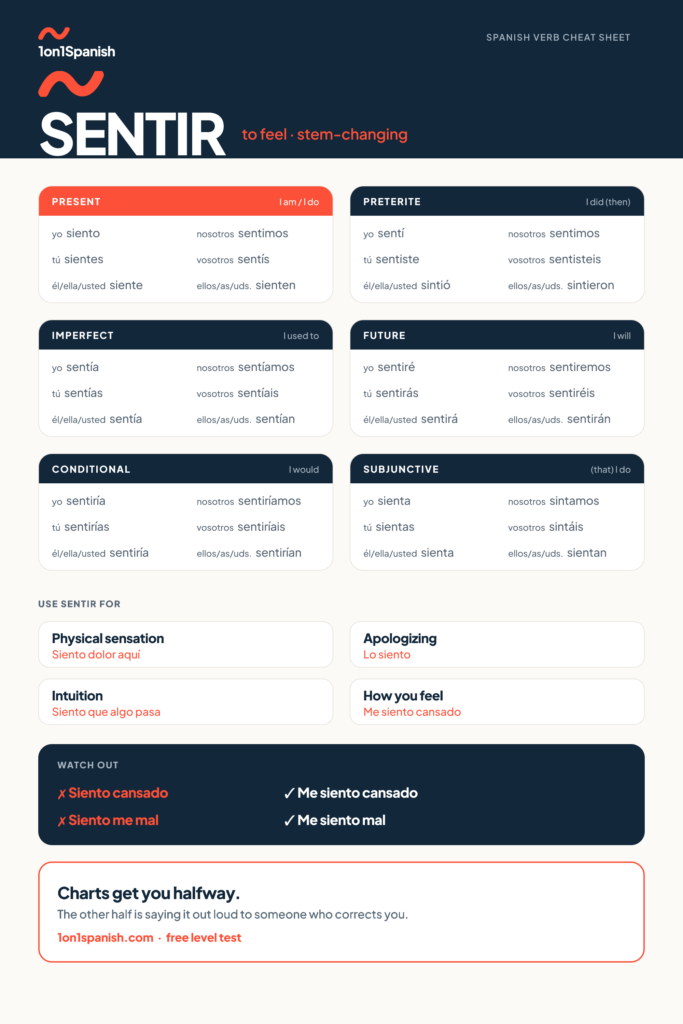
Take the chart with you
The chart is free to view and share. Drop your email and we’ll send the print-ready US Letter PDF — the version you stick on the fridge.
Practice
Practice sentir and sentirse with a real teacher
Charts get you halfway. The other half is saying it out loud to someone who corrects you on the spot. At 1on1Spanish you get 25-minute private lessons with a qualified native teacher, exercises built from the mistakes you make in class, and AI practice between lessons.
First month $1. No contracts, cancel anytime.
The fastest way to make this stick is to say it to someone. Learn Spanish online with a real teacher.
Take your free level testBuilt on RingTeacher's method — 700,000+ classes delivered since 2017, teaching English to Spanish speakers. Now in the other direction.
Frequently asked questions
Is sentir regular or irregular in Spanish?
Sentir is a stem-changing verb with two changes. The stem becomes sient- when the stress falls on it (siento, sientes, siente, sienten) and sint- when it doesn’t (sintió, sintieron, sintiendo, sintiera). Endings are otherwise regular, and the imperfect, future and conditional show no change at all.
What is the difference between sentir and sentirse?
Sentir takes a direct object and means to perceive something: siento un dolor, siento el frío. Sentirse takes a reflexive pronoun plus an adjective and means how you are: me siento cansado, se siente sola. English uses “feel” for both. The quick rule: if an adjective follows, you need the pronoun.
How do you say “I feel tired” in Spanish?
Me siento cansado if you are male, me siento cansada if you are female. The adjective agrees with you. Estoy cansado is just as natural and slightly more common in everyday speech. Siento cansado, without the pronoun, is not correct and is one of the most frequent English-speaker errors with this verb.
What is the past tense of sentir in Spanish?
Both past tenses exist and mean different things. The preterite is sentí, sentiste, sintió, sentimos, sentisteis, sintieron, for a sensation at one moment: sintió un mareo. The imperfect is sentía, sentías, sentía, sentíamos, sentíais, sentían, for how you felt over a stretch of time: me sentía sola.
Does “lo siento” really mean “I feel it”?
Literally, yes. Lo siento is sentir plus the object pronoun lo, so it means “I feel it” and is used the way English uses “I’m sorry”. You can strengthen it with lo siento mucho or lo siento muchísimo. For an apology about something specific, Spanish prefers siento llegar tarde or siento haberte molestado.