
Tener conjugation in Spanish: every tense you need, with examples
Tener means “to have”, and it does far more work in Spanish than “have” does in English: it carries possession, age, obligation, hunger, cold and fear. It is irregular twice over — the stem changes from e to ie in the present (tienes, tiene), and the preterite runs on tuv- (tuve, tuviste). Every tense is below, followed by the expressions you will actually say. 1on1Spanish teaches this in 25-minute one-on-one lessons with qualified native teachers, online across the United States.
Reviewed by María Jiménez — Licenciada en Filología Hispánica (BA in Hispanic Philology) · Updated Aug 2026
What tener means
The base meaning is possession: Tengo dos hijos. ¿Tienes el número del médico? From there Spanish extends it to states that English expresses with “to be”: tengo 42 años (I’m 42), tengo frío (I’m cold), tengo prisa (I’m in a hurry).
The other job is obligation, through tener que + infinitive: Tengo que llamar al banco. This is the everyday way to say “I have to”, far more common in conversation than deber.
It is one of the three or four Spanish verbs worth learning before anything else, simply because so many everyday sentences run through it.
Structurally it is a stem-changing verb (e→ie) with an irregular yo form (tengo), an irregular future and conditional stem (tendr-), and an irregular preterite stem (tuv-). The participle is tenido and the gerund is teniendo.
Tener conjugation: present tense
| Form | Example | |
|---|---|---|
| yo | tengo | Tengo una reunión a las nueve. (I have a meeting at nine.) |
| tú | tienes | ¿Tienes hermanos? (Do you have siblings?) |
| él / ella / usted | tiene | Mi hija tiene ocho años. (My daughter is eight.) |
| nosotros | tenemos | Tenemos dos carros. (We have two cars.) |
| vosotros | tenéis | ¿Tenéis hambre? (Are you hungry?) |
| ellos / ellas / ustedes | tienen | Mis padres tienen seguro médico. (My parents have health insurance.) |
Tener conjugation: preterite
Irregular stem tuv- with the endings of the strong preterites. No written accents anywhere.
| Form | |
|---|---|
| yo | tuve |
| tú | tuviste |
| él / ella / usted | tuvo |
| nosotros | tuvimos |
| vosotros | tuvisteis |
| ellos / ellas / ustedes | tuvieron |
Tuvimos un problema con el vuelo. — We had a problem with the flight.
Tener conjugation: imperfect
Regular. This is the tense for what you used to have, and for age in the past.
| Form | |
|---|---|
| yo | tenía |
| tú | tenías |
| él / ella / usted | tenía |
| nosotros | teníamos |
| vosotros | teníais |
| ellos / ellas / ustedes | tenían |
Cuando tenía veinte años, no tenía carro. — When I was twenty, I didn’t have a car.
Tener conjugation: future
Irregular stem tendr-, regular endings.
| Form | |
|---|---|
| yo | tendré |
| tú | tendrás |
| él / ella / usted | tendrá |
| nosotros | tendremos |
| vosotros | tendréis |
| ellos / ellas / ustedes | tendrán |
Tendremos los resultados el viernes. — We’ll have the results on Friday.
Tener conjugation: conditional
Same irregular stem tendr-.
| Form | |
|---|---|
| yo | tendría |
| tú | tendrías |
| él / ella / usted | tendría |
| nosotros | tendríamos |
| vosotros | tendríais |
| ellos / ellas / ustedes | tendrían |
Tendrías que verlo tú mismo. — You’d have to see it for yourself.
Tener conjugation: present subjunctive
Built on the yo form tengo, so the -g- runs through every person.
| Form | |
|---|---|
| yo | tenga |
| tú | tengas |
| él / ella / usted | tenga |
| nosotros | tengamos |
| vosotros | tengáis |
| ellos / ellas / ustedes | tengan |
Espero que tengas un buen viaje. — I hope you have a good trip.
Tener conjugation: imperfect subjunctive
Built on the preterite stem tuv-. Both sets are correct; the -ra forms dominate in speech.
| Form (-ra) | Form (-se) | |
|---|---|---|
| yo | tuviera | tuviese |
| tú | tuvieras | tuvieses |
| él / ella / usted | tuviera | tuviese |
| nosotros | tuviéramos | tuviésemos |
| vosotros | tuvierais | tuvieseis |
| ellos / ellas / ustedes | tuvieran | tuviesen |
Si tuviera tiempo, iría contigo. — If I had time, I’d go with you.
Tener commands (imperative)
The tú command is the short form ten, with no accent.
| Affirmative | Negative | |
|---|---|---|
| tú | ten | no tengas |
| usted | tenga | no tenga |
| nosotros | tengamos | no tengamos |
| vosotros | tened | no tengáis |
| ustedes | tengan | no tengan |
Ten cuidado con el escalón. — Watch out for the step. Tenga is the polite form you’ll hear when someone hands you something: Tenga, su recibo.
Participle, gerund and compound tenses
Participle tenido, gerund teniendo. Compounds take haber:
He tenido tres entrevistas esta semana (present perfect) · Había tenido el mismo carro diez años (past perfect) · Habré tenido suerte (future perfect).
When to use tener
Possession
The literal use: Tengo dos maletas. ¿Tienes cambio?
Age
Spanish “has” years rather than “being” them: Tengo cuarenta y dos años. ¿Cuántos años tiene su hijo?
Physical and emotional states
Tengo hambre, tengo sed, tengo frío, tengo calor, tengo sueño, tengo miedo, tengo prisa. All of these are “I am” in English, and all of them are tener in Spanish.
Relationships and appointments
Tengo un hermano en Denver. Tengo cita con el dentista el martes.
Tener vs haber
Both can translate as “to have”, but they never swap. Haber is the auxiliary that builds compound tenses and the verb behind hay; tener is the one that means actual possession.
| With tener | With haber |
|---|---|
| Tengo una reserva — I have a reservation | He reservado — I have booked |
| Tiene mucho trabajo — He has a lot of work | Hay mucho trabajo — There’s a lot of work |
| Tengo que ir — I have to go | Hay que ir — Someone has to go / one must go |
| Tenía dos carros — He had two cars | Había dos carros — There were two cars |
Common mistakes English speakers make with tener
Age is possessed, not stated. This is the single most recognizable English-speaker error in Spanish, and it appears in a first lesson every week.
Tener que only means obligation when an infinitive follows. With a noun, drop the que.
Tengo calor means your own body is hot. The temperature outside is hacer: Hace calor hoy.
Hunger, thirst, cold, fear and sleepiness all take tener, never estar and never ser.
The imperfect describes an obligation you had; the preterite says you carried it out. The full contrast is in preterite vs imperfect.
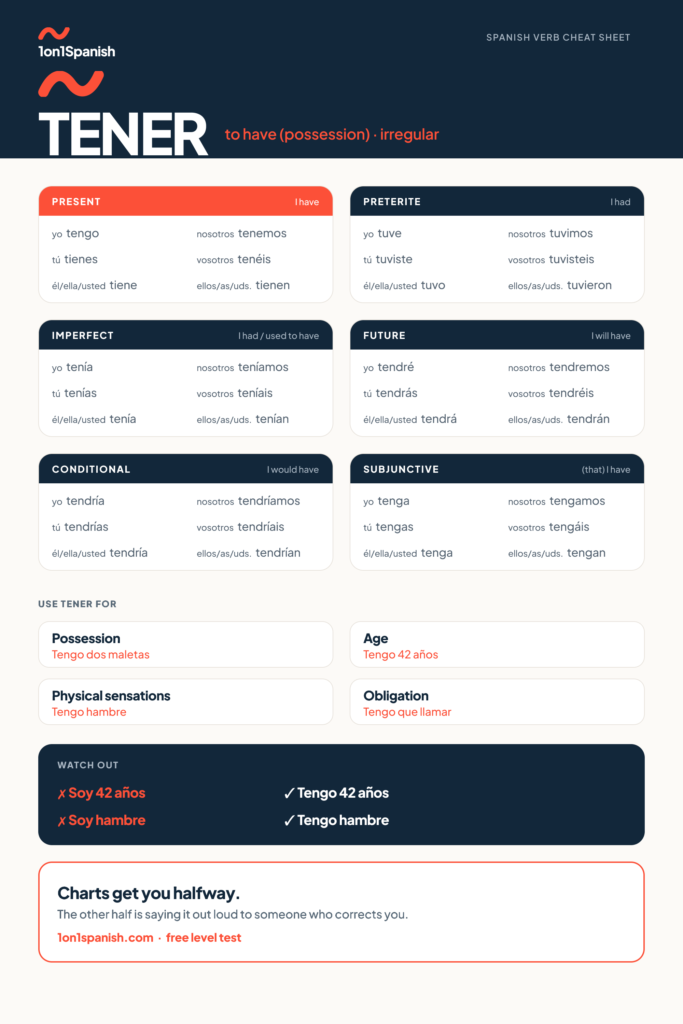
Take the chart with you
The chart is free to view and share. Drop your email and we’ll send the print-ready US Letter PDF — the version you stick on the fridge.
Practice
Practice tener with a real teacher
Charts get you halfway. The other half is saying it out loud to someone who corrects you on the spot. At 1on1Spanish you get 25-minute private lessons with a qualified native teacher, exercises built from the mistakes you make in class, and AI practice between lessons.
First month $1. No contracts, cancel anytime.
Work through the tener expressions one by one with a Spanish tutor.
Reading about it only gets you so far. Learn Spanish online in 25-minute conversations and use it.
Take your free level testBuilt on RingTeacher's method — 700,000+ classes delivered since 2017, teaching English to Spanish speakers. Now in the other direction.
Frequently asked questions
Is tener regular or irregular in Spanish?
Tener is irregular in four places. The present changes its stem from e to ie (tienes, tiene) and takes tengo in the yo form. The preterite uses tuv-. The future and conditional use tendr-. The subjunctive inherits the -g- from tengo. Only the imperfect (tenía) behaves like a normal -er verb.
How do you say your age in Spanish with tener?
You say how many years you have: Tengo treinta y cinco años. To ask, use ¿Cuántos años tienes? or the formal ¿Cuántos años tiene usted? The word años is not optional — leaving it out changes the sentence into a statement about quantity of something unnamed, which sounds odd to a native ear.
What does tener que mean in Spanish?
Tener que + infinitive means “to have to” and it is the standard way to express obligation in conversation: Tengo que ir al banco. Tienes que descansar. It conjugates on tener only, and the second verb stays in the infinitive. In the preterite it means the obligation was carried out: Tuve que ir means I had to go, and I went.
What is the preterite of tener in Spanish?
Tuve, tuviste, tuvo, tuvimos, tuvisteis, tuvieron. It belongs to the group of strong preterites that carry no written accents, alongside estuve and pude. Beyond possession, it often means “got” or “received”: Tuve una idea is “I got an idea”, and Tuvimos suerte is “we got lucky”.
Do I need the subjunctive of tener in everyday conversation?
Yes, mostly in fixed good-wishes and in requirements. Que tengas buen día, espero que tengan hambre, aunque tenga razón, busco a alguien que tenga experiencia. Because tenga comes straight from tengo, it is one of the easier subjunctives to build once you have the yo form memorized.