
Estar conjugation in Spanish: every tense you need, with examples
Estar means “to be”, but only the half of “to be” that covers where something is and how it is doing today: estoy en la oficina, está cansado, estamos listos. It is irregular in the present and in the preterite, and it carries the accent marks that decide whether you sound like a learner or not. Every tense is below, with the line that separates estar from ser. 1on1Spanish teaches this in 25-minute one-on-one lessons with qualified native teachers, online across the United States.
Reviewed by María Jiménez — Licenciada en Filología Hispánica (BA in Hispanic Philology) · Updated Aug 2026
What estar means
Estar answers how and where, never what. It covers location (El banco está en la esquina), physical and emotional state (Estoy agotada), the result of a change (La puerta está abierta) and the progressive tenses (Estoy trabajando).
Grammatically it is a -ar verb with two irregular blocks: the present, where every form except estamos carries a written accent and the yo form is estoy, and the preterite, which uses the stem estuv- with no accents at all. Everything else is regular. The participle is estado and the gerund is estando.
It sits alongside ser, tener and hacer at the top of any list of Spanish verbs, and it is the one you will use most often on your first day in the language.
One detail that matters more than it looks: the accents in estás, está and están are not decoration. Está is the verb; esta, without the accent, is the demonstrative “this”.
Estar conjugation: present tense
| Form | Example | |
|---|---|---|
| yo | estoy | Estoy en el aeropuerto. (I’m at the airport.) |
| tú | estás | ¿Estás libre el jueves? (Are you free on Thursday?) |
| él / ella / usted | está | Mi madre está mucho mejor. (My mother is much better.) |
| nosotros | estamos | Estamos esperando la factura. (We’re waiting for the invoice.) |
| vosotros | estáis | ¿Estáis en el hotel? (Are you at the hotel?) |
| ellos / ellas / ustedes | están | Los niños están dormidos. (The kids are asleep.) |
Estar conjugation: preterite
Irregular stem estuv-, and none of these forms takes a written accent.
| Form | |
|---|---|
| yo | estuve |
| tú | estuviste |
| él / ella / usted | estuvo |
| nosotros | estuvimos |
| vosotros | estuvisteis |
| ellos / ellas / ustedes | estuvieron |
Estuve tres días en el hospital. — I was in the hospital for three days.
Estar conjugation: imperfect
Completely regular. This is the tense for how things used to be, and for background in a story.
| Form | |
|---|---|
| yo | estaba |
| tú | estabas |
| él / ella / usted | estaba |
| nosotros | estábamos |
| vosotros | estabais |
| ellos / ellas / ustedes | estaban |
Cuando llegué, la reunión ya estaba empezada. — When I arrived, the meeting had already started.
Estar conjugation: future
Regular endings on the full infinitive.
| Form | |
|---|---|
| yo | estaré |
| tú | estarás |
| él / ella / usted | estará |
| nosotros | estaremos |
| vosotros | estaréis |
| ellos / ellas / ustedes | estarán |
El paquete estará aquí el lunes. — The package will be here on Monday.
Estar conjugation: conditional
| Form | |
|---|---|
| yo | estaría |
| tú | estarías |
| él / ella / usted | estaría |
| nosotros | estaríamos |
| vosotros | estaríais |
| ellos / ellas / ustedes | estarían |
Estaría mejor con menos sal. — It would be better with less salt.
Estar conjugation: present subjunctive
Same accents problem as the present indicative, moved onto -e endings.
| Form | |
|---|---|
| yo | esté |
| tú | estés |
| él / ella / usted | esté |
| nosotros | estemos |
| vosotros | estéis |
| ellos / ellas / ustedes | estén |
Cuando estés listo, me avisas. — Let me know when you’re ready.
Estar conjugation: imperfect subjunctive
Built on the preterite stem estuv-. Both sets are correct; the -ra forms dominate in speech.
| Form (-ra) | Form (-se) | |
|---|---|---|
| yo | estuviera | estuviese |
| tú | estuvieras | estuvieses |
| él / ella / usted | estuviera | estuviese |
| nosotros | estuviéramos | estuviésemos |
| vosotros | estuvierais | estuvieseis |
| ellos / ellas / ustedes | estuvieran | estuviesen |
Si estuviera en tu lugar, aceptaría el trabajo. — If I were in your shoes, I’d take the job.
Estar commands (imperative)
| Affirmative | Negative | |
|---|---|---|
| tú | está | no estés |
| usted | esté | no esté |
| nosotros | estemos | no estemos |
| vosotros | estad | no estéis |
| ustedes | estén | no estén |
Está tranquilo, yo me encargo. — Relax, I’ll handle it. In everyday speech people usually say estate tranquilo, with the reflexive pronoun attached.
Participle, gerund and compound tenses
Participle estado, gerund estando. Compounds take haber:
He estado enfermo toda la semana (present perfect) · Había estado allí antes (past perfect) · Habré estado media hora esperando (future perfect).
Estar is also the engine of the progressive: estar + gerund. Estoy comiendo, estaba llamando, estaremos viajando.
When to use estar
Location of people and things
La farmacia está al lado del banco. Estoy en el carro. The one exception is an event, which takes ser: La cena es en su casa.
How someone feels or looks today
Estás muy guapo hoy. Estoy nerviosa por la entrevista.
The result of something that happened
A past participle after estar describes the state left behind: La tienda está cerrada. El informe ya está terminado.
Progressive actions
Anything happening right now: Estoy hablando con el seguro. ¿Qué estás haciendo?
Fixed expressions
Estar de acuerdo (to agree), estar a punto de (to be about to), estar de viaje (to be away), estar harto (to be fed up). These are memorized whole.
Estar vs ser
Both translate as “to be”. Swapping them changes the meaning of the sentence, not its politeness.
| With estar | With ser |
|---|---|
| Está aburrido — He’s bored | Es aburrido — He’s a boring person |
| Está lista — She’s ready | Es lista — She’s smart |
| El pescado está bueno — It tastes good | El pescado es bueno — Fish is good for you |
| Está callado — He’s being quiet today | Es callado — He’s a quiet person |
The complete rule, with the adjectives that flip meaning, is in ser vs estar.
Common mistakes English speakers make with estar
Where a person or an object is takes estar, no exceptions. English uses one verb for both, which is why this one survives so long.
A profession is identity, so it takes ser. Estoy de enfermera exists, but it means you’re covering that role temporarily.
For how long you have been somewhere, Spanish uses llevar, not estar.
Obligation is tener que. Estar never takes que + infinitive that way.
Missing the opening ¿ and the accent on estás is the fastest way to look like a beginner in writing.
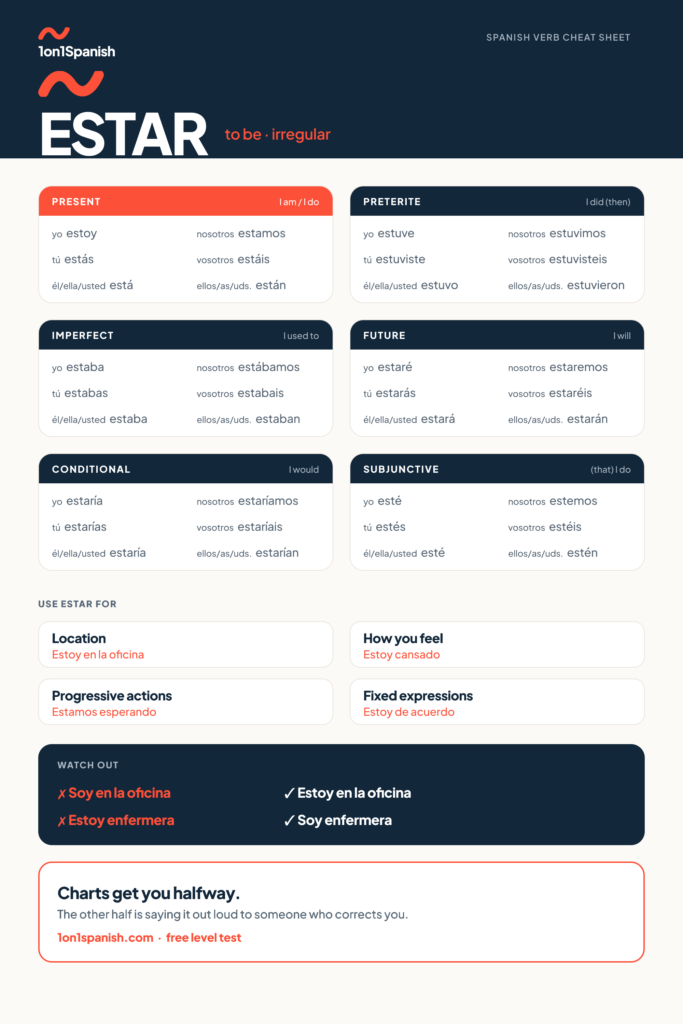
Take the chart with you
The chart is free to view and share. Drop your email and we’ll send the print-ready US Letter PDF — the version you stick on the fridge.
Practice
Practice ser and estar with a real teacher
Charts get you halfway. The other half is saying it out loud to someone who corrects you on the spot. At 1on1Spanish you get 25-minute private lessons with a qualified native teacher, exercises built from the mistakes you make in class, and AI practice between lessons.
First month $1. No contracts, cancel anytime.
Ready to use these forms in a real conversation? Start with conversational Spanish.
Reading about it only gets you so far. Learn Spanish online in 25-minute conversations and use it.
Take your free level testBuilt on RingTeacher's method — 700,000+ classes delivered since 2017, teaching English to Spanish speakers. Now in the other direction.
Frequently asked questions
Is estar regular or irregular in Spanish?
Estar is irregular in two places only. The present tense adds an unexpected -oy in estoy and puts written accents on estás, está, están. The preterite switches to the stem estuv-: estuve, estuviste, estuvo. The imperfect, future and conditional follow the normal -ar pattern with no surprises at all.
When do you use estar instead of ser?
Use estar for location, for how someone feels or looks at this moment, for the state left behind by an action (está roto, está cerrado), and for the progressive with a gerund (estoy comiendo). Use ser for identity, origin, profession, material, time and prices. Be careful with the “how or where” shortcut you’ll see elsewhere: ¿Cómo es tu jefe? — Es simpático and ¿Dónde es la reunión? — Es en el hotel both answer how and where, and both take ser.
What is the preterite of estar in Spanish?
Estuve, estuviste, estuvo, estuvimos, estuvisteis, estuvieron. None of them carries a written accent, which is unusual for a preterite and worth memorizing on its own. You use it for a state inside a closed period of time: Estuve dos semanas en México means you were there and you came back.
How do you say “I am tired” in Spanish?
Estoy cansado if you’re male, estoy cansada if you’re female — the adjective agrees with you, not with the verb. Saying soy cansado means you’re a tiring person to be around. The same pattern applies to estoy enfermo (I’m sick) and estoy preocupado (I’m worried).
Do I need the subjunctive of estar in everyday conversation?
Yes. Esté and estés turn up constantly in ordinary sentences: cuando estés listo, espero que esté bien, aunque esté cansado, no creo que estén en casa. Any time you talk about a future moment after cuando, or you express a wish or a doubt about how someone is, the subjunctive is what native speakers use.