
Ser vs estar: which “to be” to use in Spanish
Use ser for what something is — identity, origin, profession, material, time — and estar for the state something is in and for where people and things are. Events are the exception worth knowing from the start: their location takes ser, as in La boda es en Miami. English collapses both into “to be”, which is why the choice feels arbitrary at first and stops feeling arbitrary the moment you hear the two in the same conversation. 1on1Spanish teaches this distinction in 25-minute one-on-one lessons with qualified native teachers, online across the United States.
Reviewed by María Jiménez — Licenciada en Filología Hispánica (BA in Hispanic Philology) · Updated Sep 2026
The rule behind ser
Ser answers the question “what is this?”. It attaches to things that define the noun rather than describe its current state.
Identity and profession: Soy contable (I’m an accountant). Origin and nationality: Somos de Ohio. Material and possession: La mesa es de roble, El carro es de mi hermana. Time, dates and quantities: Son las siete, Hoy es jueves, Son cuarenta dólares.
There’s one case that surprises everyone: events use ser even though they happen somewhere. La reunión es en la oficina — the meeting takes place at the office. But La oficina está en el centro — the office is located downtown. The difference is that an event happens; a building sits.
The rule behind estar
Estar covers where people and things are, physical and emotional states, and anything that is the result of a change. It is tempting to shorten this to “how or where”, but the shortcut breaks: ¿Cómo es tu jefe? and ¿Dónde es la boda? both take ser.
Location of people and objects: El médico está en la consulta. Conditions and moods: Estoy cansado, La sopa está fría. Ongoing actions with the gerund: Estamos esperando. And results of a change: La puerta está abierta — somebody opened it.
That gerund pairing is estar’s busiest job in everyday speech: it’s the engine of the whole present progressive, and estar is the verb that carries it.
A shortcut that holds up: if an adjective describes a change from a previous state, use estar. Nobody is born tired, open, broken or sitting down.
Both verbs are irregular in almost every tense, so settling the choice is only half the work. The ser conjugation and the estar conjugation each have their own chart.
Reference chart
| Situation | Verb | Example |
|---|---|---|
| Identity, profession | ser | Es enfermera. |
| Origin, nationality | ser | Soy de Texas. |
| Material, possession | ser | Es de plata. |
| Time, dates, prices | ser | Son las diez. |
| Where an event takes place | ser | La boda es en Miami. |
| Passive voice | ser | Fue construido en 1970. |
| Location of a person or thing | estar | Está en el hotel. |
| Physical or emotional state | estar | Estoy nervioso. |
| Result of a change | estar | La tienda está cerrada. |
| Gerund, action in progress | estar | Está lloviendo. |
The mnemonics, and where they break
Two acronyms circulate in American classrooms. DOCTOR for ser: Description, Occupation, Characteristic, Time, Origin, Relationship. PLACE for estar: Position, Location, Action, Condition, Emotion.
They’re useful for the first month and then they get in the way, because “Description” and “Condition” overlap in English. He’s tall and He’s tired are both descriptions to an English ear. The question that actually works is different: does this word tell me what it is, or what happened to it? Tall is what he is. Tired is what happened to him.
The other common shortcut — “ser is permanent, estar is temporary” — fails on the two cases people quote most: estar muerto (dead is permanent, and it takes estar) and ser joven (young is temporary, and it takes ser). Drop it early.
Adjectives that change meaning
Same adjective, different verb, different sentence. This is where the distinction stops being grammar and starts being vocabulary.
| With ser | With estar |
|---|---|
| Es aburrido — He’s boring | Está aburrido — He’s bored |
| Es listo — She’s clever | Está lista — She’s ready |
| Es rico — He’s wealthy | Está rico — It tastes good |
| Es verde — It’s green (color) | Está verde — It’s unripe |
| Es malo — He’s a bad person | Está malo — He’s sick |
| Es orgulloso — He’s arrogant | Está orgulloso — He’s proud |
| Es vivo — He’s sharp | Está vivo — He’s alive |
Native speakers don’t think of these as exceptions. They hear two different words.
Common mistakes English speakers make
Tiredness is a state you arrived at, so it takes estar. Soy cansado means you’re a tiring person to be around.
Events take ser, even when the sentence names a place. The trap is that the English sentence looks like a location.
Nationality is identity. Estar here suggests you’re temporarily American, which is not a thing. Estadounidense is the precise word: in Latin America americano often means the continent.
Time always takes ser, and it agrees in plural with the hour: es la una, but son las dos.
Agreement is a position you hold at that moment. This one survives for years in otherwise solid Spanish.
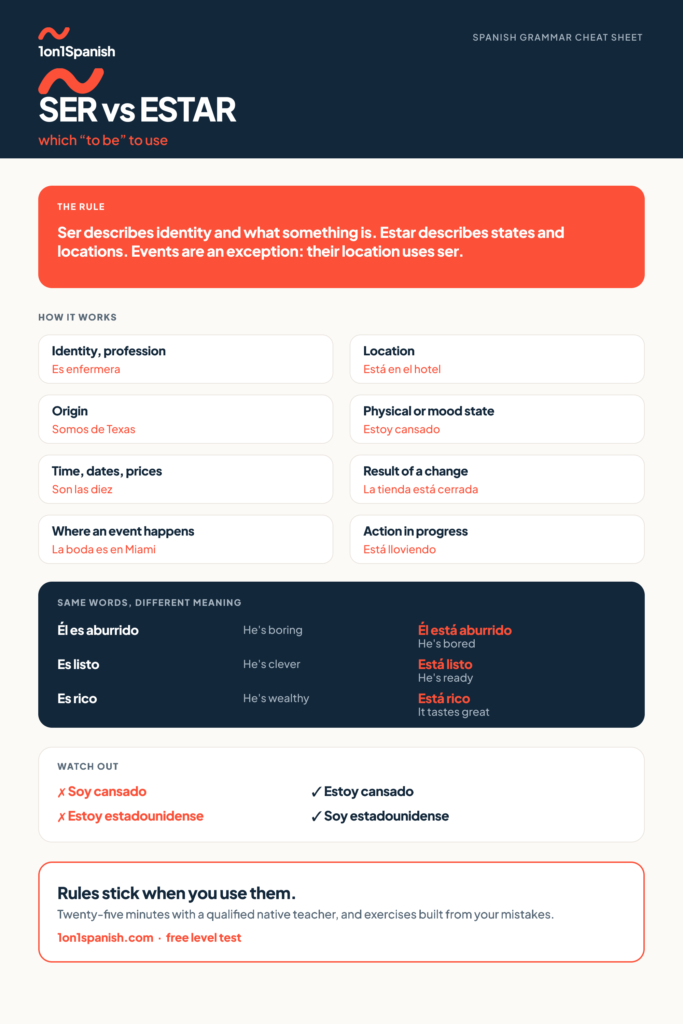
Take the chart with you
The chart is free to view and share. Drop your email and we’ll send the print-ready US Letter PDF — the version you stick on the fridge.
Practice
Practice ser and estar with a real teacher
Charts get you halfway. The other half is saying it out loud to someone who corrects you on the spot. At 1on1Spanish you get 25-minute private lessons with a qualified native teacher, exercises built from the mistakes you make in class, and AI practice between lessons.
First month $1. No contracts, cancel anytime.
Everything on this page is free to use. If you want feedback on your own Spanish, learn Spanish online with us.
Take your free level testBuilt on RingTeacher's method — 700,000+ classes delivered since 2017, teaching English to Spanish speakers. Now in the other direction.
Frequently asked questions
When do you use ser instead of estar in Spanish?
Use ser when the sentence defines the noun: identity, profession, origin, nationality, material, possession, time, dates and prices. Es mi vecina, Somos de Denver, Son las cinco. Use estar for location, physical or emotional states and anything resulting from a change. If you can replace “is” with “consists of” or “amounts to” in English, you almost certainly need ser.
What’s the easiest way to remember ser vs estar?
Ask what the sentence is doing: naming the thing or describing its current condition. Naming takes ser, condition takes estar. The popular “permanent versus temporary” shortcut fails often. Estar muerto is permanent, ser joven is temporary. Drop it and use the naming-versus-condition test instead.
Is ser vs estar different in Latin America and Spain?
The rule is identical across every Spanish-speaking country. What varies is a small set of regional habits: some Latin American speakers use estar with adjectives where Spaniards prefer ser, as in está muy alto for a child who has grown. Nobody will misunderstand you either way, and no country teaches a different rule.
Do native speakers ever hesitate between ser and estar?
Almost never, because they don’t experience it as a choice between two verbs. To a native ear es aburrido and está aburrido are as different as “boring” and “bored” are in English. Hesitation happens only with a handful of borderline adjectives, and even then the two options mean different things rather than one being wrong.
What’s the most common ser vs estar mistake?
Saying soy cansado instead of estoy cansado. English speakers map “I am tired” word by word and land on ser, which turns the sentence into “I’m a tiring person”. The same pattern produces soy aburrido and soy enfermo. Any adjective describing how you feel today belongs with estar.