
Ir conjugation in Spanish: every tense you need, with examples
Ir means “to go”, and almost nothing in its conjugation comes from the infinitive: the present is built on v- (voy, vas, va), the preterite is fui, fuiste, fue, identical to ser, and the imperfect is iba, one of only three irregular imperfects in the entire language. It’s also the verb that carries the everyday future: voy a llamarte is how Spanish speakers actually talk about tomorrow. Every table is below. 1on1Spanish teaches this in 25-minute one-on-one lessons with qualified native teachers, online across the United States.
Reviewed by María Jiménez — Licenciada en Filología Hispánica (BA in Hispanic Philology) · Updated Aug 2026
What ir means
Ir is movement toward a place, and it needs a before the destination: Voy a la oficina, van al hospital. Without a the sentence is broken, which is the first thing to internalize.
Three structures do most of the work in real conversation. Ir a + infinitive is the near future: Vamos a cenar fuera. Irse means to leave, with the emphasis on departure rather than destination: Me voy, que es tarde. And ¿Cómo va…? asks how something is going: ¿Cómo va el proyecto?
It’s irregular in every main tense, the most irregular of the common Spanish verbs along with ser, and it shares its entire preterite with ser. Participle ido, gerund yendo, an odd-looking form worth a second glance, since it’s not iendo.
Ir conjugation: present tense
Built on a stem that appears nowhere else in the verb.
| Form | Example | |
|---|---|---|
| yo | voy | Voy al gimnasio los martes. (I go to the gym on Tuesdays.) |
| tú | vas | ¿Vas en carro o en tren? (Are you driving or taking the train?) |
| él / ella / usted | va | Mi hija va a la universidad en Boston. (My daughter goes to college in Boston.) |
| nosotros | vamos | Vamos a casa de mis suegros. (We’re going to my in-laws’ place.) |
| vosotros | vais | ¿Vais al concierto? (Are you going to the concert?) |
| ellos / ellas / ustedes | van | Van directos al aeropuerto. (They’re going straight to the airport.) |
Ir conjugation: preterite
Identical, form for form, to the preterite of ser. Context does all the disambiguating, and the preposition a is usually the tell.
| Form | |
|---|---|
| yo | fui |
| tú | fuiste |
| él / ella / usted | fue |
| nosotros | fuimos |
| vosotros | fuisteis |
| ellos / ellas / ustedes | fueron |
Fui a Chicago por trabajo. — I went to Chicago for work. Compare with Fui su jefe dos años — I was his boss for two years.
Ir conjugation: imperfect
One of the only three irregular imperfects in Spanish, alongside ser and ver. This is what people searching ir imperfect come for.
| Form | |
|---|---|
| yo | iba |
| tú | ibas |
| él / ella / usted | iba |
| nosotros | íbamos |
| vosotros | ibais |
| ellos / ellas / ustedes | iban |
De niño iba al colegio andando. — As a kid I walked to school. Also used for a plan that fell through: Iba a llamarte, pero se me olvidó.
Ir conjugation: future
Fully regular here. Endings on the infinitive, which in this verb is just two letters.
| Form | |
|---|---|
| yo | iré |
| tú | irás |
| él / ella / usted | irá |
| nosotros | iremos |
| vosotros | iréis |
| ellos / ellas / ustedes | irán |
In conversation you’ll hear voy a ir far more often than iré.
Ir conjugation: conditional
| Form | |
|---|---|
| yo | iría |
| tú | irías |
| él / ella / usted | iría |
| nosotros | iríamos |
| vosotros | iríais |
| ellos / ellas / ustedes | irían |
Yo iría en taxi, hay obras en toda la avenida. — I’d take a cab, there’s construction all along the avenue.
Ir conjugation: present subjunctive
Another stem you won’t find anywhere else: vay-.
| Form | |
|---|---|
| yo | vaya |
| tú | vayas |
| él / ella / usted | vaya |
| nosotros | vayamos |
| vosotros | vayáis |
| ellos / ellas / ustedes | vayan |
No creo que vaya a la reunión. — I don’t think I’ll go to the meeting. Vaya also survives as an interjection: ¡Vaya! means “wow” or “oh no”, depending on your tone.
Ir conjugation: imperfect subjunctive
Same as ser again, since it comes from the shared preterite stem.
| Form (-ra) | Form (-se) | |
|---|---|---|
| yo | fuera | fuese |
| tú | fueras | fueses |
| él / ella / usted | fuera | fuese |
| nosotros | fuéramos | fuésemos |
| vosotros | fuerais | fueseis |
| ellos / ellas / ustedes | fueran | fuesen |
Si fuera contigo, saldríamos antes. — If I went with you, we’d leave earlier.
Ir commands (imperative)
| Affirmative | Negative | |
|---|---|---|
| tú | ve | no vayas |
| usted | vaya | no vaya |
| nosotros | vamos / vayamos | no vayamos |
| vosotros | id | no vayáis |
| ustedes | vayan | no vayan |
Ve al médico, llevas una semana así. — Go to the doctor, you’ve been like this for a week. For “let’s go”, real speech uses vamos, not vayamos; the reflexive vámonos is even more common. Note that ve is also the tú command of ver.
Participle, gerund and compound tenses
Participle ido, gerund yendo. That y isn’t optional. Iendo doesn’t exist.
He ido dos veces esta semana (present perfect) · Ya se habían ido cuando llegamos (past perfect) · Para las siete ya habré ido al banco (future perfect). The gerund appears in voy yendo, meaning “I’m on my way, slowly”.
When to use ir
Going somewhere, always with a
Voy a la farmacia, vamos al aeropuerto. Remember that a + el contracts to al, with no exceptions.
The near future, with ir a + infinitive
Voy a llamar al banco esta tarde. This is the future tense of everyday speech; the simple future (llamaré) sounds more formal or more distant. It works in the past too: iba a llamar means “I was going to call”. More on the split in Spanish future tense.
Leaving, with irse
Me voy a las seis means “I’m leaving at six”. Voy a las seis means “I’m going at six”. Nearly the same in English, quite different in Spanish. The pronoun shifts the focus from where you’re headed to the fact that you’re out the door.
Asking how things are going
¿Cómo va todo?, ¿Cómo te va en el trabajo nuevo? A standard opener with colleagues and neighbors, and it uses ir where English uses “to be”.
Means of transport, with ir en
Voy en metro, en carro, en avión. The exception is on foot: ir a pie.
Ir vs venir vs irse
Spanish anchors ir and venir to where the listener is, not just the speaker. That’s why answering a knock with the English instinct produces the wrong verb.
| Say this | It means |
|---|---|
| Voy a tu casa | I’m going to your place |
| Vengo de tu casa | I’m coming from your place |
| ¡Ya voy! (someone calls you) | I’m coming! — Spanish uses ir, not venir |
| Me voy | I’m leaving |
| Ven aquí | Come here |
The rule in one line: venir means movement toward the speaker; everything else is ir. And when the point is the departure rather than the destination, use irse.
Common mistakes English speakers make with ir
Ir cannot take a destination without a. It’s the single most common error with this verb, and it’s audible immediately.
A + el always contracts to al. The full form only survives before a name: voy a El Paso.
Ir a + infinitive already is the future. Stacking iré a on top makes it mean you’ll physically travel somewhere to call.
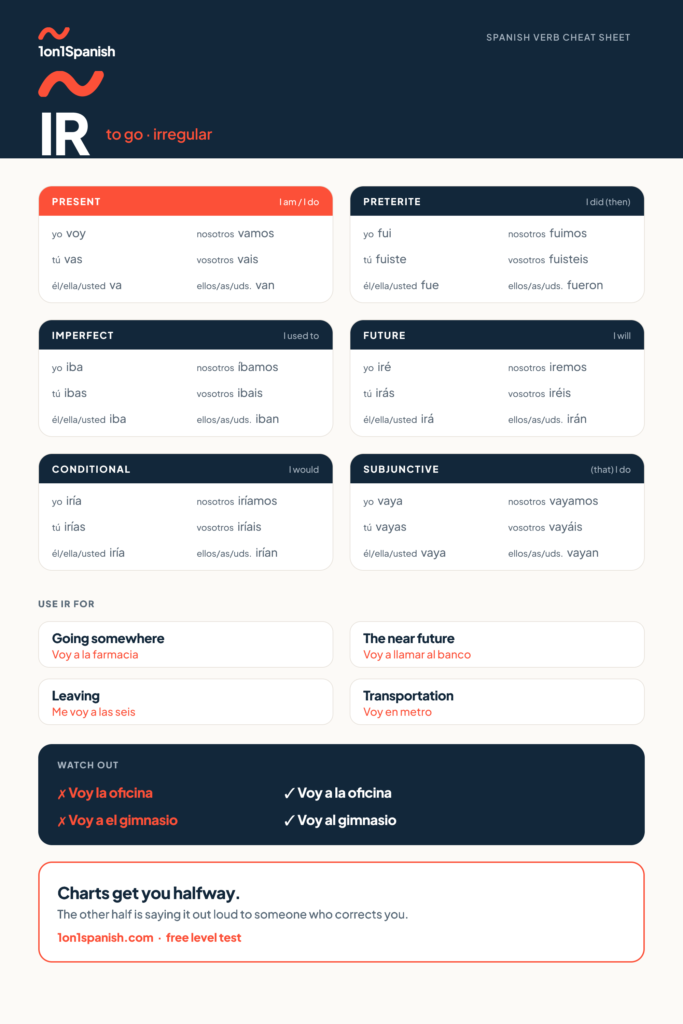
Take the chart with you
The chart is free to view and share. Drop your email and we’ll send the print-ready US Letter PDF — the version you stick on the fridge.
Practice
Practice ir with a real teacher
Charts get you halfway. The other half is saying it out loud to someone who corrects you on the spot. At 1on1Spanish you get 25-minute private lessons with a qualified native teacher, exercises built from the mistakes you make in class, and AI practice between lessons.
First month $1. No contracts, cancel anytime.
Voy a is the structure you’ll use most in conversational Spanish, so drill it out loud.
These guides are free. When you want someone correcting you out loud, learn Spanish online with a qualified native teacher.
Take your free level testBuilt on RingTeacher's method — 700,000+ classes delivered since 2017, teaching English to Spanish speakers. Now in the other direction.
Frequently asked questions
Why is the preterite of ir the same as the preterite of ser?
Both verbs use fui, fuiste, fue, fuimos, fuisteis, fueron, an overlap inherited from Latin, where two separate verbs collapsed into one past-tense set. In practice it causes no confusion: fui a Miami is “I went to Miami” and fui mesero is “I was a waiter”. The preposition a is the giveaway almost every time.
How do you use “ir a” to talk about the future in Spanish?
Conjugate ir in the present, add a, then the infinitive: voy a llamar, vamos a salir, van a llegar tarde. It’s the everyday future in spoken Spanish, the way “going to” works in English. The simple future (llamaré) still exists, but it sounds more formal, more distant, or is used for guesses: serán las diez.
What is the imperfect of ir in Spanish?
Iba, ibas, iba, íbamos, ibais, iban. It’s irregular, one of only three verbs with an irregular imperfect, along with ser and ver. Use it for past habits (iba al colegio andando) and for plans that never happened (iba a llamarte, pero se me hizo tarde). Note the accent on íbamos, which is easy to drop in writing.
What’s the difference between ir and irse?
Ir points at a destination: voy al supermercado. Irse points at the departure: me voy, “I’m leaving” or “I’m off”. You can use both together: me voy al supermercado means you’re heading out, now, and the supermarket is where you’ll end up. When someone is walking out the door, they say me voy, never just voy.
How do you say “let’s go” in Spanish?
Vamos, which is the present indicative doing duty as a command. The formally correct subjunctive form vayamos exists but sounds stiff in conversation. If you’re leaving somewhere, the natural choice is vámonos. To hurry someone along, ¡vamos ya! or the very common ¡venga, vamos! in Spain.