
Servir conjugation in Spanish: every tense you need, with examples
Servir means “to serve”, and also “to be useful for” — two meanings that come up constantly and share the same irregular pattern. The stem vowel e becomes i wherever it’s stressed (sirvo), and it also shows up in the third person of the preterite, throughout the subjunctive, and in the gerund (sirvió, sirva, sirviendo). Every tense is below, along with what no sirve actually means — one of the most useful everyday phrases in the language. 1on1Spanish teaches this in 25-minute one-on-one lessons with qualified native teachers, online across the United States.
Reviewed by María Jiménez — Licenciada en Filología Hispánica (BA in Hispanic Philology) · Updated Sep 2026
What servir means
Servir is “to serve”: sirvieron la cena a las ocho, me sirvo un poco más de arroz. It’s the standard verb for serving food, drinks, or a role — sirvió en el ejército, sirve en la junta directiva.
Just as commonly, it means “to be useful” or “to work” for a purpose: este cargador ya no sirve is this charger doesn’t work anymore, and no sirve para nada is a phrase you’ll hear about everything from broken appliances to bad plans. Servir para plus a noun or an infinitive marks what something is useful for: esta app sirve para aprender vocabulario.
Grammatically it’s a stem-changing verb (e→i). Unlike o→ue verbs such as dormir or cerrar, the e→i change of -ir verbs like servir reaches every form of the subjunctive, not just the stressed ones — sirvamos and sirváis both take it.
Servir conjugation: present tense
Stem change in every form except nosotros and vosotros.
| Form | Example | |
|---|---|---|
| yo | sirvo | Me sirvo agua antes de dormir. (I pour myself water before bed.) |
| tú | sirves | ¿Te sirves más ensalada? (Are you having more salad?) |
| él / ella / usted | sirve | Esta receta sirve para seis personas. (This recipe serves six people.) |
| nosotros | servimos | Servimos la cena a las siete en punto. (We serve dinner at seven sharp.) |
| vosotros | servís | ¿Vosotros servís el postre después del café? (Do you serve dessert after coffee?) |
| ellos / ellas / ustedes | sirven | En ese restaurante sirven comida hasta la medianoche. (That restaurant serves food until midnight.) |
Servir conjugation: preterite
Only the third person takes the change.
| Form | |
|---|---|
| yo | serví |
| tú | serviste |
| él / ella / usted | sirvió |
| nosotros | servimos |
| vosotros | servisteis |
| ellos / ellas / ustedes | sirvieron |
Sirvieron la cena tarde porque llegaron invitados de más. — They served dinner late because extra guests showed up.
Servir conjugation: imperfect
Fully regular — the imperfect never carries a stem change.
| Form | |
|---|---|
| yo | servía |
| tú | servías |
| él / ella / usted | servía |
| nosotros | servíamos |
| vosotros | servíais |
| ellos / ellas / ustedes | servían |
Antes servía mesas los fines de semana para pagar la universidad. — I used to wait tables on weekends to pay for college.
Servir conjugation: future
Regular endings on the infinitive.
| Form | |
|---|---|
| yo | serviré |
| tú | servirás |
| él / ella / usted | servirá |
| nosotros | serviremos |
| vosotros | serviréis |
| ellos / ellas / ustedes | servirán |
Serviremos la comida en el jardín si hace buen tiempo. — We’ll serve the food in the yard if the weather’s good.
Servir conjugation: conditional
| Form | |
|---|---|
| yo | serviría |
| tú | servirías |
| él / ella / usted | serviría |
| nosotros | serviríamos |
| vosotros | serviríais |
| ellos / ellas / ustedes | servirían |
Este manual te serviría mucho para el trabajo nuevo. — This manual would be very useful for the new job.
Servir conjugation: present subjunctive
The e→i change reaches every single form, including nosotros and vosotros.
| Form | |
|---|---|
| yo | sirva |
| tú | sirvas |
| él / ella / usted | sirva |
| nosotros | sirvamos |
| vosotros | sirváis |
| ellos / ellas / ustedes | sirvan |
Espero que la cena sirva para reconciliarlos. — I hope the dinner helps bring them back together.
Servir conjugation: imperfect subjunctive
Built on the preterite stem sirvieron-, so every form carries the i.
| Form (-ra) | Form (-se) | |
|---|---|---|
| yo | sirviera | sirviese |
| tú | sirvieras | sirvieses |
| él / ella / usted | sirviera | sirviese |
| nosotros | sirviéramos | sirviésemos |
| vosotros | sirvierais | sirvieseis |
| ellos / ellas / ustedes | sirvieran | sirviesen |
Si sirviera para algo, ya lo habrían arreglado. — If it were any use, they would have fixed it already.
Servir commands (imperative)
| Affirmative | Negative | |
|---|---|---|
| tú | sirve | no sirvas |
| usted | sirva | no sirva |
| nosotros | sirvamos | no sirvamos |
| vosotros | servid | no sirváis |
| ustedes | sirvan | no sirvan |
Sírvete lo que quieras, estás en tu casa. — Help yourself to whatever you want, you’re at home.
Participle, gerund and compound tenses
Participle servido, completely regular. Gerund sirviendo, with the same e→i change as the preterite. Compounds take haber:
Ha servido en dos restaurantes distintos este año (present perfect) · Ya había servido la cena cuando llegamos (past perfect) · Para la boda ya habrán servido más de cien platos (future perfect).
When to use servir
Serving food or drinks
Sirvieron la cena a las ocho en punto. The most literal use, and the one every learner meets first at a restaurant or a family dinner.
Being useful or working properly
Esta impresora ya no sirve. This is the sense with no direct English equivalent — “it doesn’t serve” instead of “it doesn’t work” — and it’s extremely common in everyday complaints about broken things.
Serving in a role or position
Sirvió en el ejército cinco años. Common in résumés, biographies and formal introductions.
Common mistakes English speakers make with servir
The third-person preterite needs the stem change: sirvió, not servió.
The purpose construction is servir para, never servir a.
After quiero que, the subjunctive needs the e→i change: sirva, not sirve.
The gerund carries the same change as the preterite: sirviendo, never serviendo.
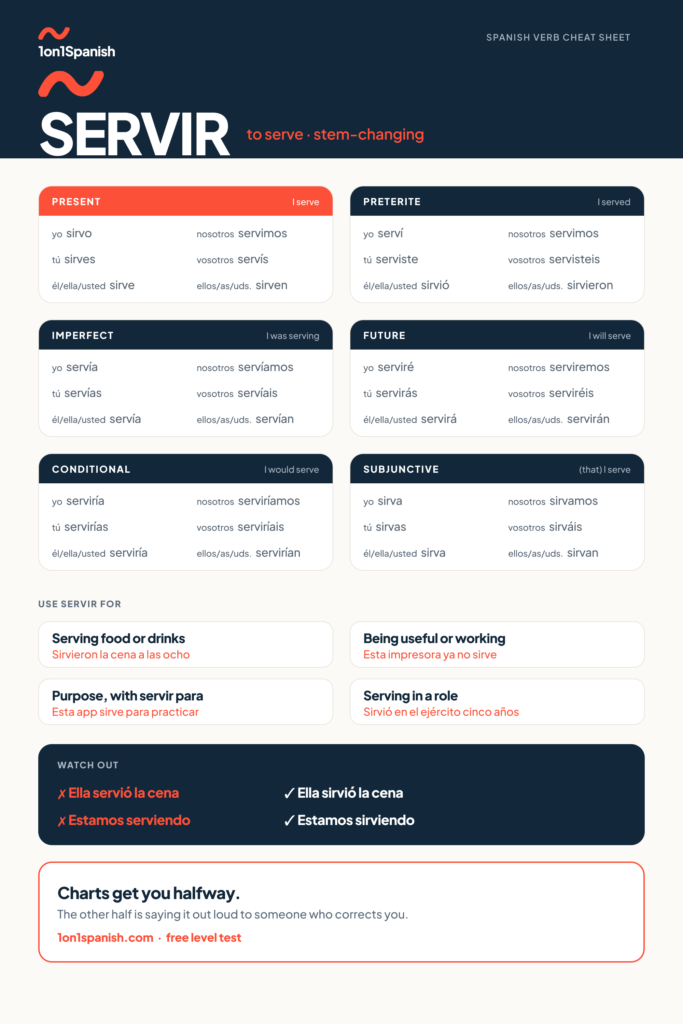
Take the chart with you
The chart is free to view and share. Drop your email and we’ll send the print-ready US Letter PDF — the version you stick on the fridge.
Practice
Practice servir with a real teacher
Charts get you halfway. The other half is saying it out loud to someone who corrects you on the spot. At 1on1Spanish you get 25-minute private lessons with a qualified native teacher, exercises built from the mistakes you make in class, and AI practice between lessons.
First month $1. No contracts, cancel anytime.
Reading about it only gets you so far. Learn Spanish online in 25-minute conversations and use it.
Take your free level testBuilt on RingTeacher's method — 700,000+ classes delivered since 2017, teaching English to Spanish speakers. Now in the other direction.
Frequently asked questions
Is servir regular or irregular in Spanish?
Irregular: it’s a stem-changing verb, e→i. The change appears wherever the stem is stressed — present sirvo, sirves, sirve, sirven — and also in the third-person preterite (sirvió, sirvieron), the whole subjunctive (sirva through sirvan), and the gerund (sirviendo). Only the imperfect, future, conditional and participle stay fully regular.
What does “no sirve” mean in Spanish?
“It doesn’t work” or “it’s no good”, used for anything broken or useless: el control remoto no sirve, esa excusa no sirve. It’s built from the sense of servir as “to be useful”, not the sense of serving food, and it’s one of the most common everyday phrases with this verb.
What’s the difference between “servir para” and “servir a”?
Servir para marks a purpose: este libro sirve para aprender gramática. Servir a is used with a person or an institution being served, more formal and less common in daily speech: sirvió a su país. Using servir a instead of servir para with a purpose is a common mistake.
What is the past tense of servir in Spanish?
Two forms. The preterite — serví, serviste, sirvió, servimos, servisteis, sirvieron — only changes in the third person, and it marks a completed act: sirvió la cena a las ocho. The imperfect — servía, servías, servía, servíamos, servíais, servían — is fully regular and marks a habit: servía mesas los fines de semana.
Do I need the subjunctive of servir in everyday conversation?
Yes, often with hopes about whether something will be useful. Sirva appears after espero que (espero que esto te sirva) and after ojalá que (ojalá que sirva para algo). It’s a common construction, especially when talking about whether advice, a tool or a plan will actually help.