
Traducir conjugation in Spanish: every tense you need, with examples
Traducir means “to translate”, and it carries two separate irregularities. The present yo form adds a zc: traduzco, not traduzo. And the preterite switches to a strong stem, traduj-, with no i in the third-person plural: tradujeron, never tradujieron. That last one is the single most common mistake with this verb. Every tense is below. 1on1Spanish teaches this in 25-minute one-on-one lessons with qualified native teachers, online across the United States.
Reviewed by María Jiménez — Licenciada en Filología Hispánica (BA in Hispanic Philology) · Updated Sep 2026
What traducir means
Traducir is “to translate”: moving meaning from one language into another, spoken or written. Traduzco documentos legales del inglés al español is a normal job description in the United States. It also works loosely for interpreting a spoken conversation, though interpretar is the more precise word for real-time speech.
Figuratively, traducirse en means “to translate into” in the sense of a result: el ahorro se traduce en menos estrés económico — the savings translate into less financial stress. Same idea as English, borrowed directly.
One warning worth knowing: English “traduce” — to speak badly of someone — looks like a cognate of traducir but means something completely different. They’re unrelated words that happen to look alike.
Grammatically it’s irregular in the present yo form and the preterite, both built on different irregular stems. Present subjunctive follows the yo form. Imperfect, future, conditional, participle (traducido) and gerund (traduciendo) are all regular.
Traducir conjugation: present tense
Only yo is irregular, with the same -zco pattern as conocer or conducir.
| Form | Example | |
|---|---|---|
| yo | traduzco | Traduzco documentos legales para una firma. (I translate legal documents for a firm.) |
| tú | traduces | ¿Traduces del inglés al español? (Do you translate from English to Spanish?) |
| él / ella / usted | traduce | Ella traduce libros para una editorial. (She translates books for a publisher.) |
| nosotros | traducimos | Traducimos el contrato entre los dos. (We’re translating the contract between us.) |
| vosotros | traducís | ¿Traducís vosotros mismos los subtítulos? (Do you translate the subtitles yourselves?) |
| ellos / ellas / ustedes | traducen | Ellos traducen para la corte. (They translate for the court.) |
Traducir conjugation: preterite
Fully irregular, built on the stem traduj-. The third-person plural takes -eron, not -ieron, because the stem already ends in j.
| Form | |
|---|---|
| yo | traduje |
| tú | tradujiste |
| él / ella / usted | tradujo |
| nosotros | tradujimos |
| vosotros | tradujisteis |
| ellos / ellas / ustedes | tradujeron |
Tradujeron el manual completo en dos días. — They translated the whole manual in two days.
Traducir conjugation: imperfect
Regular endings.
| Form | |
|---|---|
| yo | traducía |
| tú | traducías |
| él / ella / usted | traducía |
| nosotros | traducíamos |
| vosotros | traducíais |
| ellos / ellas / ustedes | traducían |
Antes traducía todo a mano, sin ayuda de software. — I used to translate everything by hand, without any software.
Traducir conjugation: future
Regular endings on the infinitive.
| Form | |
|---|---|
| yo | traduciré |
| tú | traducirás |
| él / ella / usted | traducirá |
| nosotros | traduciremos |
| vosotros | traduciréis |
| ellos / ellas / ustedes | traducirán |
La agencia traducirá los documentos en 48 horas. — The agency will translate the documents in 48 hours.
Traducir conjugation: conditional
| Form | |
|---|---|
| yo | traduciría |
| tú | traducirías |
| él / ella / usted | traduciría |
| nosotros | traduciríamos |
| vosotros | traduciríais |
| ellos / ellas / ustedes | traducirían |
Yo no traduciría ese contrato sin un abogado. — I wouldn’t translate that contract without a lawyer.
Traducir conjugation: present subjunctive
Built on traduzc-, the same stem as traduzco.
| Form | |
|---|---|
| yo | traduzca |
| tú | traduzcas |
| él / ella / usted | traduzca |
| nosotros | traduzcamos |
| vosotros | traduzcáis |
| ellos / ellas / ustedes | traduzcan |
Necesito que traduzcas esto antes del viernes. — I need you to translate this before Friday.
Traducir conjugation: imperfect subjunctive
Built on the preterite stem traduj-, so there’s no i in the ending here either.
| Form (-ra) | Form (-se) | |
|---|---|---|
| yo | tradujera | tradujese |
| tú | tradujeras | tradujeses |
| él / ella / usted | tradujera | tradujese |
| nosotros | tradujéramos | tradujésemos |
| vosotros | tradujerais | tradujeseis |
| ellos / ellas / ustedes | tradujeran | tradujesen |
Le pedí que tradujera el correo con cuidado. — I asked her to translate the email carefully.
Traducir commands (imperative)
The affirmative tú form is regular; everything else uses the subjunctive stem.
| Affirmative | Negative | |
|---|---|---|
| tú | traduce | no traduzcas |
| usted | traduzca | no traduzca |
| nosotros | traduzcamos | no traduzcamos |
| vosotros | traducid | no traduzcáis |
| ustedes | traduzcan | no traduzcan |
Traduzca este párrafo, por favor. — Please translate this paragraph.
Participle, gerund and compound tenses
Participle traducido, gerund traduciendo. Both regular. Compounds take haber:
He traducido tres contratos esta semana (present perfect) · Ya había traducido el capítulo antes de la reunión (past perfect) · Para diciembre habré traducido todo el manual (future perfect).
When to use traducir
Translating written text
Traduzco documentos oficiales del inglés al español. The core, everyday use, from contracts to school forms to medical paperwork.
Loosely, for spoken conversation
¿Me puedes traducir lo que dijo el doctor? Common in informal speech, even though interpretar is the more precise term for real-time interpreting.
Figuratively, for outcomes
El nuevo horario se traduce en más tiempo con la familia. Just like English “translates into”, used for describing a result.
Common mistakes English speakers make with traducir
The yo form of traducir takes -zco, the same pattern as conocer (conozco) and conducir (conduzco).
This is the classic error with this verb. Because the stem traduj- already ends in j, the third-person plural preterite drops the i: tradujeron, not tradujieron.
Spanish needs both prepositions: de before the source language, a (or al) before the target one.
The tú form of the preterite never ends in -s. Adding one is a common slip, by analogy with other tú forms that do carry an -s.
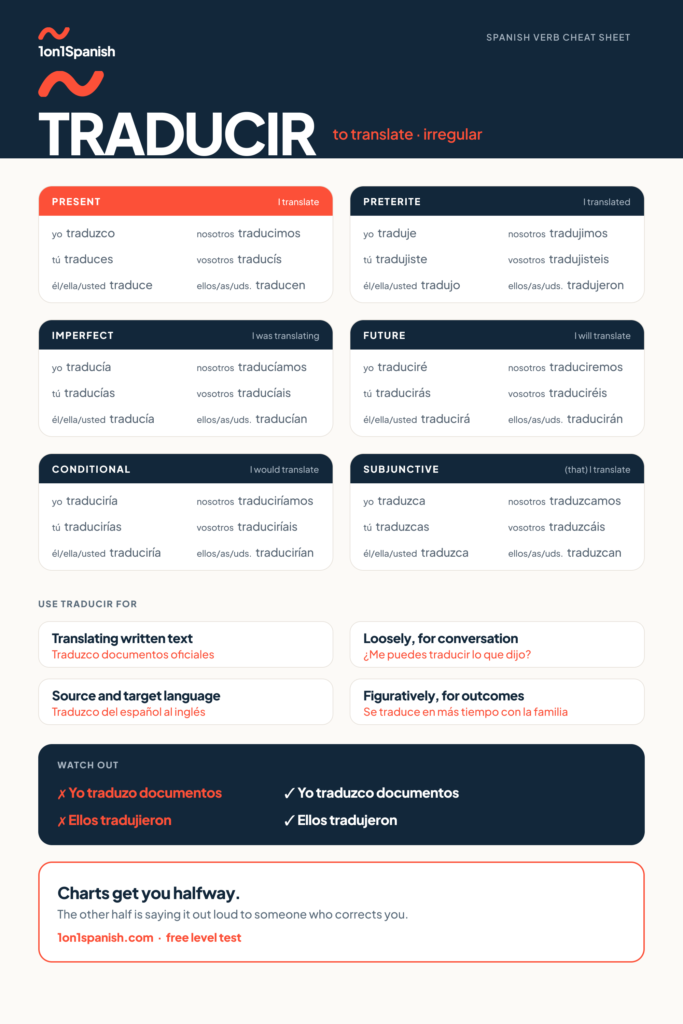
Take the chart with you
The chart is free to view and share. Drop your email and we’ll send the print-ready US Letter PDF — the version you stick on the fridge.
Practice
Practice traducir with a real teacher
Charts get you halfway. The other half is saying it out loud to someone who corrects you on the spot. At 1on1Spanish you get 25-minute private lessons with a qualified native teacher, exercises built from the mistakes you make in class, and AI practice between lessons.
First month $1. No contracts, cancel anytime.
Guides help. A teacher hears what a guide cannot — Learn Spanish online with a real teacher.
Take your free level testBuilt on RingTeacher's method — 700,000+ classes delivered since 2017, teaching English to Spanish speakers. Now in the other direction.
Frequently asked questions
Is traducir regular or irregular in Spanish?
Irregular in two specific places. The present yo form is traduzco, with the same -zco ending as conocer and conducir. The preterite is built on the strong stem traduj-: traduje, tradujiste, tradujo, tradujimos, tradujisteis, tradujeron. The imperfect, future, conditional, participle and gerund are all completely regular.
Why is it “tradujeron” and not “tradujieron”?
Because the preterite stem traduj- already ends in the consonant j, the third-person plural ending drops its usual i, giving -eron instead of -ieron. This happens with every verb that takes a j-stem preterite: decir → dijeron, traer → trajeron, conducir → condujeron. Tradujieron is a very common mistake, but it doesn’t exist in standard Spanish.
How do you say “translate from English to Spanish”?
Traducir del inglés al español. Spanish needs both prepositions — de (or del, when it contracts with el) before the source language, and a (or al) before the target one. Dropping either preposition, as in traducir inglés a español, sounds foreign to a native speaker.
What is the past tense of traducir in Spanish?
Two, and they mark different things — the same split covered in preterite vs. imperfect. The preterite — traduje, tradujiste, tradujo, tradujimos, tradujisteis, tradujeron — describes a finished act: tradujo el documento ayer. The imperfect — traducía, traducías, traducía, traducíamos, traducíais, traducían — describes an ongoing or repeated activity: traducía para la ONU en esos años.
Do I need the subjunctive of traducir in everyday conversation?
Yes, usually after expressions of need or request. Traduzca appears after necesito que (necesito que traduzcas esto) and after espero que (espero que traduzcan el contrato a tiempo). It’s not advanced Spanish — it’s what a manager says every day in a workplace that handles documents in more than one language.