
Ver conjugation in Spanish: every tense you need, with examples
Ver means “to see”. It looks like a short, easy verb, and then the first form you need is veo instead of the vo the pattern predicts. Ver is irregular in three specific places — the yo form of the present, the whole imperfect, and the participle visto — and completely regular everywhere else. Every tense is below, along with the line between ver and mirar, which is where most of the real confusion sits. 1on1Spanish teaches this in 25-minute one-on-one lessons with qualified native teachers, online across the United States.
Reviewed by María Jiménez — Licenciada en Filología Hispánica (BA in Hispanic Philology) · Updated Sep 2026
What ver means
Ver covers seeing in the broad English sense: perceiving with your eyes, but also meeting up, watching something, and understanding. No veo nada sin lentes is I can’t see anything without my glasses. Nos vemos el viernes is see you Friday, and it’s how most conversations end in Spanish.
It also does the work of “to watch” for screens: ver la tele, ver una película, ver el partido. A native speaker says vi una película anoche, not miré una película.
Then there’s a ver, two words that mean something like “let’s see” or “let me check”, and that you’ll hear ten times in a lesson: A ver, repite eso.
Grammatically: irregular, but only in a few forms. Present yo is veo. The imperfect keeps the -e- of the infinitive all the way through (veía, not vía). The participle is visto, not vido. The gerund viendo is regular.
Ver conjugation: present tense
Only the yo form is irregular. Note that veis carries no accent — it’s a single syllable.
| Form | Example | |
|---|---|---|
| yo | veo | Veo la tele por la noche. (I watch TV at night.) |
| tú | ves | ¿Ves el letrero desde aquí? (Can you see the sign from here?) |
| él / ella / usted | ve | Mi papá ve el partido los domingos. (My dad watches the game on Sundays.) |
| nosotros | vemos | Nos vemos en la oficina. (We’ll see each other at the office.) |
| vosotros | veis | ¿Veis lo mismo que yo? (Do you see the same thing I do?) |
| ellos / ellas / ustedes | ven | Mis vecinos no ven nunca las noticias. (My neighbors never watch the news.) |
Ver conjugation: preterite
Regular endings, but written without accents: vi and vio are one syllable each, so the rule that puts an accent on hablé and habló doesn’t apply here.
| Form | |
|---|---|
| yo | vi |
| tú | viste |
| él / ella / usted | vio |
| nosotros | vimos |
| vosotros | visteis |
| ellos / ellas / ustedes | vieron |
Vi tu mensaje ayer, perdona. — I saw your message yesterday, sorry.
Ver conjugation: imperfect
The irregular one, and the easiest to get right once you see why: ver keeps the -e- of the infinitive, so the forms are veía, not vía. Every form carries an accent on the í.
| Form | |
|---|---|
| yo | veía |
| tú | veías |
| él / ella / usted | veía |
| nosotros | veíamos |
| vosotros | veíais |
| ellos / ellas / ustedes | veían |
De niño veía dibujos animados los sábados. — As a kid I used to watch cartoons on Saturdays.
Ver conjugation: future
Regular endings on the full infinitive.
| Form | |
|---|---|
| yo | veré |
| tú | verás |
| él / ella / usted | verá |
| nosotros | veremos |
| vosotros | veréis |
| ellos / ellas / ustedes | verán |
Ya veremos. — We’ll see. Said exactly as often as in English, and usually meaning no.
Ver conjugation: conditional
| Form | |
|---|---|
| yo | vería |
| tú | verías |
| él / ella / usted | vería |
| nosotros | veríamos |
| vosotros | veríais |
| ellos / ellas / ustedes | verían |
Yo no vería esa serie con los niños. — I wouldn’t watch that show with the kids.
Ver conjugation: present subjunctive
Built on the veo stem, so the -e- stays. Note the accent in veáis.
| Form | |
|---|---|
| yo | vea |
| tú | veas |
| él / ella / usted | vea |
| nosotros | veamos |
| vosotros | veáis |
| ellos / ellas / ustedes | vean |
Quiero que veas esto antes de firmar. — I want you to see this before you sign.
Ver conjugation: imperfect subjunctive
Built on the third-person preterite stem vier-. Both endings are correct and interchangeable; the -ra set is far more common in Latin America.
| Form (-ra) | Form (-se) | |
|---|---|---|
| yo | viera | viese |
| tú | vieras | vieses |
| él / ella / usted | viera | viese |
| nosotros | viéramos | viésemos |
| vosotros | vierais | vieseis |
| ellos / ellas / ustedes | vieran | viesen |
Si viera el precio, no lo compraría. — If he saw the price, he wouldn’t buy it.
Ver commands (imperative)
| Affirmative | Negative | |
|---|---|---|
| tú | ve | no veas |
| usted | vea | no vea |
| nosotros | veamos | no veamos |
| vosotros | ved | no veáis |
| ustedes | vean | no vean |
Ve is identical to the tú command of ir, so context decides: ve la película is watch the movie, ve a la tienda is go to the store.
Participle, gerund and compound tenses
Participle visto, irregular and worth memorizing on its own — it also gives you the adjective in está visto and the expression por lo visto (apparently). Gerund viendo, regular. Compounds take haber:
He visto esa película dos veces (present perfect) · Nunca había visto tanta nieve (past perfect) · Para diciembre habré visto la temporada entera (future perfect).
When to use ver
Seeing, with your eyes
No veo el letrero desde aquí. This is the literal use, and it’s also where ver shows up with the verb poder: ¿puedes ver la pantalla? is the normal way to ask, where English would just say “can you see the screen”.
Watching anything on a screen
Ver la tele, ver una película, ver el partido. Spanish uses ver here, never mirar, and this is the use that comes up most in everyday conversation.
Meeting up with someone
Nos vemos el viernes is see you Friday. The reflexive verse means to see each other, so hace mucho que no nos vemos is we haven’t seen each other in a long time.
Understanding or checking
Ya veo is I see, in the sense of I get it. Vamos a ver and its short form a ver mean let’s see or let me check, and they open half the sentences a teacher says in a lesson.
Ver vs mirar
Both translate as “to see” or “to watch”, and they are not interchangeable. Ver is what your eyes register; mirar is what you deliberately point them at. English does the same thing with “see” and “look at”, so the distinction is familiar — it’s the screen use that breaks the parallel.
| Spanish | What it means |
|---|---|
| Vi a tu hermana en el súper. | I ran into your sister at the store (I saw her). |
| Miré a tu hermana. | I looked at your sister on purpose. |
| ¿Viste el partido? | Did you watch the game? (the normal way to ask) |
| Mira esto. | Look at this. (pointing at something) |
| No veo bien de lejos. | I can’t see well at a distance (my eyesight). |
Rule of thumb: for anything on a screen, Spanish uses ver. For directing someone’s attention, mirar.
Common mistakes English speakers make with ver
The yo form keeps the -e-: veo. This is the single most common slip with this verb, because the infinitive is so short that the pattern looks obvious.
The imperfect of ver never loses the -e-. Vía is a different word entirely — it means track or lane.
Grammatical, but nobody says it. Movies, shows and games take ver.
The participle is irregular. Vido doesn’t exist in modern Spanish.
Once you use the pronoun lo, adding a él is redundant unless you’re contrasting. This is standard behavior for direct object pronouns, and ver is where learners meet them first.
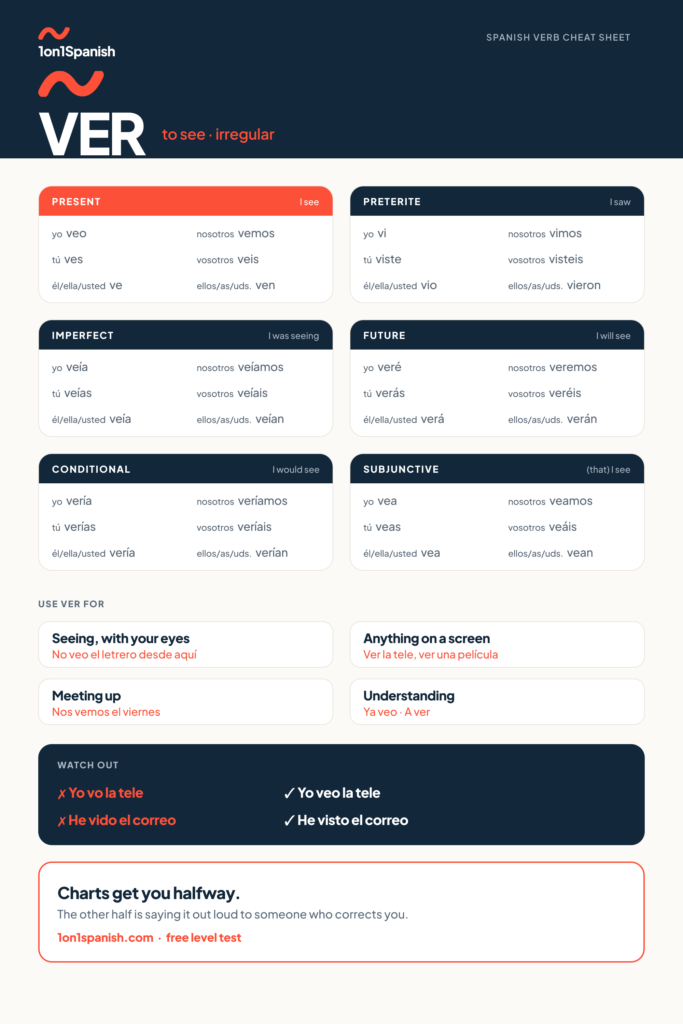
Take the chart with you
The chart is free to view and share. Drop your email and we’ll send the print-ready US Letter PDF — the version you stick on the fridge.
Practice
Practice ver with a real teacher
Charts get you halfway. The other half is saying it out loud to someone who corrects you on the spot. At 1on1Spanish you get 25-minute private lessons with a qualified native teacher, exercises built from the mistakes you make in class, and AI practice between lessons.
First month $1. No contracts, cancel anytime.
Grammar you can read. Speaking you cannot. Learn Spanish online and practice it live.
Take your free level testBuilt on RingTeacher's method — 700,000+ classes delivered since 2017, teaching English to Spanish speakers. Now in the other direction.
Frequently asked questions
Is ver regular or irregular in Spanish?
Irregular, but only in three places. The present yo form is veo instead of the expected vo. The imperfect keeps the -e- of the infinitive throughout: veía, veías, veía, veíamos, veíais, veían. And the participle is visto, not vido. The preterite, future, conditional and gerund all behave like a normal -er verb, which makes ver far less irregular than it feels.
What’s the difference between ver and mirar in Spanish?
Ver is passive perception, what your eyes take in: no veo nada sin lentes. Mirar is deliberate looking: mira esto. English splits them the same way with “see” and “look at”. The exception is screens: movies, shows and sports games take ver in Spanish, so vi el partido is correct and miré el partido sounds wrong to a native ear.
Why is it “veía” and not “vía” in the imperfect?
Because ver is a shortened form of an older infinitive, veer, and the imperfect preserves that extra -e-. So the stem is ve- plus the regular -ía endings, giving veía. Vía is a real Spanish word, but it means track, route or lane, so dropping the e doesn’t just sound off — it says something else.
What is the past tense of ver in Spanish?
Two, and they do different jobs. The preterite is vi, viste, vio, vimos, visteis, vieron, for a single completed act: vi tu mensaje. The imperfect is veía, veías, veía, veíamos, veíais, veían, for habits and background: veía la tele todas las noches. Note that vi and vio take no written accent, because both are one syllable.
How do you say “see you later” in Spanish?
Nos vemos, literally “we see each other”, is the everyday goodbye, and it works with any time marker: nos vemos el lunes, nos vemos luego, nos vemos mañana. Hasta luego is the more neutral equivalent. Te veo luego also works and is slightly more direct, aimed at one person you know well.