
Conjugate the verb vivir: every tense you need, with examples
Vivir means “to live”, and it is completely regular — there is not a single irregular form in any tense. That makes it the reference verb for the whole -ir family: learn these endings and you can conjugate escribir, recibir, abrir, subir and hundreds more without memorizing anything new. The tables below cover every tense you need, and the sections after them show where vivir stops meaning “reside” and starts meaning something else. 1on1Spanish teaches this in 25-minute one-on-one lessons with qualified native teachers, online across the United States.
Reviewed by María Jiménez — Licenciada en Filología Hispánica (BA in Hispanic Philology) · Updated Aug 2026
What vivir means
Vivir covers three of the things English splits between different words. It means to reside (Vivo en Austin), to be alive (Mi abuelo todavía vive), and to go through an experience (Vivimos un año muy duro). A fourth use, vivir de, means to make a living from something: Vive de la música.
Grammatically it is the easy one. No stem change, no spelling change, no irregular preterite. The participle is vivido and the gerund is viviendo, both formed with the standard rule. Every form below is the stem viv- plus a regular ending, which is exactly why teachers use it as the model verb.
The -ir endings you are actually learning here
Spanish regular verbs come in three families: -ar, -er and -ir. Strip the -ir off vivir and you get the stem viv-. Everything else is an ending that belongs to the family, not to this particular verb.
The -er and -ir families share almost every ending. They only differ in two places: the nosotros and vosotros forms of the present (vivimos, vivís against comemos, coméis), and the vosotros form of the affirmative command (vivid against comed). Learn vivir and you have most of comer for free. The rest of the family, irregulars included, is indexed under Spanish verbs.
Vivir conjugation: present tense
Endings: -o, -es, -e, -imos, -ís, -en. No irregular forms.
| Form | Example | |
|---|---|---|
| yo | vivo | Vivo en Denver desde 2019. (I’ve lived in Denver since 2019.) |
| tú | vives | ¿Vives cerca de la oficina? (Do you live near the office?) |
| él / ella / usted | vive | Mi hermana vive con su pareja. (My sister lives with her partner.) |
| nosotros | vivimos | Vivimos en un segundo piso. (We live on the second floor.) |
| vosotros | vivís | ¿Vivís juntos? (Do you live together?) |
| ellos / ellas / ustedes | viven | Mis padres viven en Florida. (My parents live in Florida.) |
Vivir conjugation: preterite
For a period of living somewhere that is finished and closed.
| Form | |
|---|---|
| yo | viví |
| tú | viviste |
| él / ella / usted | vivió |
| nosotros | vivimos |
| vosotros | vivisteis |
| ellos / ellas / ustedes | vivieron |
Viví cinco años en Chicago. — I lived in Chicago for five years.
Note that vivimos is both present and preterite. Only the sentence tells you which: Ahora vivimos aquí against Vivimos allí de 2010 a 2014.
Vivir conjugation: imperfect
For where you used to live, without saying when it started or ended.
| Form | |
|---|---|
| yo | vivía |
| tú | vivías |
| él / ella / usted | vivía |
| nosotros | vivíamos |
| vosotros | vivíais |
| ellos / ellas / ustedes | vivían |
Cuando era estudiante vivía con tres compañeros. — When I was a student I lived with three roommates.
Vivir conjugation: future
Regular endings on the full infinitive.
| Form | |
|---|---|
| yo | viviré |
| tú | vivirás |
| él / ella / usted | vivirá |
| nosotros | viviremos |
| vosotros | viviréis |
| ellos / ellas / ustedes | vivirán |
Vivir conjugation: conditional
| Form | |
|---|---|
| yo | viviría |
| tú | vivirías |
| él / ella / usted | viviría |
| nosotros | viviríamos |
| vosotros | viviríais |
| ellos / ellas / ustedes | vivirían |
Yo no viviría tan lejos del trabajo. — I wouldn’t live that far from work.
Vivir conjugation: present subjunctive
Take the yo form of the present, drop the -o, add the -ar endings. Shows up after cuando, espero que and ojalá.
| Form | |
|---|---|
| yo | viva |
| tú | vivas |
| él / ella / usted | viva |
| nosotros | vivamos |
| vosotros | viváis |
| ellos / ellas / ustedes | vivan |
Cuando vivas aquí lo entenderás. — Once you live here you’ll understand.
Vivir conjugation: imperfect subjunctive
Both sets are correct. The -ra forms dominate in speech; the -se forms sound formal or written.
| Form (-ra) | Form (-se) | |
|---|---|---|
| yo | viviera | viviese |
| tú | vivieras | vivieses |
| él / ella / usted | viviera | viviese |
| nosotros | viviéramos | viviésemos |
| vosotros | vivierais | vivieseis |
| ellos / ellas / ustedes | vivieran | viviesen |
Si viviera más cerca, iría andando. — If I lived closer, I’d walk.
Vivir commands (imperative)
| Affirmative | Negative | |
|---|---|---|
| tú | vive | no vivas |
| usted | viva | no viva |
| nosotros | vivamos | no vivamos |
| vosotros | vivid | no viváis |
| ustedes | vivan | no vivan |
Commands with vivir are rare with the “reside” meaning and common with the “experience” one: Vive el momento. — Live in the moment.
Participle, gerund and compound tenses
Participle vivido, gerund viviendo. Compounds use haber:
He vivido en tres estados (present perfect) · Había vivido allí antes de casarse (past perfect) · Para junio habré vivido un año en Miami (future perfect).
When to use vivir
Where you live
The default use, always with a preposition of place: Vivo en Portland. Viven al lado del hospital. Spanish never drops the en.
Being alive
Su padre todavía vive. Note that English “he’s alive” is está vivo with estar, while “he lives” is vive. Both are correct and they are not interchangeable.
Living through something
Vivimos un huracán en 2022. Está viviendo un divorcio complicado. Here vivir takes a direct object and no preposition.
Making a living
Vivir de plus the source: Vive de sus ahorros. No se puede vivir del alquiler.
Living with someone
Vivir con is neutral and factual: Vivo con mi hermano. If you mean a couple moving in together, Spanish speakers often say irse a vivir juntos.
Vivir vs quedarse
English “stay” and “live” both land on vivir for a lot of learners, and hotels are where it goes wrong. Vivir is your address. Quedarse is temporary lodging.
| Vivir | Quedarse |
|---|---|
| Vivo en Boston — Boston is my home | Me quedo en Boston tres noches — I’m staying three nights |
| Vivimos en un apartamento — that’s our apartment | Nos quedamos en un hotel — we’re staying at a hotel |
| Vivió con su tía dos años — she lived at her aunt’s | Se quedó con su tía el fin de semana — she stayed at her aunt’s for the weekend |
The choice between viví and vivía follows the same logic as every other Spanish verb; the full rule is in preterite vs imperfect.
Common mistakes English speakers make with vivir
Learners drop the en because “live in” feels like a single unit in English and gets translated as one word. In Spanish the preposition is a separate piece and it is never optional.
For an action that started in the past and is still going, Spanish uses the present with desde hace, not the perfect with for.
The gerund is reserved for something genuinely temporary or in progress. A permanent address takes the plain present.
Origin is ser, not vivir. Somebody can be de Colombia and live in Houston, and Spanish keeps those two facts in different verbs.
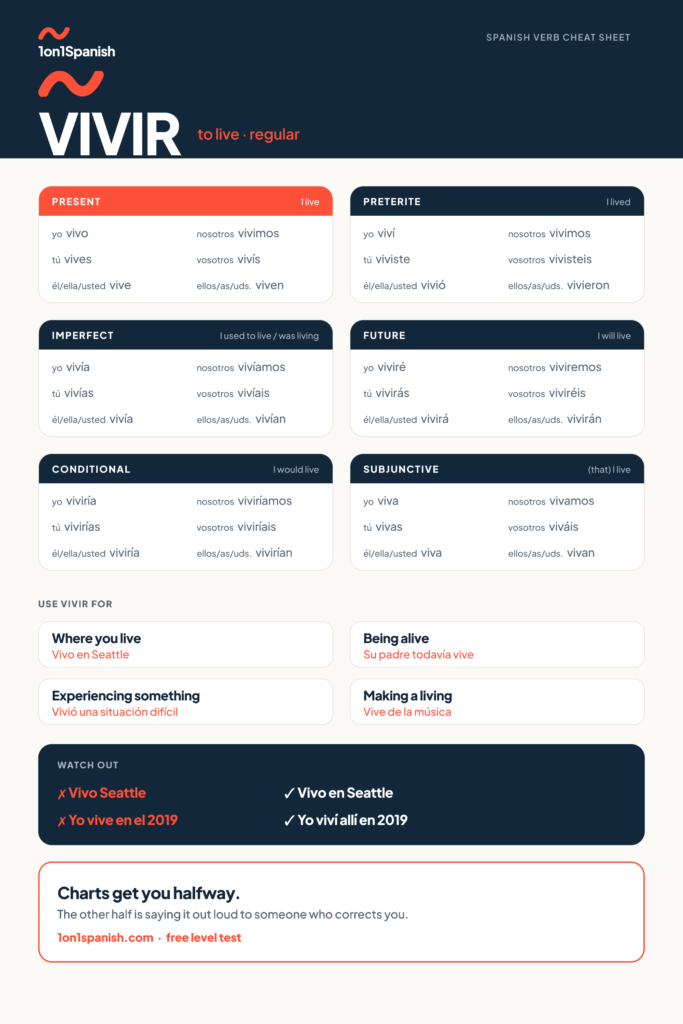
Take the chart with you
The chart is free to view and share. Drop your email and we’ll send the print-ready US Letter PDF — the version you stick on the fridge.
Practice
Practice vivir and the -ir verbs with a real teacher
Charts get you halfway. The other half is saying it out loud to someone who corrects you on the spot. At 1on1Spanish you get 25-minute private lessons with a qualified native teacher, exercises built from the mistakes you make in class, and AI practice between lessons.
First month $1. No contracts, cancel anytime.
Want a teacher listening while you practice? Learn Spanish online with us, one lesson at a time.
Take your free level testBuilt on RingTeacher's method — 700,000+ classes delivered since 2017, teaching English to Spanish speakers. Now in the other direction.
Frequently asked questions
Is vivir a regular verb in Spanish?
Yes. Vivir is regular in every main tense, with no stem change and no spelling change, which is why it is the standard model for the -ir family. Once you know its endings you can conjugate escribir, recibir, abrir, subir, decidir and permitir the same way. The participle vivido and the gerund viviendo also follow the normal rules.
What are the -ir verb endings in Spanish?
In the present they are -o, -es, -e, -imos, -ís, -en. In the preterite, -í, -iste, -ió, -imos, -isteis, -ieron. In the imperfect, -ía, -ías, -ía, -íamos, -íais, -ían. The -er and -ir families share every ending except nosotros and vosotros in the present and the vosotros command, so learning one gets you most of the other.
How do you say “I have lived in the US for ten years” in Spanish?
Vivo en Estados Unidos desde hace diez años. Spanish uses the plain present, not the present perfect, for something that started in the past and is still true. He vivido diez años en Estados Unidos is also correct, but it suggests the period is finished. The everyday version is the one with desde hace.
What is the difference between vivir and quedarse?
Vivir is where your home is; quedarse is where you are staying temporarily. Vivo en Miami means Miami is your city, while Me quedo en Miami una semana means you are visiting. Using vivir at a hotel front desk is one of the quickest ways to confuse a receptionist, since it sounds like you are moving in.
Is the preterite of vivir the same as the present?
Only in the nosotros form. Vivimos is both “we live” and “we lived”, and context is the only thing that separates them: Ahora vivimos en Nueva York against Vivimos allí hasta 2018. Every other person is distinct: vivo against viví, vives against viviste, vive against vivió.