
Volver conjugation in Spanish: every tense you need, with examples
Volver means “to come back” or “to go back”, and it breaks in two places at once: the stem changes from o to ue whenever the syllable is stressed (vuelvo, not volvo), and the past participle is vuelto, never volvido. Everything else follows the regular -er pattern. All the tables are below, plus the volver a + infinitive structure that Spanish speakers use every day. 1on1Spanish teaches this in 25-minute one-on-one lessons with qualified native teachers, online across the United States.
Reviewed by María Jiménez — Licenciada en Filología Hispánica (BA in Hispanic Philology) · Updated Aug 2026
What volver means
Volver covers the idea of going back to a place you had left: Vuelvo a Denver el domingo (I’m going back to Denver on Sunday). It also means “to turn”: Vuelve la página, volver la cabeza.
Two things make it worth memorizing. First, volver a + infinitive is how Spanish says “to do something again”: volví a llamar is “I called again”, with no extra word for “again”. Second, the reflexive volverse means “to become” in the sense of a change that sticks: se ha vuelto muy callado.
It’s a stem-changing verb (o→ue), the same pattern as poder, dormir and encontrar, so it’s worth learning properly, because it covers a large group of Spanish verbs. The stem only changes when the syllable carries the stress, so nosotros and vosotros keep the plain o. The participle is vuelto and the gerund is volviendo.
Volver conjugation: present tense
| Form | Example | |
|---|---|---|
| yo | vuelvo | Vuelvo a casa sobre las siete. (I get home around seven.) |
| tú | vuelves | ¿Vuelves en el vuelo de la mañana? (Are you coming back on the morning flight?) |
| él / ella / usted | vuelve | Mi hija vuelve del campamento el viernes. (My daughter comes back from camp on Friday.) |
| nosotros | volvemos | Volvemos a Miami cada invierno. (We go back to Miami every winter.) |
| vosotros | volvéis | ¿Volvéis andando? (Are you walking back?) |
| ellos / ellas / ustedes | vuelven | Vuelven de la reunión a las cuatro. (They’re back from the meeting at four.) |
Volver conjugation: preterite
No stem change here. Regular -er endings from start to finish.
| Form | |
|---|---|
| yo | volví |
| tú | volviste |
| él / ella / usted | volvió |
| nosotros | volvimos |
| vosotros | volvisteis |
| ellos / ellas / ustedes | volvieron |
Volví al hotel a medianoche. — I got back to the hotel at midnight.
Volver conjugation: imperfect
Fully regular. Use it for the trip you used to make, not the one you made once.
| Form | |
|---|---|
| yo | volvía |
| tú | volvías |
| él / ella / usted | volvía |
| nosotros | volvíamos |
| vosotros | volvíais |
| ellos / ellas / ustedes | volvían |
Antes volvía a la oficina después de comer. — I used to go back to the office after lunch.
Volver conjugation: future
Regular endings on the full infinitive.
| Form | |
|---|---|
| yo | volveré |
| tú | volverás |
| él / ella / usted | volverá |
| nosotros | volveremos |
| vosotros | volveréis |
| ellos / ellas / ustedes | volverán |
Volver conjugation: conditional
| Form | |
|---|---|
| yo | volvería |
| tú | volverías |
| él / ella / usted | volvería |
| nosotros | volveríamos |
| vosotros | volveríais |
| ellos / ellas / ustedes | volverían |
Yo no volvería a ese restaurante. — I wouldn’t go back to that restaurant.
Volver conjugation: present subjunctive
Same o→ue rule, same stressed syllables. Nosotros and vosotros stay plain.
| Form | |
|---|---|
| yo | vuelva |
| tú | vuelvas |
| él / ella / usted | vuelva |
| nosotros | volvamos |
| vosotros | volváis |
| ellos / ellas / ustedes | vuelvan |
Avísame cuando vuelvas. — Let me know when you get back.
Volver conjugation: imperfect subjunctive
Built on the preterite stem, so no vowel change at all. Both sets of endings are correct; the -ra forms dominate in speech.
| Form (-ra) | Form (-se) | |
|---|---|---|
| yo | volviera | volviese |
| tú | volvieras | volvieses |
| él / ella / usted | volviera | volviese |
| nosotros | volviéramos | volviésemos |
| vosotros | volvierais | volvieseis |
| ellos / ellas / ustedes | volvieran | volviesen |
Si volviera antes, cenaríamos juntos. — If I got back earlier, we’d have dinner together.
Volver commands (imperative)
| Affirmative | Negative | |
|---|---|---|
| tú | vuelve | no vuelvas |
| usted | vuelva | no vuelva |
| nosotros | volvamos | no volvamos |
| vosotros | volved | no volváis |
| ustedes | vuelvan | no vuelvan |
Vuelva mañana con la receta. — Come back tomorrow with the prescription.
Participle, gerund and compound tenses
Participle vuelto, gerund volviendo. The participle is the one irregular form you can’t guess from the infinitive, and it never changes: vuelto with haber, vuelto in devuelto, envuelto and revuelto too.
He vuelto tres veces esta semana (present perfect) · Ya había vuelto cuando llamaste (past perfect) · Para el jueves habré vuelto (future perfect). More on why some participles break the pattern in past participle.
When to use volver
Going back somewhere you already were
This is the core meaning and it needs a before the destination: Vuelvo a la oficina, volvemos al hotel. Without a destination it works alone: ¿A qué hora vuelves?
Doing something again, with volver a + infinitive
Volví a leer el contrato is “I read the contract again”. No vuelvas a hacer eso is “don’t do that again”. Far more common in speech than otra vez, and native speakers reach for it without thinking.
Becoming, with volverse
For a change in character or state that lasts: Se volvió muy exigente con la comida. For a profession or a deliberate result, Spanish uses hacerse instead.
Turning something over
Vuelve la tortilla, volver la mirada. Less frequent in conversation, but you’ll see it in recipes and instructions.
Volver vs regresar vs devolver
Three verbs, one English word. Volver and regresar both mean “to go back” and are interchangeable in most sentences. Regresar is more common in Mexico and much of Latin America, volver dominates in Spain. Devolver is the one that isn’t interchangeable: it means giving something back.
| Say this | Not this |
|---|---|
| Vuelvo el lunes — I’m back on Monday | Devuelvo el lunes |
| Regresé tarde a casa — I got home late | — |
| Tengo que devolver estos zapatos — I have to return these shoes | Tengo que volver estos zapatos |
| Me devolvieron el dinero — They refunded me | Me volvieron el dinero |
Shortcut: if there’s an object you can hand over, it’s devolver. If it’s you moving, it’s volver.
Common mistakes English speakers make with volver
The participle is irregular. Volvido doesn’t exist, and it’s the single most audible error with this verb.
The stem only changes under stress. Nosotros and vosotros keep the o, in both the present indicative and the subjunctive.
Volver a needs the a. Drop it and the sentence means nothing to a Spanish speaker.
Handing an object back is devolver. Volver moves people, not possessions.
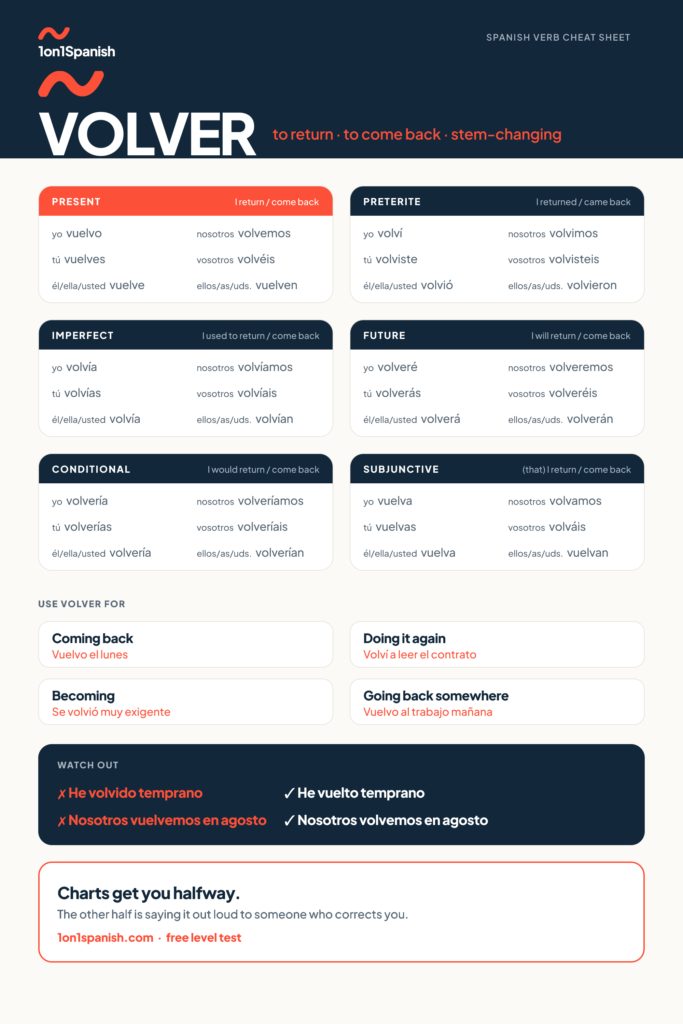
Take the chart with you
The chart is free to view and share. Drop your email and we’ll send the print-ready US Letter PDF — the version you stick on the fridge.
Practice
Practice volver with a real teacher
Charts get you halfway. The other half is saying it out loud to someone who corrects you on the spot. At 1on1Spanish you get 25-minute private lessons with a qualified native teacher, exercises built from the mistakes you make in class, and AI practice between lessons.
First month $1. No contracts, cancel anytime.
Ask for conversational Spanish if talking is what you’re after.
These guides are free. When you want someone correcting you out loud, learn Spanish online with a qualified native teacher.
Take your free level testBuilt on RingTeacher's method — 700,000+ classes delivered since 2017, teaching English to Spanish speakers. Now in the other direction.
Frequently asked questions
Is volver regular or irregular in Spanish?
Volver is a stem-changing verb, not a fully irregular one. The o becomes ue whenever the stem is stressed, which affects the present indicative, the present subjunctive and most commands. Every other tense uses regular -er endings. The one true irregularity is the past participle, vuelto, which has to be memorized on its own.
What’s the difference between volver and devolver?
Volver is about you going back somewhere: vuelvo a la oficina. Devolver is about giving something back to someone: devolver un libro, devolver el dinero. English uses “return” for both, which is why the mix-up is so common. If the sentence has a thing that changes hands, you need devolver, and its participle is devuelto.
How do you say “to do something again” in Spanish?
Use volver a + infinitive. Volví a leer el informe means “I read the report again”; no vuelvas a llegar tarde means “don’t be late again”. Spanish prefers this over adding otra vez, and it works in any tense: volveré a intentarlo, ha vuelto a llamar. The a is mandatory.
What is the past participle of volver?
The past participle is vuelto, not volvido. You use it in every compound tense: he vuelto, había vuelto, habré vuelto. The same irregular ending shows up in the verbs built on it: devuelto from devolver, envuelto from envolver, resuelto from resolver. Learn one and you have four.
Do I need the subjunctive of volver in everyday conversation?
Yes, mostly in one very common pattern: cuando plus a future action. Cuando vuelva, te llamo and avísame cuando vuelvas are things people say daily. It also appears after espero que and ojalá. Learning vuelva and vuelvas covers the vast majority of real situations you’ll meet.