
Body parts in Spanish: the words you need at the doctor’s
You’ll use this list more than any other vocabulary set on this site, because bodies get hurt, sore and tired in a doctor’s office, a gym, a pharmacy line and a phone call to a worried parent. The words themselves are easy. What trips up English speakers is the grammar around them: Spanish almost never says “my head hurts” — it says something closer to “the head hurts to me.” At 1on1Spanish we drill that construction out loud with qualified native teachers in 25-minute one-on-one lessons, so it becomes automatic before you need it in an urgent care waiting room.
Reviewed by María Jiménez — Licenciada en Filología Hispánica (BA in Hispanic Philology) · Updated Sep 2026
The parts you’ll name every week
Start with the head down: la cabeza (head), la cara (face), los ojos (eyes), la nariz (nose), la boca (mouth), los dientes (teeth), las orejas (ears, the outer part) versus los oídos (ears, the inner part you hear with — Spanish splits this into two words where English has one). El cuello is the neck, la garganta the throat, which you’ll need the moment you get a cold: me duele la garganta.
Down the trunk and limbs: el pecho (chest), la espalda (back), el estómago or la panza (stomach — panza is the everyday word in Mexico, estómago the clinical one), el brazo (arm), la mano (hand), los dedos (fingers, and also toes — Spanish doesn’t separate them; dedos del pie specifies toes when it matters), la pierna (leg), la rodilla (knee), el pie (foot), el tobillo (ankle).
Talking about pain: the construction that isn’t optional
This is the part that actually decides whether you sound natural. English says “my back hurts” — subject, possessive, verb. Spanish flips it: me duele la espalda, literally “to me hurts the back.” Doler works like gustar: the body part is the subject of the verb, and the person feeling the pain is an indirect object pronoun in front of it. Me duele la cabeza (my head hurts), te duele el brazo (your arm hurts), le duele la garganta (his/her throat hurts).
The verb agrees with what hurts, not with the person: one thing hurting is duele, more than one is duelen. Me duelen los pies — “my feet hurt,” plural because there are two feet. Saying me duele los pies is the single most common mistake here, and it’s an easy one to catch once you know to look for it: check the noun after duele/duelen, not the person before it.
Quick reference
| English | Spanish | Example with doler |
|---|---|---|
| head | la cabeza | Me duele la cabeza. |
| face | la cara | Tengo la cara hinchada. |
| eyes | los ojos | Me duelen los ojos. |
| ears (outer) | las orejas | Me duele la oreja izquierda. |
| ears (inner, hearing) | los oídos | Me duele el oído. |
| nose | la nariz | Tengo la nariz tapada. |
| mouth | la boca | Me duele la boca. |
| teeth | los dientes | Me duele un diente. |
| throat | la garganta | Me duele la garganta. |
| neck | el cuello | Me duele el cuello. |
| chest | el pecho | Me duele el pecho. |
| back | la espalda | Me duele la espalda. |
| stomach | el estómago / la panza | Me duele el estómago. |
| arm | el brazo | Me duele el brazo derecho. |
| hand | la mano | Me duele la mano. |
| finger | el dedo | Me duele el dedo. |
| leg | la pierna | Me duele la pierna. |
| knee | la rodilla | Me duele la rodilla. |
| foot | el pie | Me duelen los pies. |
| ankle | el tobillo | Me duele el tobillo. |
The mistake that makes you sound like a phrasebook
Almost every English speaker’s first instinct is to grab the possessive, because that’s what English does. It’s the single biggest tell that someone learned Spanish from a translation rather than from a native speaker.
| In English | Wrong instinct | What Spanish actually says |
|---|---|---|
| “My hand hurts” | Mi mano duele | Me duele la mano — definite article, no possessive, pronoun in front of the verb |
| “I washed my hands” | Lavé mis manos | Me lavé las manos — again the article, not the possessive, because it’s already clear whose hands they are |
| “She broke her arm” | Ella rompió su brazo | Se rompió el brazo — the reflexive plus the article carries the meaning without a possessive at all |
The rule generalizes past body parts: when it’s obvious who a body part or piece of clothing belongs to, Spanish reaches for el/la/los/las, not mi/tu/su. Using the possessive isn’t grammatically wrong, exactly — it’s just not what a native speaker says, and it’s one of the fastest tells that a sentence was translated word for word.
Common mistakes English speakers make
The possessive is redundant — me already says whose head it is.
Doler agrees with what hurts, and feet come in pairs.
Injuries to your own body almost always take the reflexive plus the article, not a possessive.
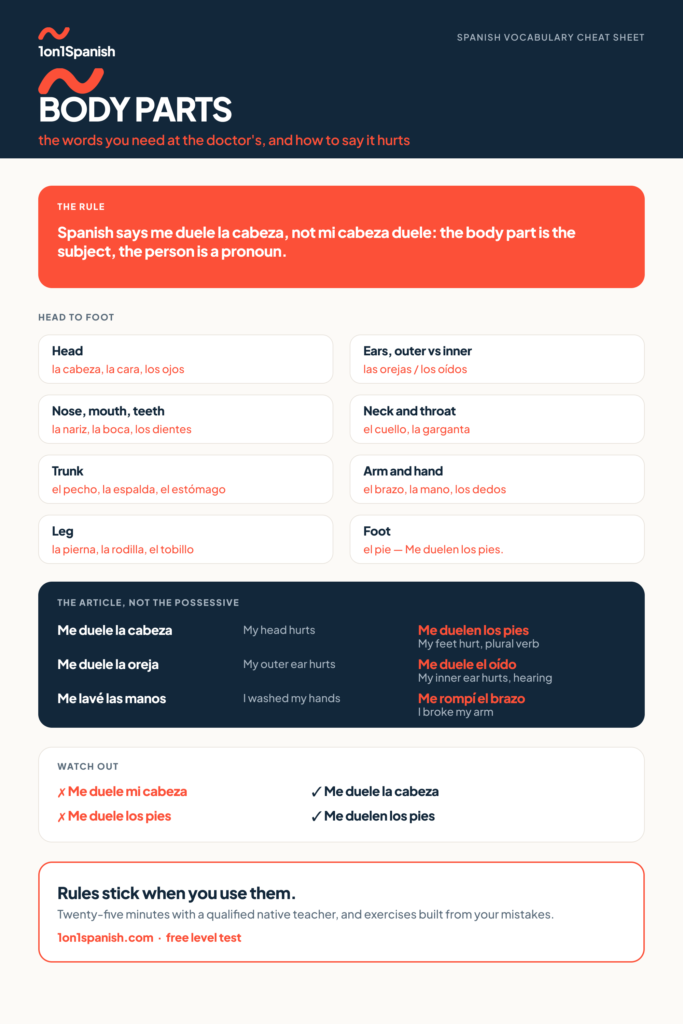
Take the chart with you
The chart is free to view and share. Drop your email and we’ll send the print-ready US Letter PDF — the version you stick on the fridge.
Practice
Practice Body parts in Spanish with a real teacher
Charts get you halfway. The other half is saying it out loud to someone who corrects you on the spot. At 1on1Spanish you get 25-minute private lessons with a qualified native teacher, exercises built from the mistakes you make in class, and AI practice between lessons.
First month $1. No contracts, cancel anytime.
Prefer to practice with a person? Take one-on-one Spanish lessons online with a qualified native teacher.
Take your free level testBuilt on RingTeacher's method — 700,000+ classes delivered since 2017, teaching English to Spanish speakers. Now in the other direction.
Frequently asked questions
How do you say “my head hurts” in Spanish?
Me duele la cabeza. Spanish doesn’t use a possessive here the way English does — it uses the definite article la plus the pronoun me in front of the verb duele. Literally it reads closer to “the head hurts to me.” This doler construction works the same way for every body part: subject is what hurts, pronoun is who feels it.
What’s the difference between oreja and oído?
Oreja is the outer, visible ear — the part on the side of your head. Oído is the inner ear, the part responsible for hearing. “My ear hurts from the earring” is about the oreja; “my ear hurts from the loud concert” is usually about the oído. Spanish keeps these as two separate words where English uses “ear” for both.
Why does Spanish use “el” instead of “mi” with body parts?
Because who the body part belongs to is usually already clear from context — often from the pronoun attached to the verb, as in me duele el brazo (my arm hurts). Adding a possessive on top, like mi brazo, is redundant to a native speaker and marks a sentence as translated rather than spoken. This pattern also applies to clothing: me puse la chaqueta, not mi chaqueta.
How do you say your feet hurt in Spanish?
Me duelen los pies, with duelen — the plural form — because there are two feet. This is the detail that trips people up most: doler agrees with the body part causing the pain, not with the person feeling it, so anything that comes in a pair or a group needs the plural verb.
Is panza a rude word for stomach?
No. Panza is completely normal, everyday Spanish for stomach in Mexico and most of Latin America, used in casual conversation by adults without a second thought. Estómago is the more formal or clinical option, the one you’d hear from a doctor. Neither is vulgar; they just sit at different levels of formality.