
Emotions and feelings in Spanish: ser, estar, tener
Emotion words in Spanish aren’t the hard part — feliz, triste, enojado are easy to learn. What’s genuinely hard is the verb standing in front of them: Spanish has three different ways to say “to be” or “to feel” an emotion, and picking the wrong one changes the meaning of the sentence, not just the grammar. At 1on1Spanish we drill this exact decision out loud with qualified native teachers in 25-minute one-on-one lessons.
Reviewed by María Jiménez — Licenciada en Filología Hispánica (BA in Hispanic Philology) · Updated Sep 2026
Ser vs. estar: the choice that changes the meaning
Most emotion adjectives can pair with either ser or estar, and the two options aren’t interchangeable — they say different things. Estar describes a temporary state: está aburrido means he’s bored right now, in this moment, at this meeting. Ser describes a characteristic, something closer to a personality trait: es aburrido means he’s a boring person, full stop, as a description of who he is. Same adjective, same emotion word, opposite message depending on the verb.
This applies across most feeling adjectives. Está nervioso (he’s nervous right now, before the interview) versus es nervioso (he’s a nervous person, generally). Está triste (she’s sad today) versus es triste — this one shifts further, from describing a person’s mood to describing a situation as sad: es triste que se haya ido, it’s sad that he left. The safest default while learning: if you’re describing how someone feels today, reach for estar. Most feeling talk is temporary by nature, so estar is right far more often than ser. Emotions are only one corner of it: the full ser vs estar rule covers location, time, jobs and the other cases where the choice is fixed.
The emotions that use tener, not “to be”
A second group of feelings doesn’t use “to be” at all — it uses tener, “to have,” the same verb Spanish uses for age and hunger. Tener miedo (to be afraid, literally “to have fear”), tener vergüenza (to be embarrassed, “to have shame”), tener celos (to be jealous), tener ganas de (to feel like doing something). Translating these word for word with ser or estar — soy miedo, estoy vergüenza — doesn’t work; Spanish treats these specific feelings as things you possess, not states you’re in.
The construction follows the same pattern as tener años for age: tengo miedo (I’m afraid), tienes vergüenza (you’re embarrassed), tenemos celos (we’re jealous). Add de plus an infinitive or a noun to say what triggers it: tengo miedo de las alturas (I’m afraid of heights), tiene vergüenza de hablar en público (she’s embarrassed to speak in public). Since these all hang on one irregular verb, the tener conjugation is worth knowing cold before the expressions themselves.
Sentirse: feeling as an action
A third option describes feeling as something you actively do, using the reflexive verb sentirse: me siento triste (I feel sad), se siente mejor (he feels better), nos sentimos cansados (we feel tired). This overlaps with estar in meaning — estoy triste and me siento triste are both fine and close to interchangeable — but sentirse leans slightly more toward describing a process, a change, or how something is affecting you, which is why it’s common after an event: me sentí nervioso durante el examen (I felt nervous during the exam). The verb underneath is sentir, a stem-changer (siento, sientes, siente), and the full sentir conjugation shows where the ie appears and where it doesn’t.
Quick reference
| English | Spanish | Verb pattern |
|---|---|---|
| happy | feliz / contento(a) | estar (temporary) / ser (personality) |
| sad | triste | estar (mood) / ser (situation) |
| angry | enojado(a) / molesto(a) | estar |
| nervous | nervioso(a) | estar (moment) / ser (trait) |
| bored | aburrido(a) | estar (moment) / ser (boring person) |
| tired | cansado(a) | estar |
| afraid | — | tener miedo |
| embarrassed | — | tener vergüenza |
| jealous | — | tener celos |
| feeling (in general) | — | sentirse + adjective |
The ones that don’t work the way you’d expect
| Detail | What trips people up |
|---|---|
| aburrido/a | estar aburrido = to be bored; ser aburrido = to be a boring person — same word, different meaning |
| tener miedo/vergüenza/celos | Built with tener, not ser or estar — literally “to have,” not “to be” |
| sentirse | Reflexive, needs a pronoun: me siento, not siento alone, which means “I feel [something specific],” like siento pena |
| es triste vs está triste | es triste shifts toward describing a situation as sad, not a person’s current mood |
| enojado vs enojoso | enojado is angry (feeling); enojoso is annoying (trait of a situation) — easy to mix up |
Common mistakes English speakers make
Soy aburrido announces you’re a boring person; estoy aburrido says you’re bored right now. This is the single most consequential ser/estar mix-up in the whole topic.
Fear, embarrassment and jealousy use tener, not any form of “to be.” There’s no way to translate these literally with ser or estar.
Sentirse is reflexive — it needs me/te/se/nos in front of it. Dropping the pronoun leaves the sentence incomplete.
The same tener pattern as fear applies to embarrassment; estar doesn’t combine with it at all.
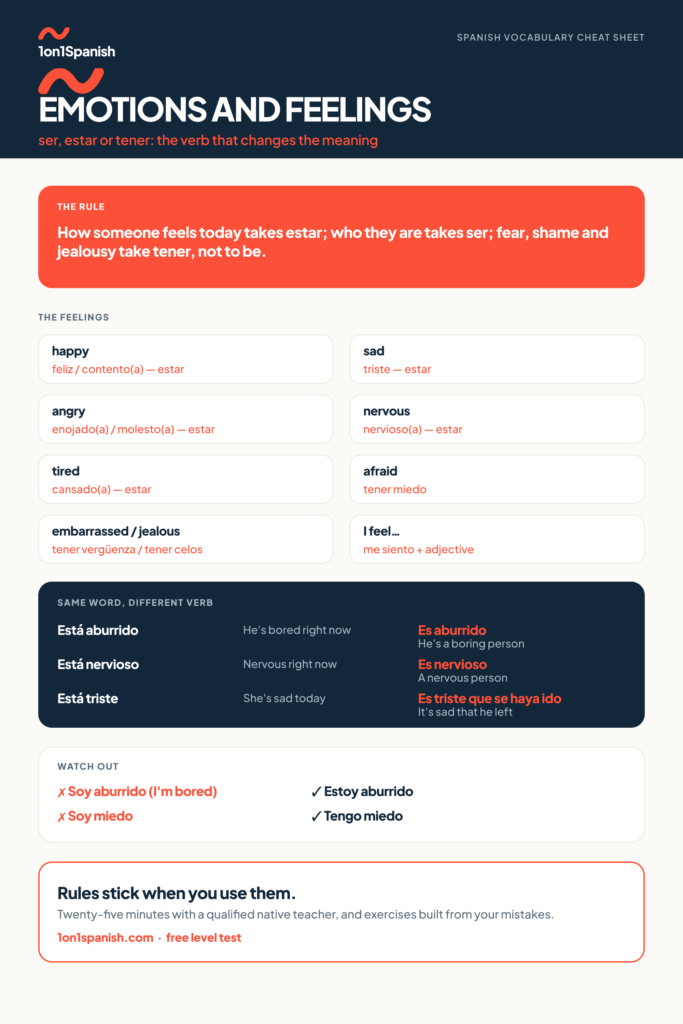
Take the chart with you
The chart is free to view and share. Drop your email and we’ll send the print-ready US Letter PDF — the version you stick on the fridge.
Practice
Practice emotions and feelings in Spanish with a real teacher
Charts get you halfway. The other half is saying it out loud to someone who corrects you on the spot. At 1on1Spanish you get 25-minute private lessons with a qualified native teacher, exercises built from the mistakes you make in class, and AI practice between lessons.
First month $1. No contracts, cancel anytime.
Prefer to practice with a person? Take one-on-one Spanish lessons online with a qualified native teacher.
Take your free level testBuilt on RingTeacher's method — 700,000+ classes delivered since 2017, teaching English to Spanish speakers. Now in the other direction.
Frequently asked questions
Is ser or estar used for emotions and feelings in Spanish?
Usually estar, because most feeling talk describes a temporary state: estoy feliz, está triste. Ser is reserved for describing a personality trait rather than a current mood — es alegre means he’s a naturally cheerful person, not that he’s happy right now. When in doubt about someone’s mood today, estar is the safer choice.
Why does aburrido mean two different things?
Because the verb changes the meaning, not the word. Está aburrido means he’s bored at this moment; es aburrido means he’s a boring person, a trait rather than a mood. This is the clearest example of why ser/estar isn’t optional grammar trivia — picking the wrong one changes what you’re actually saying about someone.
What’s the difference between estar triste and tener miedo?
The verb pattern itself. Most emotions, like sadness, use estar: estoy triste. A smaller set — fear, embarrassment, jealousy — uses tener, “to have,” instead: tengo miedo, tengo vergüenza. There’s no rule that predicts which group a feeling falls into; it has to be learned per expression.
How do you say “I feel” in Spanish?
Me siento, from the reflexive verb sentirse: me siento cansado (I feel tired), me siento mejor (I feel better). It needs the reflexive pronoun me in front of it — dropping it, saying just siento, changes the meaning to “I feel [a specific thing],” as in siento pena (I feel sorrow), which works differently.
Why do some emotions use tener instead of ser or estar?
Spanish treats a handful of feelings — fear, embarrassment, jealousy, the urge to do something — as things you possess rather than states you’re in, the same logic it uses for age (tengo veinte años) and hunger (tengo hambre). There’s no literal translation with “to be” that works for these; tener miedo, tener vergüenza and tener celos have to be learned as fixed expressions.