
Animals in Spanish: names, sounds and regional words
Animal vocabulary shows up everywhere adult life happens in Spanish — a vet appointment, a menu, a farmers market, a kid’s homework you’re helping with. It also hides one of the same traps as fruit: the animal on your plate often has a different name depending on which country your teacher or neighbor is from. Below is the vocabulary you’ll actually use, grouped by where you’ll need it, with the regional variants flagged instead of hidden. At 1on1Spanish you practice this out loud with qualified native teachers in 25-minute one-on-one lessons, online across the United States.
Reviewed by María Jiménez — Licenciada en Filología Hispánica (BA in Hispanic Philology) · Updated Sep 2026
Pets and household animals
El perro is dog, el gato is cat, and both take the masculine article by default even when the specific animal is female — el perro can refer to a female dog in general conversation, while la perra specifies a female one. El pez is fish, but only while it’s alive and swimming; once it’s food, it becomes el pescado — a distinction Spanish makes that English doesn’t. El pájaro is bird in general, el conejo rabbit, el hámster hamster. That masculine-by-default habit is a general rule of the gender of Spanish nouns, not something special about animals.
Farm animals
La vaca is cow, el toro bull, el caballo horse, la oveja sheep, la cabra goat. Pig has real regional spread: el cerdo is the neutral, widely understood word, el chancho dominates in much of South America, and el puerco is common in Mexico, sometimes with a slightly more casual or rural tone. Chicken is straightforward — el pollo — but turkey isn’t: el guajolote is the everyday word in Mexico (from Nahuatl), while el pavo is what you’ll hear in most of the rest of Latin America and in Spain.
Wild and sea animals
El león is lion, el elefante elephant, el oso bear, el lobo wolf, la serpiente or la culebra snake — the second one is more common in everyday speech in much of Latin America. In the ocean: el tiburón shark, el delfín dolphin, la ballena whale. And the one that trips people up at a seafood restaurant: el camarón is shrimp across almost all of Latin America, while la gamba is the word you’d find on a menu in Spain for the same thing.
Quick reference
| English | Spanish | Regional variant |
|---|---|---|
| dog | el perro | — |
| cat | el gato | — |
| fish (alive) | el pez | — |
| fish (as food) | el pescado | — |
| bird | el pájaro | — |
| cow | la vaca | — |
| horse | el caballo | — |
| pig | el cerdo | el chancho (South America), el puerco (Mexico) |
| chicken | el pollo | — |
| turkey | el pavo | el guajolote (Mexico) |
| sheep | la oveja | — |
| goat | la cabra | — |
| lion | el león | — |
| elephant | el elefante | — |
| bear | el oso | — |
| snake | la serpiente | la culebra (colloquial) |
| shark | el tiburón | — |
| dolphin | el delfín | — |
| whale | la ballena | — |
| shrimp | el camarón | la gamba (Spain) |
| butterfly | la mariposa | — |
| bee | la abeja | — |
| spider | la araña | — |
Where the word actually changes
The overlap between “animal vocabulary” and “food vocabulary” is where mistakes cost the most — ordering the wrong dish, or using a word that means something else at the table next to you. The table side of that overlap is covered in our food and drink vocabulary, and the same country-by-country split shows up in fruit vocabulary, where a peach is durazno or melocotón depending on who’s talking.
| Word | The situation |
|---|---|
| camarón / gamba | Camarón is what nearly every menu and market in Latin America uses. Gamba is Spain’s word for the same animal; using it in Mexico or Central America will get you a correction, not confusion, but it flags you as having learned European Spanish |
| chancho / puerco / cerdo | All three mean pig. Cerdo is the safest, most neutral choice anywhere. Puerco can sound informal or even mildly insulting when used about a person (as in English “you pig”), so it’s fine for the animal but worth knowing |
| guajolote / pavo | Guajolote is specifically Mexican; pavo travels everywhere else, including Spain. Both are correct — the difference is entirely regional, with no formality distinction |
| pez / pescado | Not regional, but a real trap: pez is the living animal, pescado is the animal once it’s caught and being eaten. Ordering pez at a restaurant sounds odd — you want pescado |
Common mistakes English speakers make
The distinction between the live animal and the food is one Spanish makes automatically and English doesn’t mark at all.
Not incorrect Spanish, just the wrong region — it’s Spain’s word, and most of Latin America won’t default to it.
Spanish uses the masculine as the unmarked general form; la perra specifically marks a female. This pattern repeats across most animals.
Both regional words are fine for the animal, but puerco used about a person can land as an insult, the same way “pig” does in English.
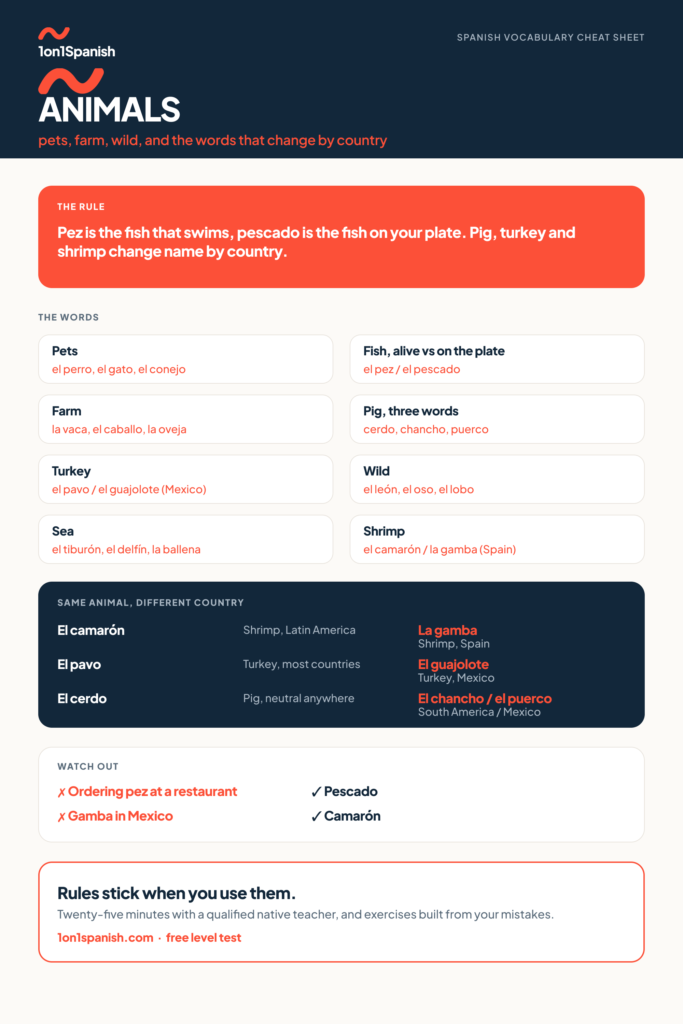
Take the chart with you
The chart is free to view and share. Drop your email and we’ll send the print-ready US Letter PDF — the version you stick on the fridge.
Practice
Practice animals in Spanish with a real teacher
Charts get you halfway. The other half is saying it out loud to someone who corrects you on the spot. At 1on1Spanish you get 25-minute private lessons with a qualified native teacher, exercises built from the mistakes you make in class, and AI practice between lessons.
First month $1. No contracts, cancel anytime.
Prefer to practice with a person? Take one-on-one Spanish lessons online with a qualified native teacher.
Take your free level testBuilt on RingTeacher's method — 700,000+ classes delivered since 2017, teaching English to Spanish speakers. Now in the other direction.
Frequently asked questions
What’s the difference between pez and pescado?
Pez is a fish while it’s alive, swimming in water. Pescado is the same animal once it’s been caught and is being sold or eaten as food. Spanish makes this distinction automatically; English uses “fish” for both, which is why it’s an easy detail to miss. Ordering food, you always want pescado.
What is shrimp called in Spanish?
Camarón across almost all of Latin America, including Mexico — the variety most commonly heard in the United States. In Spain, the same animal is usually called gamba. Both are correct Spanish; the difference is entirely regional, similar to “shrimp” versus “prawn” in different English-speaking countries.
Why does turkey have two different names in Spanish?
Guajolote comes from Nahuatl and is the everyday word in Mexico, where turkeys are native and have been part of the diet since before Spanish arrived. Pavo is used in the rest of Latin America and in Spain. Neither is more correct — it’s a regional split similar to durazno versus melocotón for peach.
What are common pet names for animals in Spanish?
Dog and cat are perro and gato; those don’t change much by region. What does vary is how people name specific breeds or affectionate nicknames for pets, which is closer to slang than core vocabulary. For the animal categories themselves — birds, fish, small mammals — the standard words above are used consistently across Spanish-speaking countries.
Is chancho or cerdo the right word for pig?
Both are correct; cerdo is the more neutral, universally understood option, while chancho is common and standard in much of South America. Puerco is another valid option, used especially in Mexico, though it can sound informal or even a little rude if applied to a person rather than the animal. None of the three is wrong — they sit in different regions and registers.