
Clothing in Spanish: vocabulary, verbs and regional words
Talking about clothing in Spanish trips people up in two specific ways: which verb goes with “wear,” and whether the color agrees with the garment the way an adjective should. Neither is obvious from a vocabulary list alone. This page covers the everyday clothing words used across most of Latin America — with Mexico as the default, since it’s the largest Spanish-speaking population in the United States — plus the verbs and the grammar that actually make a sentence about clothing correct. At 1on1Spanish a qualified native teacher corrects exactly this kind of detail in every 25-minute one-on-one lesson.
Reviewed by María Jiménez — Licenciada en Filología Hispánica (BA in Hispanic Philology) · Updated Sep 2026
Three verbs for “to wear,” and when each one fits
English uses “wear” for almost everything; Spanish splits the idea across three verbs. Llevar is the most common for describing what someone has on right now: Lleva una camisa azul (she’s wearing a blue shirt). Ponerse is reflexive and means “to put on,” used for the action of getting dressed: Me pongo el abrigo antes de salir (I put on my coat before going out). Usar can mean “to wear” in the sense of habitually or typically: Uso lentes para leer (I wear glasses to read) — it also just means “to use,” so context decides which meaning applies. Since llevar is the one you’ll say most, the full llevar conjugation is worth having open the first few times.
The everyday wardrobe
La camisa is a button-up shirt, la camiseta a T-shirt (in Mexico often la playera, in Argentina and Uruguay la remera). Los pantalones are pants, always plural in Spanish the way “pants” is in English; los jeans or los vaqueros (Spain) or los mahones (Puerto Rico) are denim jeans specifically. La falda is a skirt, el vestido a dress, la chaqueta a jacket, el suéter a sweater (el jersey in Spain), los zapatos shoes, las botas boots, los tenis or las zapatillas deportivas sneakers depending on the country.
Underneath and on top
La ropa interior is underwear, general term. Los calcetines are socks (las medias in much of South America, where medias also means stockings — context clarifies). El abrigo is a heavy coat, la bufanda a scarf, los guantes gloves, el sombrero a hat with a brim, la gorra a cap. El cinturón is a belt.
Colors have to agree with the garment
Color adjectives in Spanish change form to match the noun they describe, and clothing vocabulary is where this comes up constantly. Una camisa roja (a red shirt, feminine singular) but un vestido rojo (a red dress, masculine singular) and unos zapatos rojos (red shoes, masculine plural). Colors ending in -o shift to -a for feminine nouns and add -s for plural; most other colors — azul, verde, café — stay the same regardless of gender and only add -s for plural: pantalones azules, not pantalones azulos. The color words themselves, including the ones like naranja that never change, are on the Spanish colors page, and the general rule is adjective agreement, which applies to every adjective, not just colors.
Quick reference
| English | Spanish | Regional variant |
|---|---|---|
| shirt | la camisa | — |
| T-shirt | la camiseta | la playera (Mexico), la remera (Argentina/Uruguay) |
| pants | los pantalones | — |
| jeans | los jeans | los vaqueros (Spain), los mahones (Puerto Rico) |
| skirt | la falda | — |
| dress | el vestido | — |
| jacket | la chaqueta | — |
| sweater | el suéter | el jersey (Spain) |
| shoes | los zapatos | — |
| sneakers | los tenis (Mexico) | las zapatillas (Spain, South America) |
| socks | los calcetines | las medias (South America) |
| coat | el abrigo | — |
| scarf | la bufanda | — |
| gloves | los guantes | — |
| hat (brimmed) | el sombrero | — |
| cap | la gorra | — |
| belt | el cinturón | — |
| underwear | la ropa interior | — |
Where this actually goes wrong out loud
Verb choice and color agreement are both invisible on a flashcard and obvious the moment they’re wrong in a real sentence.
| Pattern | The risk |
|---|---|
| llevar / ponerse | Llevo un suéter describes what you have on right now; me pongo un suéter describes the act of putting it on. Using ponerse to describe a static outfit sounds like you’re mid-motion when you’re not |
| color agreement | Zapatos negro instead of zapatos negros is one of the most common small grammar slips learners make, precisely because clothing descriptions come up so often and fast in conversation |
| camiseta / playera / remera | None is wrong — they’re regional. Using playera with someone from Argentina won’t confuse them, but remera is what they’d actually say |
| medias | Means socks in much of South America and stockings in other contexts; calcetines is the safer, unambiguous word for socks across most of Latin America |
Common mistakes English speakers make
Color adjectives agree in number and, when they end in -o, in gender too — this is the single most common clothing-related grammar slip.
Usar leans toward habitual use or general possession; describing what’s on you right now calls for llevar.
Like English “pants,” Spanish treats it as inherently plural, even when you mean one item.
Camiseta is the safe, understood-everywhere default if you’re not sure which region your listener is from.
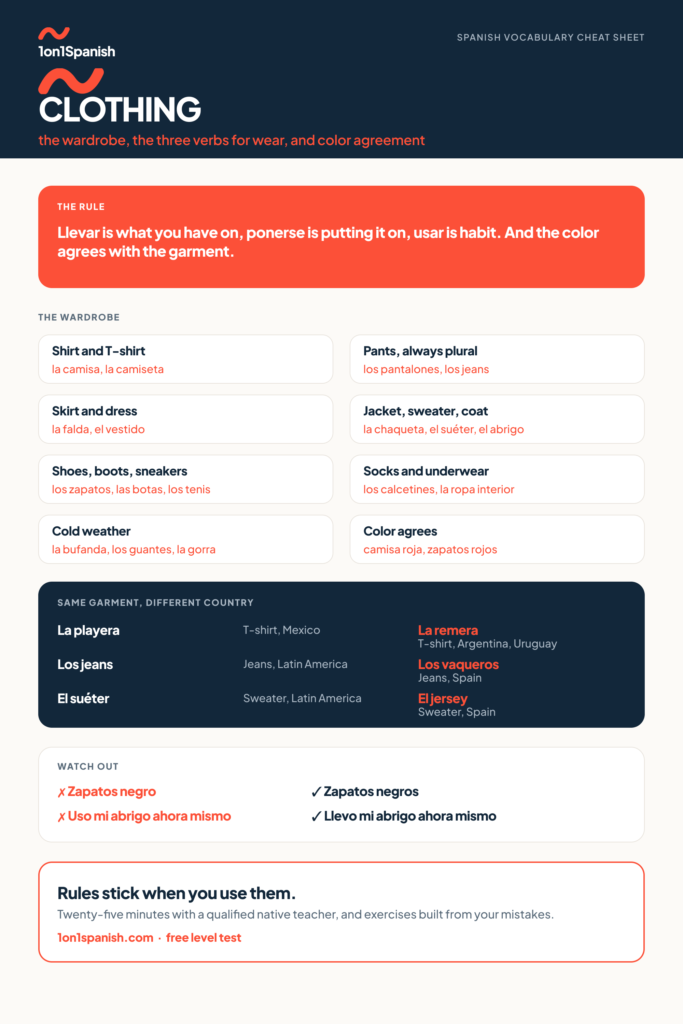
Take the chart with you
The chart is free to view and share. Drop your email and we’ll send the print-ready US Letter PDF — the version you stick on the fridge.
Practice
Practice clothing in Spanish with a real teacher
Charts get you halfway. The other half is saying it out loud to someone who corrects you on the spot. At 1on1Spanish you get 25-minute private lessons with a qualified native teacher, exercises built from the mistakes you make in class, and AI practice between lessons.
First month $1. No contracts, cancel anytime.
Everything on this page is free to use. If you want feedback on your own Spanish, learn Spanish online with us.
Take your free level testBuilt on RingTeacher's method — 700,000+ classes delivered since 2017, teaching English to Spanish speakers. Now in the other direction.
Frequently asked questions
What is the difference between “llevar” and “ponerse” for clothing?
Llevar describes what someone has on at a given moment: lleva una chaqueta (she’s wearing a jacket). Ponerse is reflexive and describes the action of putting something on: me pongo la chaqueta (I put on my jacket). Mixing them up doesn’t usually cause confusion, but it does make a static description sound like an action in progress, or the reverse.
Do colors change form to match clothing in Spanish?
Yes. Color adjectives agree in gender and number with the noun they describe, so camisa roja (feminine singular), vestido rojo (masculine singular) and zapatos rojos (masculine plural) all use different endings for the same color. Colors that don’t end in -o, like azul or verde, only change for plural, not gender.
Is “camiseta” the same word everywhere for T-shirt?
Camiseta is understood everywhere and is the safest default, but Mexico commonly says playera and Argentina and Uruguay say remera for the exact same garment. None is more correct — they’re regional defaults, similar to how a T-shirt is called different things in different English- speaking countries.
What’s the word for jeans in Spanish?
Jeans is widely used and understood as a direct loanword across Latin America. Spain typically says vaqueros, and Puerto Rico often uses mahones. All three refer to the same denim pants, and a Spanish speaker from any region will understand jeans even if it’s not their default word.
How do I know whether to use “medias” or “calcetines” for socks?
Calcetines is the unambiguous, safe word for socks across most of Latin America. Medias also means socks in much of South America, but it can additionally mean stockings, so if precision matters — buying a specific item, for example — calcetines avoids any doubt about which one you mean.