
Days of the week in Spanish: pronunciation and lowercase
The days of the week look like the simplest vocabulary in Spanish, and they trip up English speakers in two small, specific ways: capitalization and pronunciation. Spanish writes days lowercase — lunes, not Lunes — which feels wrong to anyone used to capitalizing Monday in English. And a few of the days have sounds that don’t map onto English letter patterns at all. At 1on1Spanish a qualified native teacher corrects pronunciation live, in every 25-minute one-on-one lesson, which is the one thing a written guide can’t fully replace.
Reviewed by María Jiménez — Licenciada en Filología Hispánica (BA in Hispanic Philology) · Updated Sep 2026
The seven days, with pronunciation
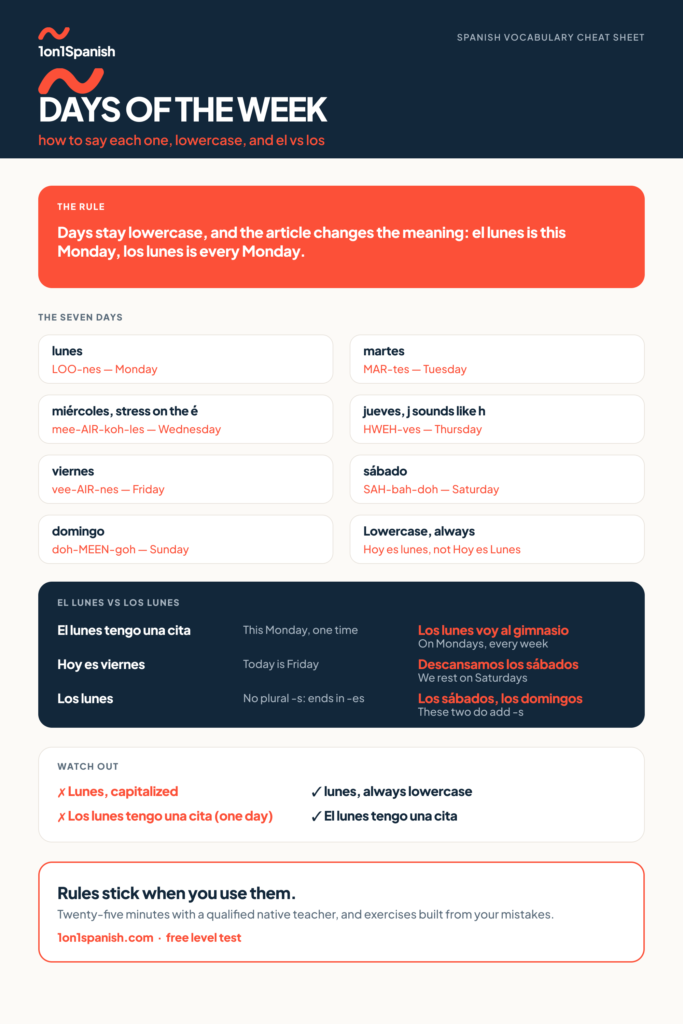
Lunes (LOO-nes) — Monday. Martes (MAR-tes) — Tuesday. Miércoles (mee-AIR-koh-les) — Wednesday, the longest and least intuitive to pronounce, with stress on the first syllable — the written accent on the é puts it there. Jueves (HWEH-ves) — Thursday, where the j sounds like the English “h” in “hello,” not like an English “j.” Viernes (vee-AIR-nes) — Friday. Sábado (SAH-bah-doh) — Saturday, stressed on the first syllable, with a written accent mark to show it. Domingo (doh-MEEN-goh) — Sunday.
The consistent pattern worth knowing: five of the seven days end in -es (lunes, martes, miércoles, jueves, viernes), and only sábado and domingo break that pattern — which also means those five don’t change form for plural (los lunes, not los luneses), while sábado and domingo do (los sábados, los domingos).
Lowercase, always
Unlike English, Spanish does not capitalize the days of the week (or the months) unless they start a sentence. Hoy es lunes (today is Monday), not Hoy es Lunes. This is one of the most common small errors English speakers carry over out of habit, and it’s purely a writing convention — it doesn’t affect pronunciation or meaning at all. The same rule covers the months in Spanish, and the full list of what Spanish does and doesn’t capitalize is in our guide to Spanish capitalization rules.
“El lunes” versus “los lunes”: a real grammar distinction
This is the part that actually changes meaning, not just spelling. El lunes with the singular article means “this Monday” or “on Monday,” referring to one specific day: el lunes tengo una cita (I have an appointment this Monday). Los lunes with the plural article means “on Mondays” in general, a recurring habit: los lunes voy al gimnasio (I go to the gym on Mondays, every week). Dropping the article entirely, as English sometimes does (“Monday I have an appointment”), doesn’t work the same way in Spanish — the article carries real information about whether you mean one day or a pattern. It’s one of the clearest cases of Spanish articles doing real work in a sentence rather than just sitting in front of a noun.
Quick reference
| Spanish | Pronunciation | English |
|---|---|---|
| lunes | LOO-nes | Monday |
| martes | MAR-tes | Tuesday |
| miércoles | mee-AIR-koh-les | Wednesday |
| jueves | HWEH-ves | Thursday |
| viernes | vee-AIR-nes | Friday |
| sábado | SAH-bah-doh | Saturday |
| domingo | doh-MEEN-goh | Sunday |
| el lunes | — | this Monday, on Monday (one time) |
| los lunes | — | on Mondays (every week) |
The ones that don’t work the way you’d expect
The days of the week don’t have regional variants — they’re the same across every Spanish-speaking country. The risk here is entirely about grammar habits carried over from English.
| Pattern | The risk |
|---|---|
| capitalizing days | Writing Lunes with a capital letter is one of the most common small mistakes, purely from English habit — it doesn’t change how the word sounds, only how it looks written |
| el lunes vs. los lunes | Using the wrong article changes the actual meaning: one refers to a single upcoming Monday, the other to every Monday as a routine |
| miércoles stress | The written accent on the é marks the stressed syllable, and it is the first one: MIÉR-co-les, three syllables with the weight up front. Stressing the middle is the common learner error |
Common mistakes English speakers make
Days and months stay lowercase in Spanish unless they open a sentence.
Los lunes implies every Monday, a routine — the wrong article changes the actual meaning of the sentence, not just the grammar.
Written accents in Spanish aren’t decorative — they mark exactly where the spoken stress falls.
Jueves starts with the same sound as “hello,” not the “j” in “juice.”
Take the chart with you
The chart is free to view and share. Drop your email and we’ll send the print-ready US Letter PDF — the version you stick on the fridge.
Practice
Practice the days of the week in Spanish with a real teacher
Charts get you halfway. The other half is saying it out loud to someone who corrects you on the spot. At 1on1Spanish you get 25-minute private lessons with a qualified native teacher, exercises built from the mistakes you make in class, and AI practice between lessons.
First month $1. No contracts, cancel anytime.
These guides are free. When you want someone correcting you out loud, learn Spanish online with a qualified native teacher.
Take your free level testBuilt on RingTeacher's method — 700,000+ classes delivered since 2017, teaching English to Spanish speakers. Now in the other direction.
Frequently asked questions
How do you pronounce “miércoles” in Spanish?
Roughly “mee-AIR-koh-les,” with the stress on the first syllable, MIÉR, marked by the written accent on the é. It’s often the day English speakers stumble on most, since the vowel cluster and the stress pattern don’t map onto any common English word.
Are the days of the week capitalized in Spanish?
No. Unlike English, Spanish writes days of the week — and months — in lowercase, except at the start of a sentence: hoy es lunes (today is Monday). This is a pure writing convention and doesn’t affect how the words are pronounced.
What’s the difference between “el lunes” and “los lunes”?
El lunes (singular article) refers to one specific Monday, usually the upcoming one: el lunes tengo una cita (I have an appointment this Monday). Los lunes (plural article) means every Monday, a routine: los lunes voy al gimnasio (I go to the gym on Mondays). The article isn’t optional — it changes the actual meaning of the sentence.
Why does “jueves” sound different from how it looks?
Spanish j is pronounced like an English “h,” so jueves starts with the same sound as “hello,” not like an English “j.” This is one of the more common pronunciation surprises for English speakers reading Spanish words for the first time.
Do the days of the week change in the plural?
Five of the seven — lunes, martes, miércoles, jueves, viernes — already end in -es and stay identical in the plural: los lunes, not los luneses. Only sábado and domingo add a plural -s: los sábados, los domingos. It’s a small irregularity, but it’s the kind of detail that gives away a learner who memorized the list without ever hearing it used in a real sentence.