
Spanish phrases: the ones you’ll actually need to use
Most Spanish phrasebooks teach you to order in a restaurant and stop there. Real conversation needs more: how to greet a client’s parents, ask someone to slow down, apologize for being late, or get help when you don’t have the word for something. Below are the phrases that show up again and again in daily adult life, grouped by what you’re trying to do, with the formal and informal version marked so you don’t guess wrong with your mother-in-law. 1on1Spanish teaches this register with qualified native teachers in 25-minute lessons.
Reviewed by María Jiménez — Licenciada en Filología Hispánica (BA in Hispanic Philology) · Updated Sep 2026
Greetings and small talk
Hola works anywhere, any time of day. Buenos días covers the morning, buenas tardes the afternoon, buenas noches the evening and night — and buenas noches also means “goodnight,” so context tells you which.
¿Cómo estás? is the informal “how are you,” for friends, coworkers your age, and family. ¿Cómo está usted? is the same question for someone’s boss, a doctor, or your partner’s parents the first few times you meet them. The verb underneath both is estar, not ser — see our ser vs estar guide for why that distinction matters everywhere, not just here. Mucho gusto is “nice to meet you,” used once, the first time you’re introduced. Saying it twice to the same person sounds like you forgot you’d met.
Courtesy that actually gets used
Por favor and gracias work exactly like “please” and “thank you,” but de nada — “you’re welcome” — has a more common alternative in everyday speech: no hay de qué. Both are correct; de nada is what you’ll say most.
Disculpe gets someone’s attention politely: a waiter, a stranger on the street, a coworker you’re interrupting. Perdón is closer to “sorry” — for stepping on someone’s foot, or arriving late. Con permiso is what you say to physically pass by someone in a hallway or a crowded room; Americans often reach for perdón here out of habit, and it works, but con permiso is what a native speaker says first.
Getting help and asking someone to repeat
No entiendo — I don’t understand — is the phrase that unlocks every other phrase on this page, because it tells the other person to adjust. ¿Puede repetir, por favor? asks someone to say it again; ¿Más despacio, por favor? asks them to slow down, which works better than repetition when the problem is speed, not vocabulary. ¿Cómo se dice “…” en español? borrows the English word and asks for the Spanish one — useful mid-sentence when you hit a wall.
Real situations: restaurant, doctor, phone
At a restaurant, Quisiera… — “I would like…” — is softer and more polite than Quiero, “I want,” the same distance as in English. La cuenta, por favor asks for the check.
At a doctor’s office, Me duele… plus the body part covers most of what you need: Me duele la cabeza, me duele el estómago. No tengo seguro — I don’t have insurance — comes up often enough in the United States to be worth memorizing on its own.
On the phone, ¿Aló? or ¿Bueno? answers the call, depending on the country — bueno is Mexican, aló is used almost everywhere else. Un momento, por favor buys you time to find a word or hand the phone to someone else.
Quick reference
| Phrase | Meaning | When to use it |
|---|---|---|
| Hola | Hi | Any time, anyone |
| Buenos días / buenas tardes / buenas noches | Good morning / afternoon / evening | Time-of-day greeting |
| ¿Cómo estás? / ¿Cómo está usted? | How are you? | Informal / formal |
| Mucho gusto | Nice to meet you | First introduction only |
| Por favor | Please | Any request |
| Gracias / de nada | Thank you / you’re welcome | Any exchange |
| Disculpe | Excuse me | Getting someone’s attention |
| Perdón | Sorry | Apologizing |
| Con permiso | Excuse me (passing by) | Moving past someone physically |
| No entiendo | I don’t understand | When you’re lost |
| ¿Puede repetir, por favor? | Can you repeat, please? | Asking someone to say it again |
| ¿Más despacio, por favor? | Slower, please | When speed is the problem |
| Quisiera… | I would like… | Ordering, requesting politely |
| La cuenta, por favor | The check, please | At a restaurant |
| Me duele… | … hurts | At the doctor |
Where formality actually matters
This is where a phrase that works with a friend can land wrong with someone else.
| Situation | The risk |
|---|---|
| Using tú with someone older or in authority | In much of Latin America, usted is expected with a boss, a doctor, or a stranger until they invite you to use tú |
| Skipping por favor | Spanish leans more formal than English in requests; dropping “please” reads ruder than it does in English |
| Perdón vs con permiso | Perdón apologizes; con permiso asks to pass. Mixing them up is understood but marks you as a learner |
| Mucho gusto every time you see someone | It’s a one-time phrase for the first meeting, not a general greeting |
Common mistakes English speakers make
✗ ¿Cómo estás? with a doctor or your boss’s parent. Use ¿Cómo está usted? until they tell you to use tú. Getting this backward isn’t offensive, but it reads careless in a professional setting.
✗ Mucho gusto every time you say hello. It only fits the first introduction. After that, hola or ¿cómo estás? is what a native speaker uses.
✗ Translating “excuse me” as one word for everything. English uses “excuse me” for getting attention, apologizing, and passing by. Spanish splits that into disculpe, perdón and con permiso, and picking the wrong one is the most common giveaway that you learned Spanish from a textbook.
✗ Staying silent when you don’t understand. No entiendo isn’t a failure — it’s the phrase that keeps the conversation going instead of ending it.
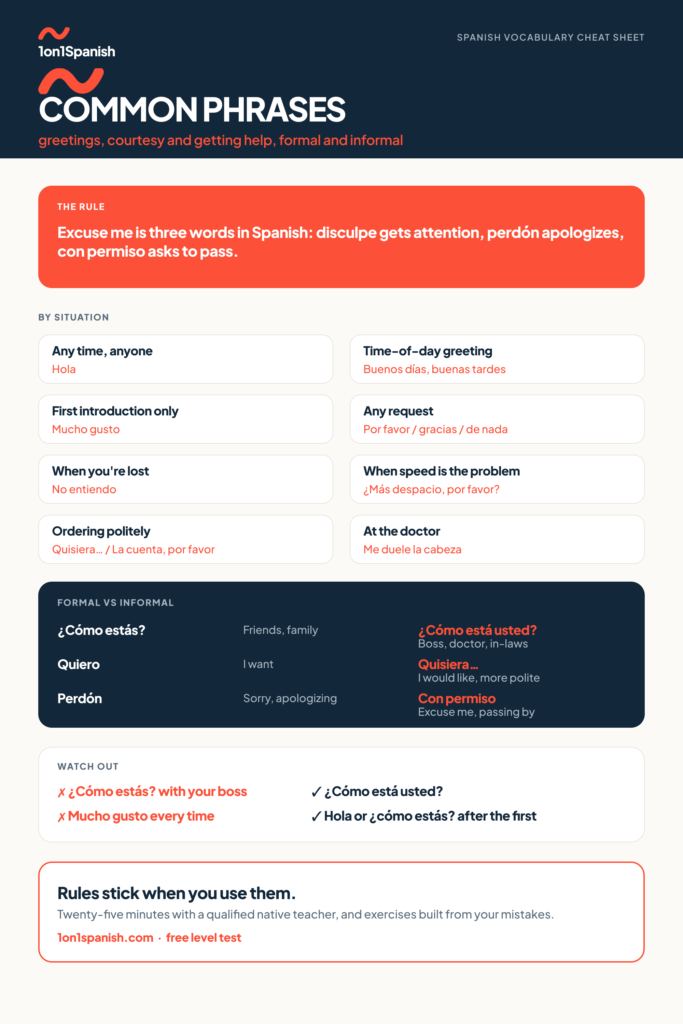
Take the chart with you
The chart is free to view and share. Drop your email and we’ll send the print-ready US Letter PDF — the version you stick on the fridge.
Practice
Practice Spanish phrases with a real teacher
Charts get you halfway. The other half is saying it out loud to someone who corrects you on the spot. At 1on1Spanish you get 25-minute private lessons with a qualified native teacher, exercises built from the mistakes you make in class, and AI practice between lessons.
First month $1. No contracts, cancel anytime.
You can go further with someone listening: Learn Spanish with 1on1Spanish, 25 minutes at a time.
Take your free level testBuilt on RingTeacher's method — 700,000+ classes delivered since 2017, teaching English to Spanish speakers. Now in the other direction.
Frequently asked questions
What are the most common Spanish phrases to learn first?
Start with hola, por favor, gracias, disculpe, and no entiendo. Those five get you through a greeting, a request, a thank-you, getting someone’s attention, and admitting you’re lost — which covers more real situations than a long list of phrases you’ll rarely use in your first months of speaking.
When do I use tú instead of usted?
Tú is for friends, family, coworkers your age, and children. Usted is for people older than you, people in authority — a boss, a doctor, a police officer — and anyone you’ve just met in a professional setting. When in doubt, start with usted; a native speaker will usually invite you to switch to tú if they’d rather.
What’s the difference between disculpe, perdón, and con permiso?
Disculpe politely gets someone’s attention, like a waiter’s. Perdón apologizes, for something like arriving late. Con permiso asks to physically pass by someone. English collapses all three into “excuse me,” which is exactly why English speakers mix them up — Spanish keeps them separate on purpose.
How do I ask someone to speak more slowly in Spanish?
¿Más despacio, por favor? — slower, please. It works better than asking someone to repeat when the real problem is speed, not vocabulary you don’t know. Pair it with no entiendo if you also need the sentence rephrased, not just slowed down.
Is mucho gusto used every time you greet someone?
No — only the first time you’re introduced to a person. After that, native speakers use hola or ¿cómo estás? instead. Saying mucho gusto again to someone you’ve already met sounds like you don’t remember meeting them, which is the opposite of the polite impression the phrase is supposed to make. Save it for genuine first introductions, whether that’s a coworker, a client, or your partner’s family.