
Hobbies in Spanish: vocabulary and how to talk about them
“What do you like to do for fun?” is one of the first real conversations you’ll have in Spanish, at a dinner, a first date, a work happy hour. The vocabulary is straightforward. The grammar around it trips up almost every English speaker in the exact same way, because English says “I like reading” with a gerund and Spanish insists on the infinitive: me gusta leer, never me gusta leyendo. At 1on1Spanish you build this into muscle memory with a qualified native teacher in every 25-minute one-on-one lesson.
Reviewed by María Jiménez — Licenciada en Filología Hispánica (BA in Hispanic Philology) · Updated Sep 2026
Everyday hobbies
Leer is to read, cocinar to cook, bailar to dance, cantar to sing, pintar to paint, dibujar to draw, escribir to write, jardinería gardening — a noun, unlike most of the others, so it pairs differently: me gusta la jardinería, not me gusta jardinería. Pescar is to fish, acampar to camp, coser to sew, tejer to knit, coleccionar to collect (stamps, coins — coleccionar estampillas). Ver películas is to watch movies, escuchar música to listen to music, tocar un instrumento to play an instrument — note tocar, not jugar, for instruments, the same way sports split their verbs.
The construction: me gusta + infinitive
This is the piece that decides whether you sound natural. Gustar works backwards from how English “like” works: the thing you like is the grammatical subject, and you are the indirect object. Me gusta leer is literally “reading pleases me.” When what follows is a verb — an activity, not a thing — Spanish always uses the infinitive, never the -ando/-iendo gerund form English speakers instinctively reach for. Me gusta leer (I like reading/to read), me gusta cocinar (I like cooking/to cook). If you like more than one activity in the same sentence, every verb stays infinitive: me gusta leer y cocinar, not leyendo y cocinando.
When the thing you like is a noun instead of an activity, the verb agrees with that noun: me gusta la jardinería (singular), but me gustan los deportes (plural) — this is the same agreement pattern that shows up with gustar and similar verbs across the whole site, not something unique to hobbies.
Talking about how often and how much
A veces (sometimes), los fines de semana (on weekends), en mi tiempo libre (in my free time) set the scene. Me encanta (“I love it,” stronger than me gusta) and me fascina (“it fascinates me”) let you show real enthusiasm. Soy aficionado/aficionada a (I’m a fan of, I’m into) works well for a more serious hobby: soy aficionado a la fotografía.
Quick reference
| English | Spanish | Example |
|---|---|---|
| to read | leer | Me gusta leer. |
| to cook | cocinar | Me gusta cocinar los domingos. |
| to dance | bailar | Nos gusta bailar salsa. |
| to sing | cantar | Le gusta cantar en la ducha. |
| to paint | pintar | Me gusta pintar paisajes. |
| to draw | dibujar | Le gusta dibujar. |
| gardening | la jardinería | Me gusta la jardinería. |
| to fish | pescar | Mi papá pesca los sábados. |
| to camp | acampar | Nos gusta acampar en verano. |
| to sew | coser | Mi abuela sabe coser. |
| to knit | tejer | Aprendí a tejer este año. |
| to collect | coleccionar | Colecciono monedas antiguas. |
| to watch movies | ver películas | Me gusta ver películas de terror. |
| to listen to music | escuchar música | Escucho música mientras trabajo. |
| to play an instrument | tocar un instrumento | Toca la guitarra. |
| photography | la fotografía | Soy aficionado a la fotografía. |
| to travel | viajar | Nos encanta viajar. |
| hiking | el senderismo | Practico senderismo los fines de semana. |
Where this actually goes wrong out loud
The gerund mistake is so consistent it’s almost predictable — and it’s the single most common grammar error tied to this topic.
| Pattern | The risk |
|---|---|
| me gusta + gerund | Me gusta leyendo is a direct, word-for-word translation of “I like reading” and it’s simply not correct Spanish. The infinitive is mandatory here: me gusta leer |
| gustar agreement with plural hobbies | Me gusta los deportes is a common slip — with a plural noun, the verb has to be plural too: me gustan los deportes. This is easy to miss because the sentence still sounds fine mid-conversation |
| tocar vs jugar with instruments | Using jugar with a musical instrument (juego guitarra) crosses signals with the sports verb pattern; instruments always take tocar |
| gustar vs encantar strength | Me gusta is a mild, everyday “I like it.” Me encanta is stronger, closer to “I love it.” Using me encanta for something only mildly enjoyable can come across as overstated |
Common mistakes English speakers make
Infinitive, never gerund, after me gusta.
The verb agrees with the plural noun.
Instruments take tocar, not jugar.
Jardinería pairs naturally with gustar, not practicar, since it’s more a pastime than a trained physical activity.
Me gusta leyendo, cocinando y bailando should be me gusta leer, cocinar y bailar.
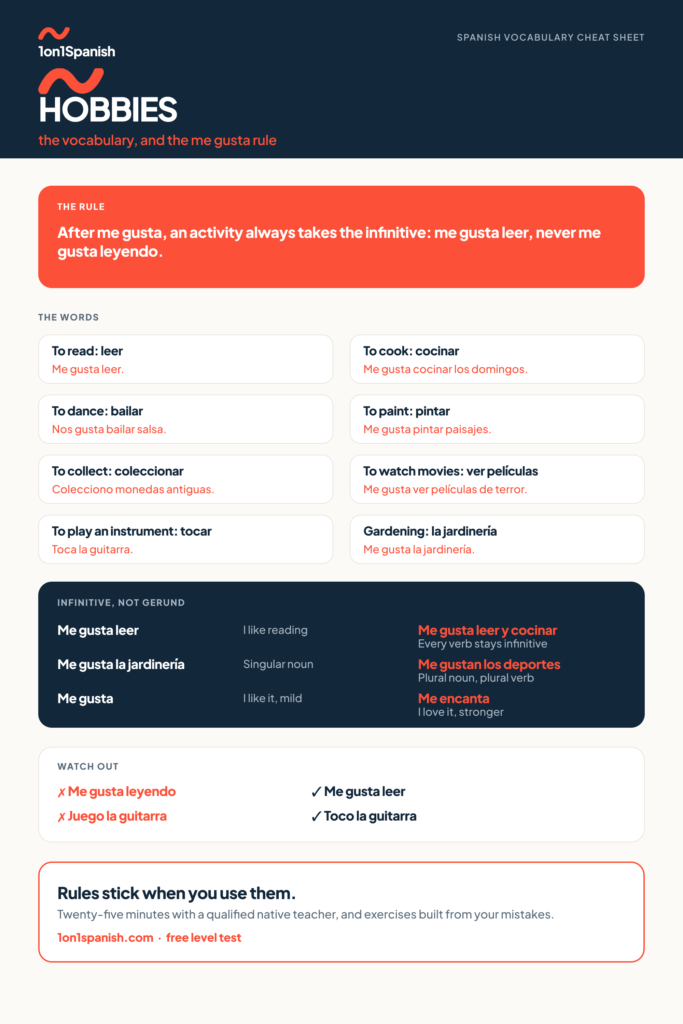
Take the chart with you
The chart is free to view and share. Drop your email and we’ll send the print-ready US Letter PDF — the version you stick on the fridge.
Practice
Practice hobbies in Spanish with a real teacher
Charts get you halfway. The other half is saying it out loud to someone who corrects you on the spot. At 1on1Spanish you get 25-minute private lessons with a qualified native teacher, exercises built from the mistakes you make in class, and AI practice between lessons.
First month $1. No contracts, cancel anytime.
The fastest way to make this stick is to say it to someone. Learn Spanish online with a real teacher.
Take your free level testBuilt on RingTeacher's method — 700,000+ classes delivered since 2017, teaching English to Spanish speakers. Now in the other direction.
Frequently asked questions
How do you say “I like reading” in Spanish?
Me gusta leer. Spanish uses the infinitive after me gusta, never the -ando/-iendo gerund that English’s “-ing” form pulls you toward. Me gusta leyendo is a common, understandable mistake, but it’s not correct — the rule is strict here: any activity after gustar stays in the infinitive, even when you’re listing several: me gusta leer y cocinar.
Why does gustar work backwards from “like” in English?
Because grammatically, the thing you like is the subject of the sentence, and you’re the indirect object receiving the feeling — me gusta leer literally translates to “reading pleases me.” This is why the verb changes form depending on what follows: singular for one thing (me gusta el libro), plural for more than one (me gustan los libros), and infinitive, always, for an activity.
What’s the difference between gustar and encantar for hobbies?
Me gusta is the everyday, moderate “I like it.” Me encanta is stronger, closer to “I love it” or “I’m really into it.” Both follow the same grammar pattern — infinitive for activities, subject agreement for nouns — so the only real difference is intensity, not structure.
What verb do you use for playing an instrument in Spanish?
Tocar, not jugar. Toco la guitarra, toca el piano, tocamos batería los fines de semana. This is a separate pattern from sports, which mostly use jugar, and it’s worth learning as its own rule rather than assuming instruments follow the sports pattern — the two verbs never overlap, so once you’ve internalized it, there’s no ambiguity left to guess at.
How do you list multiple hobbies in one Spanish sentence?
Keep every verb in the infinitive after me gusta: me gusta leer, cocinar y bailar — I like reading, cooking and dancing. English speakers often shift to gerunds partway through a list because that’s the natural instinct in English; in Spanish, every item in the list stays infinitive, all the way through.