
Transportation vocabulary in Spanish: tomar, not coger
Getting around in Spanish means two things at once: knowing the right word for the vehicle, and knowing which verb to use to say you’re getting on it — because one very common English-to-Spanish translation is vulgar across most of Latin America. At 1on1Spanish we practice real transportation conversations with qualified native teachers in 25-minute one-on-one lessons.
Reviewed by María Jiménez — Licenciada en Filología Hispánica (BA in Hispanic Philology) · Updated Sep 2026
Tomar the bus, not coger it
In Spain, coger is the completely normal verb for “to take” or “to catch” — coger el autobús is standard, everyday Spanish. In Mexico and almost all of Latin America, coger is vulgar slang for sex, and using it to mean “take the bus” gets you a reaction you didn’t intend, even said with complete innocence.
The safe, standard verb across the region — and the one taught here — is tomar: tomo el autobús (I take the bus), vamos a tomar un taxi (we’re going to take a taxi). Agarrar also works as a casual alternative in some countries. If you learn Spanish from material that uses coger casually, know that it’s a Spain-first choice — switch to tomar the moment you’re speaking with someone from Latin America.
Bus: the word that changes across almost every country
This is the vocabulary item that most clearly shows how one everyday word splits by region. El autobús is the neutral, understood-everywhere term, but it’s rarely the word people actually reach for in casual speech. El camión is the everyday word for bus in Mexico — confusingly, the same word also means “truck” elsewhere, so context decides which one’s meant.
La guagua is the word across the Caribbean — Cuba, Puerto Rico, Dominican Republic (and, as an unrelated coincidence, guagua also means “baby” in Chile, so the same word carries two totally different meanings depending on the country). El colectivo is used in Argentina and parts of the Andes, often for a smaller shared van or minibus route. El bus is a simplified, widely understood option that works as a safe default almost anywhere.
For a US audience, where the largest Hispanic community is of Mexican origin, camión is the word you’ll hear most in daily conversation — but el bus and el autobús will always be understood if you’re not sure which regional term applies.
Other ways to get around
El carro (car — the Latin American default; el coche is more common in Spain), el taxi (taxi), el metro (subway), el tren (train), la bicicleta or la bici (bicycle), a pie (on foot, walking) — voy a pie (I’m walking there), manejar (to drive — the Latin American term; conducir is more common in Spain), estacionar (to park), el estacionamiento (parking lot).
Quick reference
| English | Spanish | Note |
|---|---|---|
| to take/catch (transportation) | tomar | not coger outside Spain |
| bus (neutral) | el autobús / el bus | understood everywhere |
| bus (Mexico) | el camión | also means “truck” |
| bus (Caribbean) | la guagua | also means “baby” in Chile |
| bus (Argentina, Andes) | el colectivo | often a smaller shared van |
| car | el carro | el coche in Spain |
| to drive | manejar | conducir in Spain |
| subway | el metro | |
| train | el tren | |
| on foot | a pie |
The ones that don’t work the way you’d expect
| Detail | What trips people up |
|---|---|
| coger | Standard in Spain, vulgar (sexual slang) in Mexico and most of Latin America |
| camión | Means “bus” in Mexico, but “truck” in most other Spanish-speaking countries |
| guagua | Means “bus” in the Caribbean, but “baby” in Chile — same word, unrelated meanings |
| carro vs coche | Both mean “car”; carro is the Latin American default, coche the Spain default |
| colectivo | In Argentina it’s shared transportation, similar to a minibus, not a private car |
Common mistakes English speakers make
Coger is completely innocent in Spain and vulgar across Latin America — a real risk, not just a style preference.
Context and country decide which meaning applies.
Same word, two unrelated meanings by region.
Both are understood, but carro is the safer default for a Mexican-first audience.
Conducir is understood everywhere but leans more toward Spain in everyday speech.
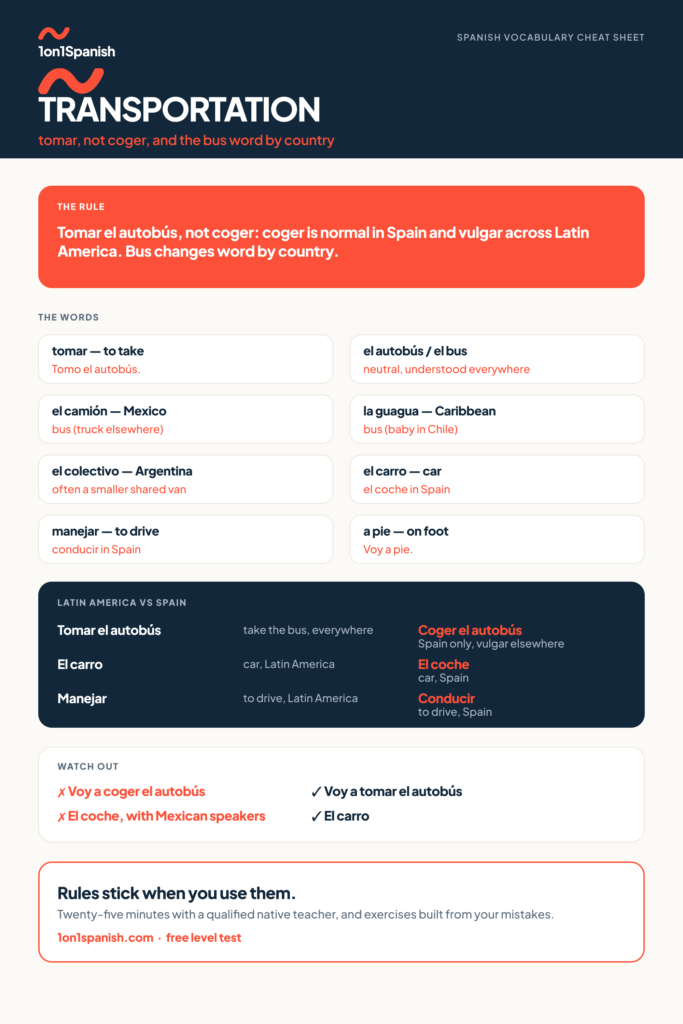
Take the chart with you
The chart is free to view and share. Drop your email and we’ll send the print-ready US Letter PDF — the version you stick on the fridge.
Practice
Practice transportation vocabulary in Spanish with a real teacher
Charts get you halfway. The other half is saying it out loud to someone who corrects you on the spot. At 1on1Spanish you get 25-minute private lessons with a qualified native teacher, exercises built from the mistakes you make in class, and AI practice between lessons.
First month $1. No contracts, cancel anytime.
Grammar you can read. Speaking you cannot. Learn Spanish online and practice it live.
Take your free level testBuilt on RingTeacher's method — 700,000+ classes delivered since 2017, teaching English to Spanish speakers. Now in the other direction.
Frequently asked questions
Should I use coger or tomar for “to take the bus” in Spanish?
Tomar, if you’re speaking with anyone from Mexico or most of Latin America. Coger is completely standard in Spain for “to take” or “to catch,” but it’s vulgar slang across almost all of Latin America. Tomar el autobús is the safe, region-appropriate choice for a US audience, where the largest Hispanic population is of Mexican origin.
What is the word for “bus” in Spanish?
It depends on the country. El autobús and el bus are neutral and understood everywhere. In Mexico, the everyday word is el camión — which confusingly also means “truck.” In the Caribbean (Cuba, Puerto Rico, Dominican Republic), it’s la guagua. In Argentina and parts of the Andes, el colectivo often refers to a smaller shared bus or van route.
Does camión always mean truck in Spanish?
No — in Mexico, camión is the everyday word for a city bus, not a truck. In most other Spanish-speaking countries, camión does mean truck, and the vehicle Mexicans call a camión would be called an autobús or a regional equivalent elsewhere. Context and country both matter for this word.
What’s the difference between carro and coche?
Both mean “car,” and both are understood across the Spanish-speaking world. Carro is the default word in Mexico and most of Latin America; coche is the default in Spain. Neither is more correct — the choice mostly signals where the speaker (or the material they learned from) is from.
Is guagua a safe word to use for “bus”?
It depends entirely on the country. In the Caribbean — Cuba, Puerto Rico, the Dominican Republic — guagua is the normal, everyday word for bus. In Chile, the same word unexpectedly means “baby,” with no connection to transportation at all. Outside a Caribbean context, autobús or bus is a safer, more universally understood choice.