
Tomar conjugation in Spanish: every tense you need, with examples
Tomar is a fully regular -ar verb, so the nine tables below hold no surprises. What does take some getting used to is how much this one verb covers: tomar café, tomar el autobús, tomar una decisión, tomar clases, all with the same word. It’s also the safer, neutral choice across most of Latin America for “to take” or “to grab”, where its rival coger is vulgar slang in several countries even though it’s completely normal in Spain. 1on1Spanish teaches this in 25-minute one-on-one lessons with qualified native teachers, online across the United States.
Reviewed by María Jiménez — Licenciada en Filología Hispánica (BA in Hispanic Philology) · Updated Sep 2026
What tomar means
Tomar starts with drinking: tomar café, tomar agua, tomar una cerveza. From there it extends to taking transportation — tomar el metro, tomar un taxi — and to taking something in a more abstract sense: tomar una decisión (to make a decision), tomar en cuenta (to take into account), tomar un descanso (to take a break). The drinks themselves, jugo, refresco, cerveza, are in our Spanish food and drink words, and the nouns that ride with tomar el metro, el camión in Mexico, el colectivo in Argentina, are in the transportation vocabulary list.
It’s also the word most of Latin America uses for the plain physical “to take” or “to grab”, the job coger does in Spain. In Mexico, Argentina, and much of Central America, coger is vulgar slang — worth knowing before you use it out of habit from a textbook written for Spain.
Grammatically it’s fully regular: standard -ar endings throughout, no stem change, no spelling change. Participle tomado, gerund tomando.
Tomar conjugation: present tense
Fully regular. No irregular forms in this table.
| Form | Example | |
|---|---|---|
| yo | tomo | Tomo café todas las mañanas. (I drink coffee every morning.) |
| tú | tomas | ¿Tomas el metro para ir al trabajo? (Do you take the subway to work?) |
| él / ella / usted | toma | Mi papá toma su medicina a las ocho. (My dad takes his medicine at eight.) |
| nosotros | tomamos | Tomamos la decisión juntos. (We made the decision together.) |
| vosotros | tomáis | ¿Tomáis clases los fines de semana? (Do you take classes on weekends?) |
| ellos / ellas / ustedes | toman | Mis colegas toman el mismo tren cada día. (My coworkers take the same train every day.) |
Tomar conjugation: preterite
Regular -ar endings, no spelling change.
| Form | |
|---|---|
| yo | tomé |
| tú | tomaste |
| él / ella / usted | tomó |
| nosotros | tomamos |
| vosotros | tomasteis |
| ellos / ellas / ustedes | tomaron |
Tomé la decisión de renunciar el viernes pasado. — I made the decision to quit last Friday.
Tomar conjugation: imperfect
Fully regular.
| Form | |
|---|---|
| yo | tomaba |
| tú | tomabas |
| él / ella / usted | tomaba |
| nosotros | tomábamos |
| vosotros | tomabais |
| ellos / ellas / ustedes | tomaban |
Antes tomaba el autobús a las siete, ahora manejo. — I used to take the bus at seven, now I drive.
Tomar conjugation: future
Regular endings on the infinitive.
| Form | |
|---|---|
| yo | tomaré |
| tú | tomarás |
| él / ella / usted | tomará |
| nosotros | tomaremos |
| vosotros | tomaréis |
| ellos / ellas / ustedes | tomarán |
Tomaremos esa decisión la próxima semana. — We’ll make that decision next week.
Tomar conjugation: conditional
| Form | |
|---|---|
| yo | tomaría |
| tú | tomarías |
| él / ella / usted | tomaría |
| nosotros | tomaríamos |
| vosotros | tomaríais |
| ellos / ellas / ustedes | tomarían |
Yo tomaría el vuelo directo, aunque cueste más. — I’d take the direct flight, even if it costs more.
Tomar conjugation: present subjunctive
Built on the tomo stem, fully regular.
| Form | |
|---|---|
| yo | tome |
| tú | tomes |
| él / ella / usted | tome |
| nosotros | tomemos |
| vosotros | toméis |
| ellos / ellas / ustedes | tomen |
Recomiendo que tomes más agua durante el día. — I recommend you drink more water during the day.
Tomar conjugation: imperfect subjunctive
Built on the preterite stem tomaron-.
| Form (-ra) | Form (-se) | |
|---|---|---|
| yo | tomara | tomase |
| tú | tomaras | tomases |
| él / ella / usted | tomara | tomase |
| nosotros | tomáramos | tomásemos |
| vosotros | tomarais | tomaseis |
| ellos / ellas / ustedes | tomaran | tomasen |
Si tomara esa oferta de trabajo, tendría que mudarme. — If I took that job offer, I’d have to move.
Tomar commands (imperative)
| Affirmative | Negative | |
|---|---|---|
| tú | toma | no tomes |
| usted | tome | no tome |
| nosotros | tomemos | no tomemos |
| vosotros | tomad | no toméis |
| ustedes | tomen | no tomen |
Tome asiento, por favor. — Please have a seat. One of the most common formal commands with this verb, heard in waiting rooms and offices everywhere.
Participle, gerund and compound tenses
Participle tomado, gerund tomando. Both regular. Compounds take haber:
He tomado esa clase dos veces (present perfect) · Ya había tomado la decisión antes de hablar contigo (past perfect) · Para entonces habré tomado el examen (future perfect).
When to use tomar
Drinking
Tomo café por la mañana, nunca por la tarde. The everyday, default meaning, and the first one most learners memorize.
Taking transportation
Tomamos el metro para llegar al centro. Used across Latin America for buses, trains, taxis and flights alike.
Making a decision
Tomé la decisión de cambiar de trabajo. This fixed phrase, tomar una decisión, is far more common than any single-word verb for “to decide”.
Taking a class or a break
Voy a tomar un curso de contabilidad. Tómate un descanso, lo necesitas. Reflexive tomarse softens the command into a suggestion, common between friends.
Tomar vs coger
Both can mean “to take” or “to grab” for a physical object, and the choice depends entirely on where you are, not on grammar.
| Tomar | Coger |
|---|---|
| Neutral everywhere in Spanish | Neutral in Spain, vulgar slang in Mexico, Argentina and much of Central America |
| Voy a tomar un taxi | Voy a coger un taxi (fine in Madrid, awkward in Mexico City) |
| Safe default for learners in the United States | Best avoided until you know the region you’re speaking to |
If you’re not sure which country your listener is from, tomar is always the safer word — it never sounds wrong, while coger sometimes does.
Common mistakes English speakers make with tomar
Decisión is feminine, so the article and any modifier need to agree — una decisión, not un decisión.
Coger is correct in Spain, but sounds vulgar to most Mexican and Central American ears. Tomar works everywhere.
After recomiendo que, the verb needs the subjunctive: tomes, not tomas.
The purpose needs para plus an infinitive; you can’t just stack “trabajo” onto the end the way English allows with “to work”.
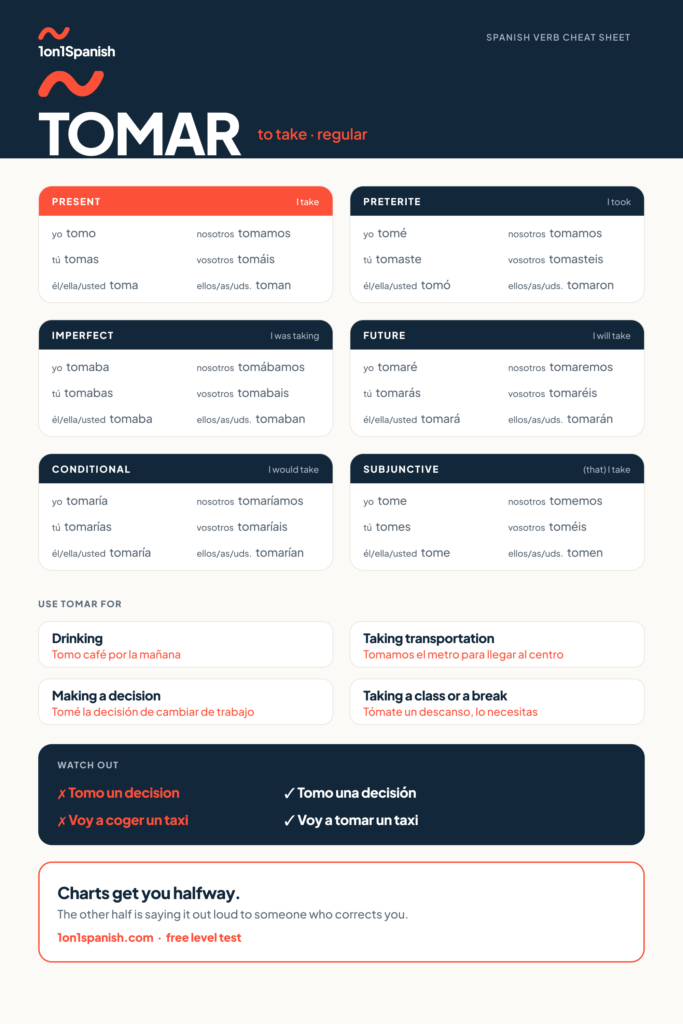
Take the chart with you
The chart is free to view and share. Drop your email and we’ll send the print-ready US Letter PDF — the version you stick on the fridge.
Practice
Practice tomar with a real teacher
Charts get you halfway. The other half is saying it out loud to someone who corrects you on the spot. At 1on1Spanish you get 25-minute private lessons with a qualified native teacher, exercises built from the mistakes you make in class, and AI practice between lessons.
First month $1. No contracts, cancel anytime.
Prefer to practice with a person? Take one-on-one Spanish lessons online with a qualified native teacher.
Take your free level testBuilt on RingTeacher's method — 700,000+ classes delivered since 2017, teaching English to Spanish speakers. Now in the other direction.
Frequently asked questions
Is tomar regular or irregular in Spanish?
Fully regular. Every tense above — present, preterite, imperfect, future, conditional and both subjunctives — follows the standard -ar pattern with no stem change and no spelling change. The difficulty with tomar is entirely in how many things it means, not in how it conjugates.
Is it rude to say coger instead of tomar?
It depends on the country. In Spain, coger is completely neutral and means “to take” or “to grab” with no other connotation. In Mexico, Argentina and much of Central America, coger is vulgar slang, so tomar (or agarrar) is the safer, standard choice. For learners in the United States, where most Spanish speakers trace back to Latin America, tomar is the word to default to.
How do you say “to make a decision” in Spanish?
Tomar una decisión is the standard phrase — literally “to take a decision” — and it’s used far more often than a single verb for “to decide”. Tomé la decisión de mudarme is I made the decision to move. Decidir also exists and means the same thing, but tomar una decisión is what you’ll hear most in everyday conversation.
What is the past tense of tomar in Spanish?
Two forms, depending on the action. The preterite — tomé, tomaste, tomó, tomamos, tomasteis, tomaron — is for a single completed act: tomé la decisión ayer. The imperfect — tomaba, tomabas, tomaba, tomábamos, tomabais, tomaban — is for a repeated habit: tomaba el autobús todos los días.
Do I need the subjunctive of tomar in everyday conversation?
Yes, especially with recommendations and wishes. Tome appears after recomiendo que (recomiendo que tomes más agua), after espero que (espero que tomen la decisión correcta), and after es importante que (es importante que tome sus medicinas). It’s common in health, work and daily advice.