
Spanish comparatives and superlatives: how to say more, less and the most
Spanish compares with three fixed frames — más + adjective + que for more, menos + adjective + que for less, and tan + adjective + como for the same — and builds the superlative with el / la / los / las + más (or menos) + adjective + de. English hides most of this inside the endings -er and -est, so the words feel like extra machinery until you notice the frames never change. 1on1Spanish teaches this in 25-minute one-on-one lessons with qualified native teachers, online across the United States.
Reviewed by María Jiménez — Licenciada en Filología Hispánica (BA in Hispanic Philology) · Updated Sep 2026
More and less: más… que, menos… que
Everything you compare — an adjective, an adverb or a noun — sits between más or menos and que.
Mi apartamento es más caro que el tuyo. Habla más despacio que su hermano. Tengo menos vacaciones que el año pasado. The verb before the frame is usually ser, and it agrees with the first element, not with the thing you compare it to. If you need the forms of that verb, the ser conjugation chart has every tense on one page.
One switch matters: before a number, Spanish uses de, not que. Trabajo más de cuarenta horas a la semana. La factura fue menos de doscientos dólares. Say más que cuarenta and a native speaker will hear a broken sentence, not an accent.
The same amount: tan… como and tanto… como
Equality has two frames, and which one you use depends on what follows.
With an adjective or an adverb, it’s tan… como: Mi carro es tan viejo como el tuyo. Llegué tan pronto como pude. With a noun, it’s tanto… como, and tanto agrees with that noun: No tengo tanto tiempo como antes, Hay tantas reuniones como el mes pasado.
A bare verb keeps tanto fixed: Duermo tanto como tú.
The four irregulars: mejor, peor, mayor, menor
Four adjectives refuse the más frame and carry the comparison inside the word: mejor (better), peor (worse), mayor (older, greater) and menor (younger, lesser). They have one form for both genders and add -es in the plural.
Este hospital es mejor que el otro. Mis notas fueron peores este semestre. Mi hermana es mayor que yo.
Más bueno and más malo do exist, but they talk about character rather than quality: Es más bueno que el pan is a fixed compliment about kindness. And mayor / menor cover age, not size — for physical size you say más grande and más pequeño. Mi hermano mayor is my older brother; mi hermano más grande would be the bigger one, which is a different fact.
The superlative: el más… de and the -ísimo ending
Spanish has two superlatives that do different jobs.
The relative superlative ranks something inside a group: article + más or menos + adjective + de. Es el restaurante más caro de la ciudad. Fue la peor semana del año. The group takes de, never en. It’s the single most common error on this page.
The absolute superlative doesn’t rank anything; it just turns the volume up, and it’s built with -ísimo: carísimo, facilísimo, cansadísima. Drop the final vowel and add the ending, with three spelling adjustments: c becomes qu (rico → riquísimo), g becomes gu (largo → larguísimo), z becomes c (feliz → felicísimo).
An -ísimo word is still an adjective, so it follows the usual agreement rules for adjectives: carísimo, carísima, carísimos, carísimas.
-ísimo is not formal or bookish. It’s what you’ll hear in a kitchen and in a work call.
Reference chart
| What you mean | Frame | Example | English |
|---|---|---|---|
| More than | más + adj + que | Es más rápido que el tren. | It’s faster than the train. |
| Less than | menos + adj + que | Estoy menos cansado que ayer. | I’m less tired than yesterday. |
| More than + number | más de + number | Pagué más de cien dólares. | I paid more than a hundred dollars. |
| As… as (adjective) | tan + adj + como | Es tan alta como su padre. | She’s as tall as her father. |
| As much / many as (noun) | tanto/-a/-os/-as + noun + como | Tengo tantos correos como tú. | I have as many emails as you. |
| As much as (verb) | verb + tanto como | Viaja tanto como yo. | He travels as much as I do. |
| Better / worse | mejor / peor + que | Este café es mejor que ese. | This coffee is better than that one. |
| Older / younger | mayor / menor + que | Soy menor que mi jefe. | I’m younger than my boss. |
| The most… in a group | el/la + más + adj + de | Es la tienda más pequeña de la zona. | It’s the smallest store in the area. |
| Extremely… | adj + -ísimo | La reunión fue larguísima. | The meeting was extremely long. |
The pairs that change the sentence
Small swaps here don’t sound clumsy — they say something else.
| Sentence | What it means |
|---|---|
| No tengo más de veinte dólares. | I have twenty at most. |
| No tengo más que veinte dólares. | I have only twenty. |
| Mi hermano mayor. | My older brother. |
| Mi hermano más grande. | My bigger brother (size). |
| Es muy bueno. | He’s very good. |
| Es el mejor. | He’s the best. |
| Es más bueno que el pan. | He’s incredibly kind. |
| Es mejor que el pan. | It’s better than bread (a comparison of quality). |
| Está buenísimo. | It tastes great. |
| Es buenísimo. | He’s extremely good at it. |
Common mistakes English speakers make
Mejor already contains the comparison. Stacking más on top is the Spanish version of “more better”, and it lands the same way.
English uses “as… as” and “so… that” with the same first word, so que slips in. The equality frame always closes with como.
Numbers take de. There’s no English trigger for this, which is why it survives for years.
English says “in the city”; Spanish frames the group with de. Translating the preposition is what breaks it.
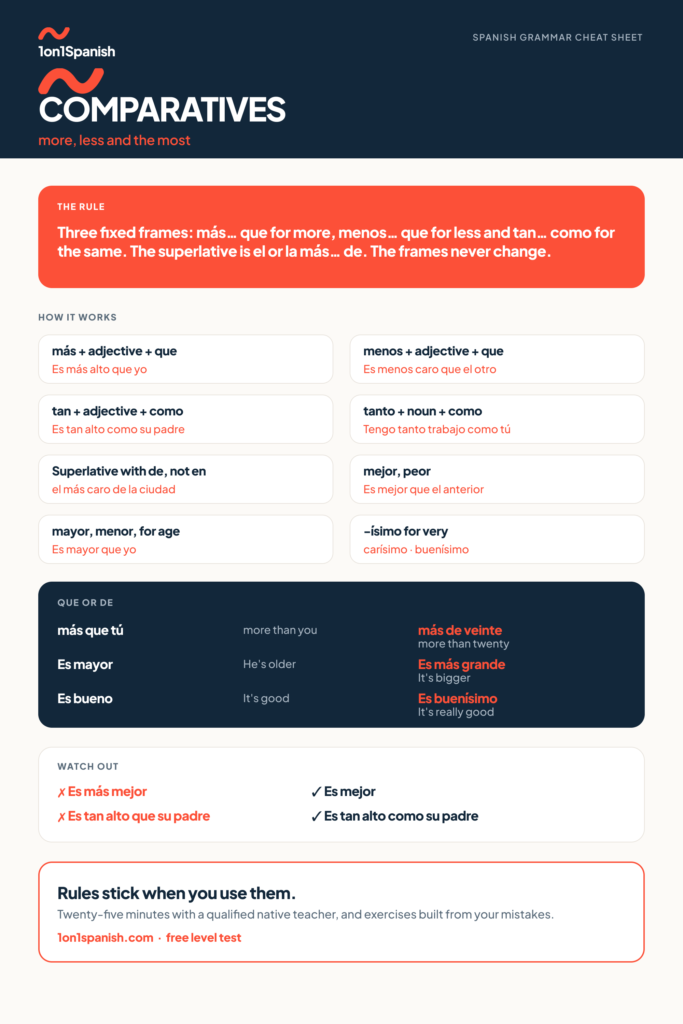
Take the chart with you
The chart is free to view and share. Drop your email and we’ll send the print-ready US Letter PDF — the version you stick on the fridge.
Practice
Practice comparatives and superlatives with a real teacher
Charts get you halfway. The other half is saying it out loud to someone who corrects you on the spot. At 1on1Spanish you get 25-minute private lessons with a qualified native teacher, exercises built from the mistakes you make in class, and AI practice between lessons.
First month $1. No contracts, cancel anytime.
Want a teacher listening while you practice? Learn Spanish online with us, one lesson at a time.
Take your free level testBuilt on RingTeacher's method — 700,000+ classes delivered since 2017, teaching English to Spanish speakers. Now in the other direction.
Frequently asked questions
When do you use más de instead of más que in Spanish?
Use más de before a number or a quantity: más de veinte personas, menos de una hora. Use más que before anything you’re comparing against — a noun, a pronoun or a clause: más caro que el otro, trabaja más que yo. The exception is no… más que, which means “only”: No tengo más que diez dólares is “I only have ten”.
What’s the easiest way to remember tan and tanto?
Look at the word right after it. If it’s an adjective or an adverb, use tan: tan alto como, tan rápido como. If it’s a noun, use tanto and make it agree: tanto trabajo, tanta gente, tantos correos, tantas horas. If nothing follows except the comparison itself, tanto stays fixed: Trabajo tanto como tú.
Are mayor and menor only about age?
Age is the everyday use, and the safest one: mi hermana mayor, mi hijo menor. Beyond that, mayor and menor also mean greater and lesser in fixed or formal contexts: la mayor parte, en menor medida, mayor de edad. For physical size in normal conversation, Spanish speakers say más grande and más pequeño, not mayor and menor.
Do native speakers actually use the -ísimo ending?
Constantly, and in ordinary speech rather than in writing. Carísimo, buenísimo, facilísimo and cansadísimo are everyday words in Mexico, Colombia, Spain and everywhere else. It reads as emphatic, not old-fashioned. The only care it needs is spelling: rico becomes riquísimo, largo becomes larguísimo, feliz becomes felicísimo.
What’s the most common mistake with Spanish comparatives?
Saying más mejor or más peor. English speakers build “more expensive” and “better” the same way mentally, so más gets attached to a word that already carries the comparison. The fix is a short list: mejor, peor, mayor and menor never take más. Everything else does.