
Spanish transition words: how to link your sentences
You can know every verb tense and still sound choppy in Spanish, because tenses tell a listener when something happened and transition words tell them how it connects to what you just said. Pero, sin embargo, por eso, o sea — these are what turn three short sentences into one that flows, and native speakers use them constantly without noticing. 1on1Spanish drills natural connected speech with qualified native teachers in 25-minute one-on-one lessons, online across the United States.
Reviewed by María Jiménez — Licenciada en Filología Hispánica (BA in Hispanic Philology) · Updated Sep 2026
Adding information
Además is “also” or “furthermore,” and it’s the most common way to stack a second point onto a first one: El trabajo paga bien. Además, el horario es flexible. También is the simpler “also,” attached closer to the verb: También hablo inglés. Es más pushes the point further, closer to “in fact”: Me gustó la clase. Es más, ya reservé la siguiente.
Showing contrast
Pero is the everyday “but,” used constantly in casual speech. Sin embargo means “however” and carries more weight — it belongs in an email to your boss more than in a text to a friend, the same distance as English “however” versus “but.” Aunque means “although,” and it can trigger the subjunctive when the contrast is hypothetical rather than a stated fact: Aunque llueva, voy a ir — “even if it rains” — takes the subjunctive because the rain hasn’t happened yet. Por otro lado, “on the other hand,” introduces a second angle on the same topic.
Cause and consequence
Porque answers “why”: No fui porque estaba enfermo. Por eso, “that’s why” or “so,” reports the result: Estaba enfermo, por eso no fui. Notice the sentence flips direction — porque points backward to the cause, por eso points forward to what happened because of it. Por lo tanto, “therefore,” is the formal version of por eso, common in writing and presentations, rare between friends.
Sequencing and time
Telling a story out loud leans on luego, entonces and después — “then,” “so/then,” “after that” — to move the listener from one moment to the next, the same connectors that carry a narrative in preterite versus imperfect. Mientras means “while,” for two things happening at once: Cociné mientras ella trabajaba. Al final closes a story: “in the end.”
Restating and clarifying
O sea and es decir both mean “that is” or “in other words,” used to rephrase what you just said more clearly. O sea is conversational and extremely common in spoken Mexican Spanish — you’ll hear it as a filler almost as often as “like” in English. Es decir is its more formal twin, more at home in writing.
Quick reference
| Word or phrase | Function | Example |
|---|---|---|
| además | adding | Es barato. Además, es rápido. |
| también | adding | También trabajo los sábados. |
| pero | contrast (casual) | Quiero ir, pero no puedo. |
| sin embargo | contrast (formal) | Sin embargo, decidimos esperar. |
| aunque | contrast/concession | Aunque es difícil, vale la pena. |
| por otro lado | another angle | Por otro lado, cuesta más tiempo. |
| porque | cause | No vine porque llovía. |
| por eso | consequence (casual) | Llovía, por eso no vine. |
| por lo tanto | consequence (formal) | El precio subió; por lo tanto, cambiamos de plan. |
| entonces | sequence / result | Terminé, entonces me fui. |
| luego / después | sequence | Comimos y luego salimos. |
| mientras | simultaneity | Estudio mientras como. |
| o sea | clarifying (casual) | O sea, no me interesa. |
| es decir | clarifying (formal) | Es decir, el plazo se cumple hoy. |
Where register changes everything
The connector you’d use in an email is often the wrong one in a conversation, and this list is the one place most textbooks skip.
| Word | The risk |
|---|---|
| sin embargo / pero | Sin embargo in a text message to a friend reads stiff, like starting a text with “however.” Pero is what people actually say |
| por lo tanto / por eso | Por lo tanto belongs in a report or a formal talk. In conversation it sounds like you’re reading from a script |
| entonces as filler | Native speakers use entonces to mean “so…” at the start of a sentence with almost no content — useful to recognize, risky to overuse yourself while learning |
| o sea | Extremely common in casual Mexican Spanish, close to meaningless as a filler in some sentences. Fine with friends, out of place in a job interview |
Common mistakes English speakers make
This is the most common false-friend transition error. Actualmente means “currently,” not “actually” — Actualmente vivo en Chicago is “I currently live in Chicago.” “Actually, I live in Chicago” is De hecho, vivo en Chicago.
Eventualmente means “possibly” or “if it happens,” not “in the end.” “We eventually finished” is Al final, terminamos, not Eventualmente terminamos.
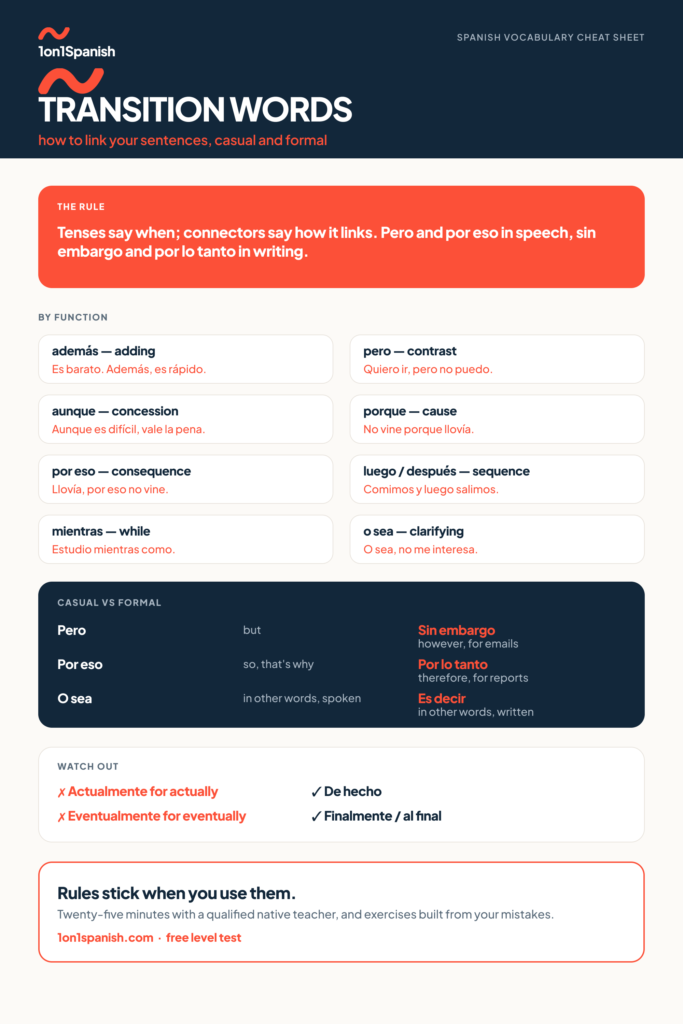
Take the chart with you
The chart is free to view and share. Drop your email and we’ll send the print-ready US Letter PDF — the version you stick on the fridge.
Practice
Practice Spanish transition words with a real teacher
Charts get you halfway. The other half is saying it out loud to someone who corrects you on the spot. At 1on1Spanish you get 25-minute private lessons with a qualified native teacher, exercises built from the mistakes you make in class, and AI practice between lessons.
First month $1. No contracts, cancel anytime.
These guides are free. When you want someone correcting you out loud, learn Spanish online with a qualified native teacher.
Take your free level testBuilt on RingTeacher's method — 700,000+ classes delivered since 2017, teaching English to Spanish speakers. Now in the other direction.
Frequently asked questions
What are the most common Spanish transition words?
Pero (but), además (also), por eso (that’s why), entonces (so/then), and aunque (although) cover most everyday conversation. Their more formal counterparts — sin embargo, por lo tanto, es decir — show up in writing, presentations, and professional emails more than in casual talk.
What’s the difference between pero and sin embargo?
Both mean “but”/”however,” but the register differs the way it does in English. Pero is the everyday word, used constantly in speech. Sin embargo carries more weight and formality — it fits a report or a serious conversation better than a text to a friend. Using sin embargo everywhere isn’t wrong, but it can sound stiffer than you intend.
Why does aunque sometimes use the subjunctive?
Aunque switches to the subjunctive when the contrast is hypothetical rather than a known fact. Aunque llueve, voy (indicative) means it’s actually raining. Aunque llueva, voy (subjunctive) means even if it rains — the rain hasn’t happened and might not. The connector is the same; the verb form signals whether you’re stating a fact or a possibility.
What does “o sea” mean and when do I use it?
O sea means “that is” or “in other words,” used to rephrase or clarify what you just said. It’s extremely common in casual Mexican Spanish, often closer to a filler word than a precise connector — similar to how “like” or “I mean” work in casual English. It fits conversation, not a formal presentation.
Why do my Spanish sentences sound choppy even though my grammar is correct?
Correct grammar tells a listener what happened; transition words tell them how it connects to what you said before. Three grammatically perfect sentences in a row, with no por eso, no aunque, no entonces, read as a list rather than a thought. Native speakers link almost every sentence to the one before it — that’s the piece a grammar book usually skips.