
Spanish possessive adjectives: mi, tu, su, nuestro
Spanish possessive adjectives go before the noun and agree with the thing owned, not the owner, which is why “her books” is sus libros and “our house” is nuestra casa. English possessives never change shape, so the instinct to say su libros survives for months. 1on1Spanish teaches this in 25-minute one-on-one lessons with qualified native teachers, online across the United States.
Reviewed by María Jiménez — Licenciada en Filología Hispánica (BA in Hispanic Philology) · Updated Sep 2026
The short forms go before the noun
There are six possessive adjectives, and four of them have only two shapes: singular and plural.
Mi (my), tu (your, informal), and su (his, her, its, their, your formal) change only for number: mi hermano, mis hermanos; tu trabajo, tus trabajos; su casa, sus casas. Gender does nothing here. Mi padre and mi madre use the same word.
Nuestro (our) and vuestro (your, plural, Spain only) change for both gender and number: nuestro carro, nuestra casa, nuestros hijos, nuestras llaves. These two are where agreement becomes visible, and they’re the ones Americans get wrong.
Tu (your) carries no accent; tú (you) does. That accent is the only thing separating the two words.
What “su” actually means
Su covers his, her, its, their, and formal your. One word, five readings. In real conversation context does the work: if you’ve been talking about your boss for two minutes, su oficina is obviously her office.
When context doesn’t settle it, Spanish drops the possessive and uses de + person: la oficina de él, la oficina de ella, la casa de ellos, el carro de usted. This isn’t a workaround learners invented; native speakers do it constantly. You can also just name the person: la oficina de Marta.
The same trick fixes the plural trap. Sus padres can mean his parents, her parents, their parents, or your parents. Los padres de ella means one thing only.
Reference chart
| Owner | Short form (before the noun) | Example | English |
|---|---|---|---|
| yo | mi / mis | Mi cuenta está vacía. | My account is empty. |
| tú | tu / tus | Tus llaves están aquí. | Your keys are here. |
| él, ella, usted | su / sus | Su vuelo sale a las seis. | His flight leaves at six. |
| nosotros | nuestro / nuestra / nuestros / nuestras | Nuestra hija vive en Chicago. | Our daughter lives in Chicago. |
| vosotros (Spain) | vuestro / vuestra / vuestros / vuestras | Vuestro pedido está listo. | Your order is ready. |
| ellos, ellas, ustedes | su / sus | Sus vecinos son ruidosos. | Their neighbors are loud. |
The long forms: mío, tuyo, suyo
Spanish has a second set that goes after the noun or stands alone: mío, tuyo, suyo, nuestro, vuestro, suyo. All four shapes, always: mío, mía, míos, mías.
They do three jobs. They follow ser to say who owns something: Este abrigo es mío, La culpa es tuya. They add emphasis or contrast after the noun: un amigo mío (a friend of mine), Dios mío. And with an article in front they replace the noun entirely: El mío está en el carro (mine is in the car).
The register difference matters. Mi carro is neutral. El carro mío sounds colloquial in most of Latin America and slightly odd in Spain. If in doubt, use the short form before the noun and keep the long form for ser sentences and for un amigo mío.
Where Spanish drops the possessive entirely
With body parts and clothing, Spanish uses the definite article where English uses a possessive, because the owner is already obvious from the verb. The nouns this rule runs on are on the Spanish body parts and clothing words in Spanish pages.
Me duele la cabeza, not mi cabeza. Se lavó las manos, not sus manos. Ponte el abrigo, not tu abrigo. Saying Me duele mi cabeza isn’t ungrammatical, it just sounds like you’re clarifying whose head hurts, which nobody needed. Doler belongs to the family of verbs that work like gustar, where the pronoun in front already says whose body it is.
Common mistakes English speakers make
The possessive matches libros, which is plural. The owner being one person changes nothing.
Nuestro has four shapes and casa is feminine. This one survives long after the su/sus problem is fixed.
Body parts take the article. The me already tells everyone whose back it is.
After ser you need the long form. Mi can’t stand without a noun behind it.
Tú with an accent is the subject pronoun. The possessive has no accent.
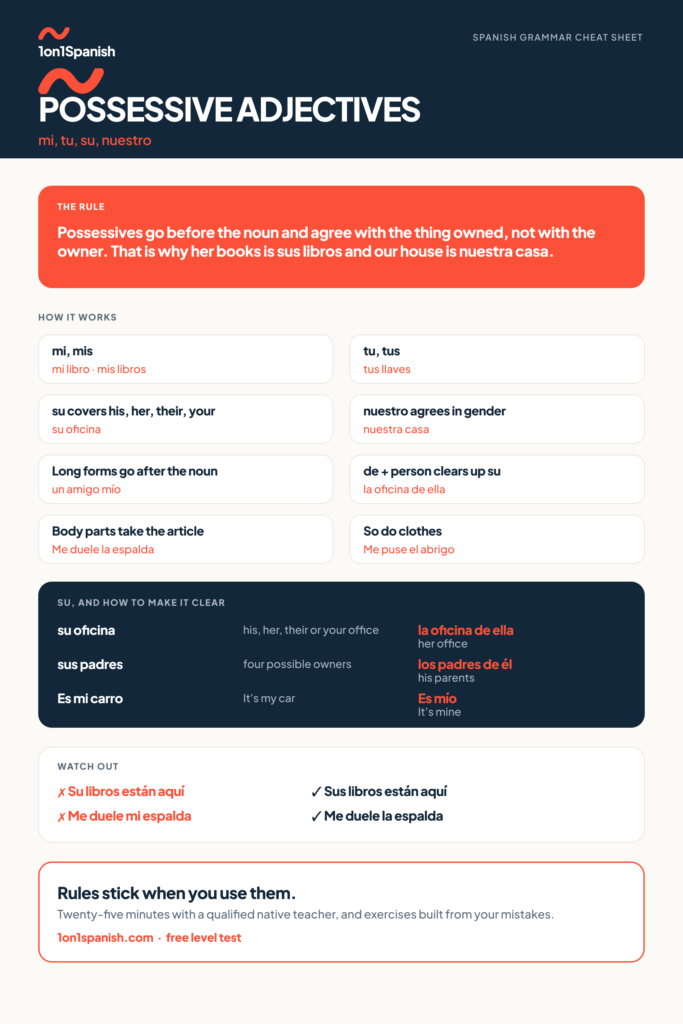
Take the chart with you
The chart is free to view and share. Drop your email and we’ll send the print-ready US Letter PDF — the version you stick on the fridge.
Practice
Practice possessive adjectives with a real teacher
Charts get you halfway. The other half is saying it out loud to someone who corrects you on the spot. At 1on1Spanish you get 25-minute private lessons with a qualified native teacher, exercises built from the mistakes you make in class, and AI practice between lessons.
First month $1. No contracts, cancel anytime.
Grammar you can read. Speaking you cannot. Learn Spanish online and practice it live.
Take your free level testBuilt on RingTeacher's method — 700,000+ classes delivered since 2017, teaching English to Spanish speakers. Now in the other direction.
Frequently asked questions
Do Spanish possessive adjectives agree with the owner or the thing owned?
With the thing owned. Sus hijos is plural because hijos is plural, no matter whether the owner is one person or twenty. Only nuestro and vuestro also agree in gender, giving four forms each: nuestro carro, nuestra casa, nuestros planes, nuestras hijas. English works the opposite way, matching the owner, which is exactly why this feels backwards at first.
How do you know if “su” means his, her, their or your?
Context usually settles it, since the person was named a sentence or two earlier. When it doesn’t, Spanish replaces the possessive with de plus the person: el carro de él, la casa de ella, el número de usted. Native speakers use this constantly, so it reads as normal Spanish rather than learner Spanish. Naming the person outright also works: el carro de Javier.
What’s the difference between mi and mío in Spanish?
Mi goes before the noun and is the everyday form: mi teléfono. Mío goes after the noun or stands alone, and it carries emphasis or ownership: Este teléfono es mío, un compañero mío, El mío no funciona. Mío also changes for gender and number — mía, míos, mías — while mi only changes for number.
Why do Spanish speakers say “me duele la cabeza” instead of “mi cabeza”?
Because the reflexive pronoun me already identifies the owner, so repeating it with a possessive is redundant. Spanish applies this to body parts and clothing: se rompió el brazo, quítate los zapatos, le lavé el pelo. Using mi cabeza is understandable but sounds like you’re contrasting your head with someone else’s.
Is “vuestro” used in Latin America?
No. Vuestro belongs to vosotros, the informal plural “you” used in Spain. Across Latin America the plural “you” is ustedes, and the possessive is su/sus for everyone, formal or not. If you learn Spanish for travel or work in the Americas, you can recognize vuestro when you read it and never produce it yourself.