
Spanish articles: el, la, los, las, un, una
Spanish has four definite articles — el, la, los, las — and four indefinite ones: un, una, unos, unas. Every one of them agrees in gender and number with the noun it introduces. English has “the” and “a”, neither of which changes shape, and it drops articles in places where Spanish insists on one. That second half is where the real errors live. 1on1Spanish teaches this in 25-minute one-on-one lessons with qualified native teachers, online across the United States.
Reviewed by María Jiménez — Licenciada en Filología Hispánica (BA in Hispanic Philology) · Updated Sep 2026
The definite articles: el, la, los, las
El goes with masculine singular nouns, la with feminine singular, los with masculine plural, las with feminine plural: el banco, la cuenta, los pagos, las facturas.
A mixed group takes the masculine plural. Four sisters and one brother are los hermanos. It’s not elegant, but it’s the rule, and there’s no neutral alternative in standard Spanish.
The article is what tells you a noun’s gender when the ending doesn’t. La flor, el color, la gente, el arte. This is why vocabulary is worth memorizing as el problema rather than problema on its own: you learn the word and its gender in one move.
The indefinite articles: un, una, unos, unas
Un and una mean “a” or “an”: un contrato, una entrevista.
The plurals unos and unas have no clean English equivalent. They mean “some” or “a few”, with a touch of approximation: unos amigos (some friends), unas semanas (a few weeks), unos veinte dólares (around twenty dollars). English usually just drops the word: “I have friends in Miami”, where Spanish can say Tengo unos amigos en Miami.
Why it’s “el agua” and not “la agua”
Feminine singular nouns that begin with a stressed a- or ha- take el and un instead of la and una, purely to avoid two identical vowel sounds colliding: el agua, el águila, el hambre, un aula.
The noun stays feminine. Everything else in the sentence proves it: el agua fría, el águila blanca, mucha hambre. And in the plural the problem disappears, so the normal article comes back: las aguas, las águilas, unas aulas.
The stress is what matters, not the letter. La abogada and la avenida start with a- but the stress falls elsewhere, so they keep la. Compare el hacha (stressed) with la harina (unstressed).
The two contractions: al and del
Spanish has exactly two obligatory contractions, and both involve el.
a + el = al: Voy al médico, Llegamos al aeropuerto a las seis. de + el = del: La llave del carro, El director del banco.
They’re not optional the way “do not” and “don’t” are in English. Voy a el médico is simply wrong.
Two limits. First, no other article contracts: a la oficina, de las oficinas, a los niños all stay separate. Second, the contraction doesn’t happen when El is part of a proper name: Vengo de El Paso, Un artículo de El País.
Where Spanish uses an article and English doesn’t
This is the section worth rereading. English drops articles constantly; Spanish keeps them.
| Case | Spanish | English |
|---|---|---|
| Days of the week | Trabajo los lunes. | I work on Mondays. |
| Likes and dislikes | Me gusta el café. | I like coffee. |
| General or abstract nouns | La vida en Nueva York es cara. | Life in New York is expensive. |
| Languages as subject | El español se aprende hablando. | Spanish is learned by speaking. |
| Titles talking about someone | El doctor Ramos llamó. | Doctor Ramos called. |
| Body parts and clothing | Me duele la espalda. | My back hurts. |
| Percentages | El veinte por ciento subió. | Twenty percent went up. |
| Times of day | Salgo a las siete. | I leave at seven. |
The days-of-the-week case also does work English needs a preposition for: el lunes is next Monday, los lunes is every Monday. No “on” required in either. The seven names themselves are on the days of the week in Spanish page — none of them capitalized, which is the other surprise for an English speaker.
The verb gustar is where the article rule bites hardest, because the thing you like is the grammatical subject and subjects of that kind take an article: Me gustan los perros, Nos gusta el vino. That backwards structure is why gustar has its own conjugation chart, and why gustar and the verbs that work like it get a page of their own.
And where Spanish drops it
After ser, professions, nationalities and religions take no article: Soy profesora, Es mexicano, Somos católicos. Adding una, as in Soy una profesora, isn’t wrong, but it turns the sentence into a contrast, as if answering “which of you is the teacher?”.
The article comes back the moment you add an adjective: Es una profesora excelente.
Languages drop the article after hablar, estudiar and prepositions: Hablo español, un libro en español, but El español tiene muchos acentos.
Cien and mil never take un: cien dólares, mil personas, not un cien dólares.
Common mistakes English speakers make
With gustar, the thing liked is the subject, and general nouns as subjects carry the definite article.
A + el always contracts. So does de + el.
Professions after ser go bare. The article turns a statement of what you do into a contrast with someone else.
Feminine nouns starting with stressed a- take el in the singular. The adjective still agrees as feminine: fría, not frío.
Spanish uses the article where English uses “on”, and the plural article is what makes it habitual.
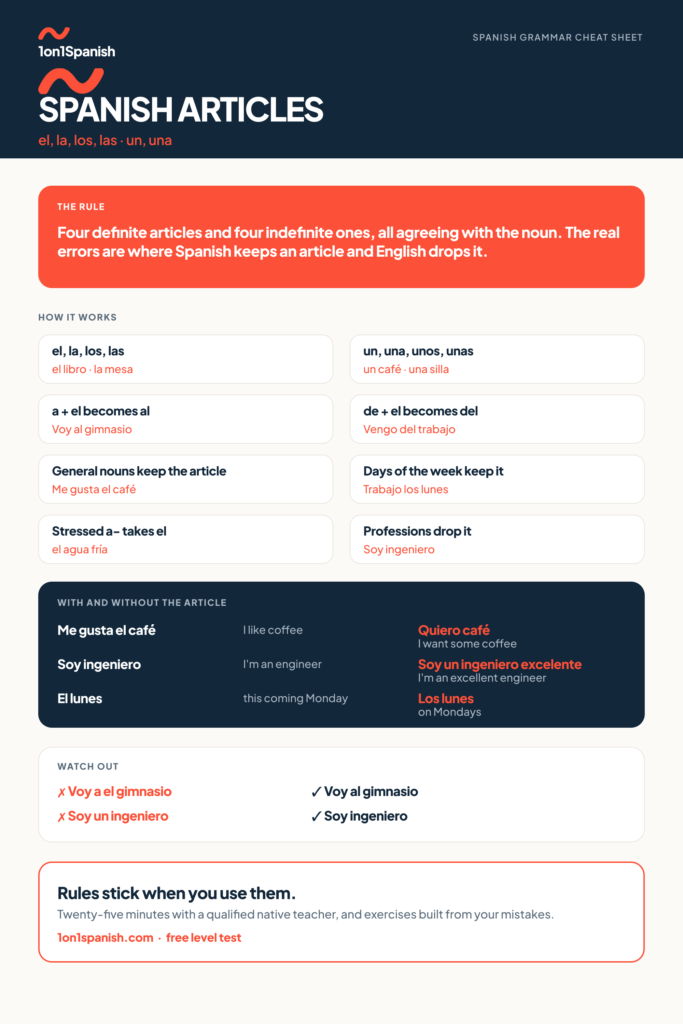
Take the chart with you
The chart is free to view and share. Drop your email and we’ll send the print-ready US Letter PDF — the version you stick on the fridge.
Practice
Practice Spanish articles with a real teacher
Charts get you halfway. The other half is saying it out loud to someone who corrects you on the spot. At 1on1Spanish you get 25-minute private lessons with a qualified native teacher, exercises built from the mistakes you make in class, and AI practice between lessons.
First month $1. No contracts, cancel anytime.
You can go further with someone listening: Learn Spanish with 1on1Spanish, 25 minutes at a time.
Take your free level testBuilt on RingTeacher's method — 700,000+ classes delivered since 2017, teaching English to Spanish speakers. Now in the other direction.
Frequently asked questions
Why is it “el agua” if agua is feminine?
Because Spanish avoids the clash of two identical stressed vowels. Feminine singular nouns starting with a stressed a- or ha- take el and un: el agua, el hambre, un aula. The noun stays feminine, as the adjectives show: el agua fría. In the plural the normal article comes back: las aguas. Words like la avenida, where the stress falls elsewhere, keep la.
When does Spanish use “el” where English uses nothing?
With general nouns as subjects (El café es caro), things you like (Me gusta el vino), days of the week (los martes), languages as subjects (El español es fácil de leer), percentages, times, body parts and titles. The pattern is that English can leave a bare noun standing alone and Spanish usually cannot. Testing sentences against gustar is the fastest way to notice the gap.
What’s the difference between “un” and “unos” in Spanish?
Un means “a” or “an” and introduces one thing: un correo. Unos means “some” or “a few”, and often adds approximation: unos correos, unos treinta minutos. English frequently drops the word altogether, as in “I got emails”, where Spanish uses unos. Its feminine forms are una and unas, following the same rule.
Do you say “soy profesor” or “soy un profesor”?
Soy profesor, with no article. After ser, professions, nationalities and religions go bare in Spanish. Adding un isn’t ungrammatical but shifts the meaning toward contrast or singling yourself out. The article returns as soon as an adjective appears: Soy un profesor con veinte años de experiencia.
Are al and del optional in Spanish?
No. A + el becomes al and de + el becomes del, always, in speech and in writing. There is no formal version that keeps them apart, unlike English contractions. Two exceptions worth knowing: the other articles never contract (a la, de los), and a capitalized El inside a proper name stays intact — de El Salvador, a El Paso.